Example: stock market
PROJECT M&E SYSTEMS - INTRAC
SYSTEMS. A project monitoring and evaluation (M&E) system covers all the work carried out during or after a project to define, select, collect, analyse and use information. It is where everything comes together, from the initial selection of objectives and indicators through to the final evaluation of a project. M&E systems in
Tags:
Information
Domain:
Source:
Link to this page:
Documents from same domain
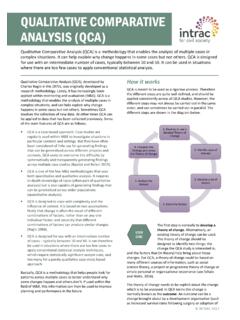
QUALITATIVE COMPARATIVE ANALYSIS (QCA) - INTRAC
www.intrac.orgQualitative Comparative Analysis (QCA), developed by Charles Ragin in the 1970s, was originally developed as a research methodology. Lately, it has increasingly been applied within monitoring and evaluation (M&E). QCA is a methodology that enables the analysis of multiple cases in complex situations, and can help explain why change
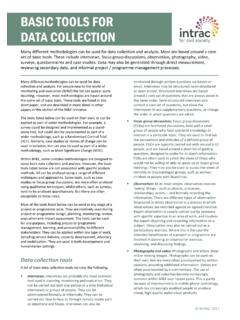
BASIC TOOLS FOR DATA COLLECTION - INTRAC
www.intrac.orgObservation: At its most simple, observation involves ‘seeing’ things – such as objects, processes, relationships, events – and formally recording the information. There are different types of observation. Structured or direct observation is a process in which observations are recorded against an agreed checklist.
Monitoring and Evaluation: New Developments and …
www.intrac.orgConference overview As development organisations, we are all finding ourselves placing a greater emphasis on measuring for results, on looking for evidence of impact, on justifying our effectiveness and on responding to a growing demand for accountability. Development organisations are continually experimenting with innovative

Theory of Change - INTRAC
www.intrac.org1 1. The reality of change Theory of Change is nothing new. It is not just a donor fad or yet another hoop to jump through. It is an on-going process of reflection to explore change and how
Theory of Change - INTRAC
www.intrac.orgA Theory of Change approach to planning and evaluation is increasingly being considered an essential practice for many organisations, programmes and projects. Theories of Change can be
PARTICIPATORY LEARNING AND ACTION (PLA)
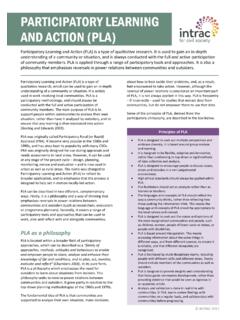
www.intrac.orgPLA was originally called Participatory Rural (or Rapid) Appraisal (PRA). It became very popular in the 1980s and 1990s, and has since kept its popularity with many CSOs. PRA was originally designed for use during appraisals and needs assessments in rural areas. However, it can be used at any stage of the project cycle – design, planning,

PROCESS TRACING
www.intrac.orgPROCESS TRACING . Process tracing is a qualitative analysis methodology. The main purpose of process tracing is to establish whether, and how, a potential cause or causes influenced a specified change or set of changes. This is done by applying formal tests to examine the strength of evidence linking potential causes to the changes.
QUANTITATIVE AND QUALITATIVE METHODS - INTRAC
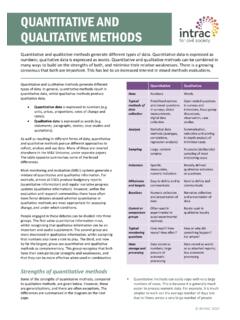
www.intrac.orgquantitative methods are seen as weaker, qualitative methods are seen as (relatively) stronger. Some of the main strengths of qualitative methods are listed below, and are summarised in the diagram above. As with the section on quantitative methods, these are general rules only, and there are often exceptions. Quantitative methods ...
SECONDARY DATA SOURCES - INTRAC
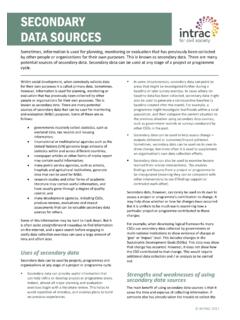
www.intrac.orgFurther papers in the M&E Universe explain other simple data collection tools and methods. To access these papers directly, click on the relevant links below. Author(s): INTRAC . Contributor(s): ... Interviews Focus group discussions Observation Photography and video Surveys and questionnaires Case studies and stories of change
THEORY OF CHANGE
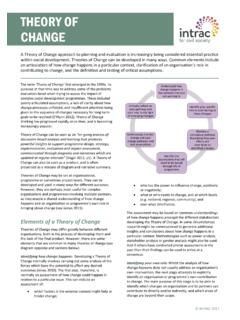
www.intrac.orgTheories of Change can be developed in many ways. Common elements include ... stakeholder analysis or gender analysis might also be used. And if others have conducted similar assessments in the past then their findings can be used to arrive at a consensus.
Related documents

How Business Use Information Systems - IJSTR
www.ijstr.orgThe use of information systems that will be reviewed in this discussion is re lated to the use of information technology in the renovation of global innovation. The rapid development of information technology has triggered new innovations that can ... of monitoring, control, decision making, and administrative activities. Management of the term ...
Review on Management Information Systems (MIS) and its ...
www.ijsrp.orginformation is an important input at every level in the organization for decision making, planning, organizing ,implementing, and monitoring and controlling[5]. Managers have to assimilate masses of data, convert that data into information, form conclusions about that information and make decisions leading to the achievement of business objectives.
INTEGRATED FINANCIAL MANAGEMENT INFORMATION …
pdf.usaid.govmanagement information systems (IFMIS) that computerize and automate key aspects of budget ... monitoring and evaluation. This Best Practices paper will catalogue and discuss good or “best” practices around the world in the design, development, and implementation of
Information Security Continuous Monitoring (ISCM) for ...
nvlpubs.nist.govSpecial Publication 800-137 Information Security Continuous Monitoring for Federal Information Systems and Organizations PAGE vii An ISCM program is established to collect information in accordance with preestablished metrics, utilizing information readily available in part through implemented security controls.
CMS Information Systems Security and Privacy Policy
www.cms.govinformation technology (IT) systems; systems maintained on behalf of CMS; and other collections of information to assure the confidentiality, integrity, and availability of CMS information and systems.
Security and Privacy Controls for Information Systems and ...
nvlpubs.nist.govFederal Information Security Modernization Act (FISMA), 44 U.S.C. § 3551 . et seq., Public Law (P.L.) 113-283. NIST is responsible for developing information security standards and guidelines, including minimum requirements for federal information systems. Such information security

WHO guidelines on safety monitoring of herbal medicines in ...
apps.who.intpharmacovigilance systems, monitoring of the safety of medicines should be enhanced and broadened in ways that will allow the successful monitoring of herbal medicines. It is not the intention to suggest that different systems should be instituted for this purpose. The guidelines should therefore be considered in
BRIEF HISTORY OF GEOGRAPHICAL INFORMATION SYSTEMS
web.mst.eduIan McHarg (1920-2001) is credited with being the father of map overlays, which had a major impact on Geographical Information Systems He was a Professor of Landscape Architecture and Regional Planning at the University of Pennsylvania from

MONITORING, EVALUATION, ACCOUNTABILITY AND …
www.crs.orgEarly monitoring systems are simple, use-oriented and flexible to accommodate change in context and activities. 2. Monitor the relevance, effectiveness and quality of the response to increase accountability to the people we serve. 3. Create a formal M&E system for the overall response as soon as the situation stabilizes.