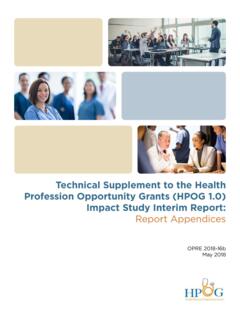
Transcription of Project Planning and Development
1 Project Planning and Development ANA Project Planning and Development Manual June 2012 Page 2 The photos on the front cover are pictures from funded ANA projects: Clockwise from top: Whaling Building Area in Barrow, AK; Karuk Tribe Project ; Ho-Chunk Community Development Project . Pueblo of Cochiti Project ; Library Friends Project from the Commonwealth of Northern Mariana Islands and from Redwood Valley Rancheria Project ;,. ANA Project Planning and Development Manual June 2012 Page 3 Boozhoo. Aloha. Bezon. Ta na n e see. Qa aasakung. Dagot ee. Nayaafabaa. Mique wush. Khahowya. O-si-yo. Welcome to the Administration for Native Americans (ANA) Project Planning and Development Training.
2 We are glad you are here. ANA s mission, our driving force, is to fund community developed projects that are sustainable and successful. We do that through two principles: we fund projects that meet the community s long range goals and are therefore wanted by the community, and we try to fund projects that will have a positive impact on the community. ANA has found, through evaluating our projects and talking with our grantees and applicants, that projects are more likely to be successful and sustainable if they are developed and planned by the community as part of a long range community strategy. This training will provide you with tools to better define the problems your community is facing and methods to design community based solutions.
3 During this training, you will engage in a Project Planning and Development process that: Is based on long-range community goals. Defines problems in the community that stand between the community and its long-range goals. Establishes a Project goal that, when accomplished, will reduce or eliminate the defined problem and move the community toward long-range goal accomplishment. Creates a Project strategy built around specific, measurable, achievable, result-oriented and time-framed objectives. Designs an evaluation process and sustainability strategy for measuring Project outcomes and continuing those outcomes after the end of Project funding. When designing a Project , 90% of the work should go into Project Planning and Development and only 10% in the writing of the application.
4 This training is focused on how to do that 90%. This training is different than application Development training, as it does not focus on how to write an application or apply for funding. Instead, it focuses on the steps that need to occur before you ever start writing an application. ANA also offers application Development training. We recommend you take a Project Planning and Development training first and then attend pre-application: application Development training once you are ready to submit your Project idea for funding consideration. The table Greetings in Ojibwe, Hawaiian, Shawnee, Plains Apache, Aleut, White Mountain Apache, Inupiaq, Ute, Chinook, Cherokee ANA Project Planning and Development Manual June 2012 Page 4 below shows the differences between our Pre-Application: Application Development and Project Planning and Development Trainings.
5 What you will learn in Project Planning and Development What you will learn in Pre-Application: Application Development Methods to describe long- range community goals Tips on writing an ANA application in response to an ANA Funding Opportunity Announcement How to document community problems and assets Guidance on how to apply through Community based Planning processes and tools The process of reviewing applications for funding The Development process that we cover in this training can be used in preparing projects that could be submitted to a variety of public or private funders, including ANA. We hope you will use the information from this training to engage in community-based Planning that creates a well designed Project .
6 You will then be able to fit your Project concept into an ANA or other funder specific application format knowing that your chances for funding will be enhanced because the Project is well crafted. Throughout this manual, tribes refers to federally recognized and non-federally recognized tribes, while organizations denotes native non-profit organizations. Native Americans, as used in this manual, includes American Indians, Alaska Natives, Native Hawaiians, Native Samoans, and the Native peoples of Guam and the Northern Mariana Islands. Thank you for attending this training or downloading this manual. We think there is a lot of great information in here on how to plan and develop a successful and sustainable community Project .
7 If, during the training or in reading this manual you come across anything you think we should revise, please let us know. Yaw k . Miigwech. Gunalch esh. Fa afetai. Nia:wen Thank you in Oneida, Anishinaabemowin, Tlingit, Samoan, Mohawk ANA Project Planning and Development Manual June 2012 Page 5 Table of Contents THE IMPORTANCE OF COMMUNITY Development 7 About the Administration for Native Americans (ANA) 7 Project Planning 9 Activity: Focus Group 17 Project Development STEPS 18 Activity: Community Goals and Project Ideas 19 Activity: Community Problems Questionnaire 24 Activity: Problems List 25 Activity: Problem Tree 26 Activity: Write Your Problem Statement 29 Activity: Community Mapping 33 Activity: Community Resources Identification 37 Activity.
8 Determine the Project Goal 41 Activity: Narrow Down Your Approach 44 Activity: Goal, Objective, or Activity? 49 Activity: Objective? 50 Activity: Establish Project Objectives and Activities 51 Activity: Assumptions 54 Activity: Identify Expected Outcomes 59 Activity: Monitoring and Evaluation Matrix 63 Activity: Develop an Objective Work Plan 64 Activity: Develop a General Sustainability Strategy 69 Activity: Gathering Ideas 70 Activity: Identify the Financial Needs 75 Activity: The Budget and the Work Plan 79 IN SUMMARY 80 Closing Activity: Next Steps 81 TOOLS TO HELP YOU IN THE COMMUNITY Planning AND Project Development PROCESS 82 Appendix A: Glossary of Terms 82 Appendix B: Some Additional Planning Processes to Consider 87 Appendix C.
9 Crafting long range goals 94 ANA Project Planning and Development Manual June 2012 Page 6 Appendix D: Sample Forms for Community Involvement 97 Appendix E: Successful Project Strategies 100 Appendix E: Bibliography 118 ANA Project Planning and Development Manual June 2012 Page 7 The Importance of Community Development Community Development is broadly defined as the practice of improving communities. Community Development is often used when discussing community economic Development , the process of bringing more business and investment into a community. But community Development can also refer to any Project or program that works to improve your community, from indigenous food production, to teaching native language classes to mapping out the cultural resources.
10 ANA funds projects that result in community Development . ANA believes community members are at the heart of lasting and positive change and community involvement is central to designing and implementing a successful Project . ANA s mission and history support community Development as the path towards Native American communities achieving self-sufficiency and cultural and language preservation. About the Administration for Native Americans (ANA) In January 1964, President Lyndon B. Johnson declared the War on Poverty, a collection of ideals that ultimately laid the foundation for ANA. President Johnson made a call to action, asking communities to prepare long-range plans for the attack on poverty.