Example: air traffic controller
Projectile Motion y(final)Projectile Motion y(final) 0
Problem #65: The figure shows three blocks attached by cords that loop over frictionless pulleys. Block B lies on a frictionless table; the masses are mfrictionless table; the masses are m A =600kg m6.00 kg, m B =800kg8.00 kg and m C =10.kg. What is the tension is the rope at the right? What is the acceleration of block B? Two Tensions T L and T R
Tags:
Information
Domain:
Source:
Link to this page:
Documents from same domain

A pendulum with a moving support point
www.phys.lsu.edu• Vertical periodic motion: Y = Y 0 cos(Ωt), X = 0. 2Y 0 cosΩt)sinθ. The motion of the support adds an oscillating component to the gravitational acceleration. This is not a driven oscillator like the previous case, because the oscillatory driving force is vertical but the natural oscillatory pendulum motion is horizontal. If Y 0Ω2 ˝ g,
PHYS 7221 - The Three-Body Problem
www.phys.lsu.edum1 to m2, s1 points in the same direction and sense as s3 from m2 to m3, and s2 points back from m3 to m1.Therefore, we can write s1 = ‚s3; s2 = ¡(1+‚)s3; (7) where ‚ is a positive scalar. Expressing everything in the equations of motion in terms of s3 and lambda, one obtains after some algebra (see Hestenes 1987 for details) a flfth degree polynomial in ‚ with one single …
Single and Double plane pendulum - LSU
www.phys.lsu.eduSingle and Double plane pendulum Gabriela Gonz´alez 1 Introduction We will write down equations of motion for a single and a double plane pendulum, following
The stability of the bicycle - Department of Physics ...
www.phys.lsu.eduridden model is not—it requires constant rider effort to main-tain its stability. A combination of the simple theories ac-counts neatly for all the facts.
Core Computing: a Foundation for Information Technology
www.phys.lsu.eduInformation technology is the outgrowth of computer science, and if LSU fails to build its program in computer science, information technology education and research at LSU will su er.

Plane Waves and Wave Propagation - LSU
www.phys.lsu.eduPlane Waves and Wave Propagation Augustin Jean Fresnel (1788 - 1827) November 9, 2001 Contents 1 Plane Waves in Uniform Linear Isotropic Nonconducting Media 2
Chapter 10: Superconductivity
www.phys.lsu.eduLondon and London derived a phenomenological theory of su-perconductivity which correctly describes the Meissner e ect. They assumed that the electrons move in a frictionless state, so that mv_ = eE (7) or, since @j @t = en sv_, @j s @t = e2n s m E (First London Eqn.) (8) 8
-2 Newton's Law of Gravitation
www.phys.lsu.eduPROBLEMS sec. 13-2 Newton's Law of Gravitation •1 A mass M is split into two parts, m and M – m, which are then separated by a certain distance. What ratio m/M maximizes the magnitude of the gravitational force between the parts? Answer: •2 Moon effect.Some people believe that the Moon controls their activities. If the Moon moves from being directly on the opposite side of …
Pretest-posttest designs and measurement of change
www.phys.lsu.eduregression coefficients, ANOVA on residual scores re-sults in an inflated α-level of significance and (b) when the regression coefficient for the total sample of all groups combined is used, ANOVA on residual scores yields an inappropriately conservative test [16]. 3.4. Repeated measures ANOVA with pretest-posttest data
Wireless and Broadband Technologies
www.phys.lsu.eduqualified telecommunication engineers and transfer technology to industry. We envision an experimental facility with gigabit connectivity among servers, high-speed wireless interconnection and routing among nodes, with ancillary equipment to support research in communications and signal processing and to implement demanding user oriented
Related documents

AP Physics Practice Test: Laws of Motion; Circular Motion
www.crashwhite.comLaws of Motion; Circular Motion ©2011, Richard White www.crashwhite.com m m 7. Blocks m 1 = 2.0 kg and m 2 = 4.0 kg are connected by a thin, light cord which is draped over a light pulley so that mass m 1 is hanging over the edge of the pulley as shown. The surface between m 2 and the table is essentially frictionless, but there is friction ...

Kindergarten Force Motion Lessons
s3.wp.wsu.eduForce & Motion Big Idea: A push or a pull is a force that makes things move Lesson 1 TARGET: I CAN MAKE THINGS MOVE ... blocks, cardboard, rain gutters, string, yard sticks, bowls, pipe cleaners, straws) and experiment ways to make their ball move without directly touching it.

Projectile Motion and Quadratic Functions
www.radford.eduThe two combined activities are designed to take 2-3 90 minute blocks. Projectile Motion and Quadratic Functions . 2 Strand . Equations and Inequalities, Functions. Mathematical Objective(s) The student will be able to: • solve quadratic equations algebraically and graphically

Linear motion standard range - SKF
www.skf.com23 LSHS Shaft blocks for compact series 24 LTDR Duo linear ball bearing units 24 LQBR Quadro linear ball bearing units 25 LEBS Tandem shaft blocks 25 Appropriate special seals 26 Ordering key for LBBR – standard series 28 LBCD Standard series 3, closed type 28 LBCR Standard series 3, closed type 29 LPAR Linear plain bearings, closed type
MOTION BLOCKS - ScratchJr
www.scratchjr.orgMOTION BLOCKS. 1 Move Left. Move Right 1. Move Up 1. Move Down 1. Turn Right 1. Turn Left 1. 2 Hop 2. Go home. TRIGGERING BLOCKS. Start on Message. Start on Message. Start on Message. ... END BLOCKS. Repeat forever. 2 Go to page. End. Title: 13-01-2015-ScratchJR-Block-Matrix Created Date: 1/13/2015 9:56:15 AM ...

NEWTON’S LAWS OF MOTION
nsmn1.uh.edu5-3 Newton s Second Law of Motion • Free-body diagrams: A free-body diagram shows every force acting on an object. 1) Sketch the forces 2) Isolate the object of interest 3) Choose a convenient coordinate system 4) Resolve the forces into components 5) Apply Newton’s second law to each coordinate direction
Chapter 5 – Force and Motion I
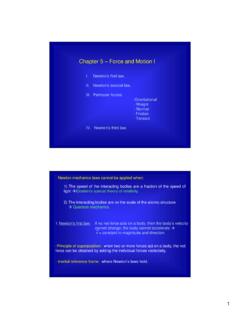
physics.ucf.eduChapter 5 – Force and Motion I I. Newton’s first law: If no net force acts on a body, then the body’s velocity cannot change; the body cannot accelerate v = constant in magnitude and direction. - Principle of superposition: when two or more forces act on a body, the net force can be obtained by adding the individual forces vectorially.