Transcription of Propylene Glycol - USP-NF
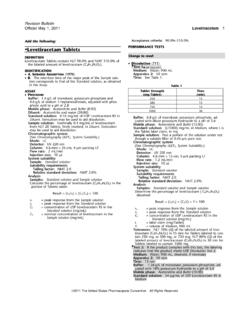
1 Revision BulletinOfficial February 1, 2010 Propylene1 Carrier gas:HeliumPropylene GlycolInjection mLFlow type:The split flow ratio is about 10: suitabilitySample:Standard solution[NOTE For informational purposes only. See the table below retention times for ethylene Glycol , internal standard, and1, Glycol . The retention time for Propylene Glycol is 4 min-1,2-Propanediol [57-55-6].utes.] Propylene Glycol contains not less than percentRelativeof and storage Preserve in tight (RRT) ethylene to read: Propylene Reference standards 11 USP Propylene Glycol RS. USPD iethylene Glycol RS. USP ethylene Glycol RS. (RB 1-Feb-2010)Diethylene to read:Suitability requirementsResolution:NLT 5 between ethylene Glycol and propyleneIdentificationglycol NOTE Compliance is determined by meeting the requirementsAnalysisof Identification tests A, B, and :Sample solution A: (RB 1-Feb-2010)Infrared Absorption 197F on undriedAcceptance Glycol :If a peak at the retention time for diethylene B:Limit of Diethylene Glycol and ethylene Glycolglycol is present in the Sample solution, the peak response ratio rel-Diluent:Methanolative to 2,2,2-trichloroethanol is not more than the peak responseStandard of USP Propylene Glycol RS,ratio for diethylene Glycol relative to 2,2,2-trichloroethanol in of USP ethylene Glycol RS, of USPS tandard solution: NMT for diethylene Glycol is Glycol RS, and of 2,2,2-trichloroethanolEthylene Glycol .
2 If a peak at the retention time for ethylene (internal standard) in is present in the Sample solution, the peak response ratio rel-Sample solution:50mg/mL of Propylene Glycol and to 2,2,2-trichloroethanol is not more than the peak responsemL of 2,2,2-trichloroethanol (internal standard) in for ethylene Glycol relative to 2,2,2-trichloroethanol in theChromatographic systemStandard solution: NMT for ethylene Glycol is found.(See Chromatography 621 , System Suitability.)C:Examine the chromatograms obtained in Identification testMode:GCB. The retention time of the Propylene Glycol peak in the chromato-Detector:Flame ionizationgram of the Sample solution corresponds to that obtained in thechromatogram of the Standard solution. (RB 1-Feb-2010) 30-m fused-silica coated with stationary phase, and a deactivated split liner with glass gravity 841 :between and Add 1mL of phenolphthalein TS to 50mL of water, thenadd sodium hydroxide until the solution remains pink for 30 Injector:220 seconds.
3 Then add 10mL of Propylene Glycol , accurately meas-Detector:250 ured, and titrate with sodium hydroxide until the originalColumn:See the temperature program table color returns and remains for 30 seconds: not more of sodium hydroxide is , Method I 921 :not more than TimeResidue on ignition Heat 50g in a tared 100-mL shallow dishInitialTemperatureFinalat Finaluntil it ignites, and allow it to burn without further application ofTemperatureRampTemperatureTemperatureh eat in a place free from drafts. Cool, moisten the residue with( )( /min)( )(min) of sulfuric acid, and ignite to constant weight: the weight of100 1004the residue does not exceed 221 A 1-mL portion shows no more chloride than cor-120502206responds to of hydrochloric acid ( ).Sulfate 221 A portion shows no more sulfate than corre-sponds to of sulfuric acid ( ).
4 Heavy metals 231 Mix with water to make 25mL: thelimit is 5 Chromatographic system (see Chromatography 621 ) The gaschromatograph is equipped with a thermal conductivity detector,and contains a 1-m 4-mm column packed with 5% G16 on sup-port S5. The injection port temperature is 240 , the detector temper- 2009 The United States Pharmacopeial ConventionAll Rights Bulletin2 PropyleneOfficial February 1, 2010ature is 250 , and the column temperature is programmed at a rateProcedure Inject a suitable volume, typically about 10 mL, ofof 5 per minute from 120 to 200 , and helium is used as the car- Propylene Glycol into a suitable gas chromatograph, and record therier gas. The approximate retention time for Propylene Glycol is Calculate the percentage of C3H8O2 in the Propyleneminutes, and the approximate retention times for the 3 isomers ofGlycol by dividing the area under the Propylene Glycol peak by thedipropylene Glycol , when present, are , , and minutes,sum of the areas under all of the peaks, excluding those due to water, and multiplying by 100.
5 2009 The United States Pharmacopeial ConventionAll Rights Reserved.