Transcription of Prostate Specific Antigen Levels Following …
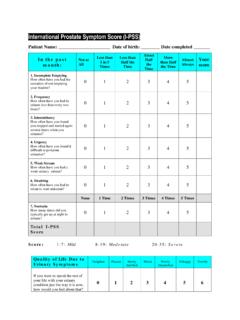
1 41 PSA Levels Following TURP Clinical UrologyInternational Braz J UrolVol. 34 (1): 41-48, January - February, 2008 Prostate Specific Antigen Levels Following TransurethralResection of the ProstateRoberto C. Fonseca, Cristiano M. Gomes, Elton B. Meireles, Geraldo C. Freire, Miguel SrougiDivision of Urology, University of Sao Paulo School of Medicine, Sao Paulo, BrazilABSTRACTO bjective: Determine how serum Prostate - Specific Antigen (t-PSA) Levels and free PSA (f/t PSA) ratio change followingtransurethral resection of the Prostate (TURP).Materials and Methods: Thirty men with a mean age of years (range 46 to 84 years) underwent TURP for BPHbetween May 2005 and October 2005. Preoperative assessment included symptom evaluation with the international ProstateSymptom Score (I-PSS) and the Prostate volume estimation by transrectal ultrasound.
2 Total PSA and f/t PSA ratio wereassessed before the procedure, as well as 30, 60 and 180 days after the : Clinical improvement after TURP, reflected by I-PSS score, was demonstrated as early as 30 days and remainedstable until the end of the follow-up. Mean t-PSA declined 71% after TURP and 60 days after surgery the reduction reachedits peak, stabilizing afterwards. It varied from ng/mL before surgery to ng/mL on day 60 (p < ). Themean baseline f/t PSA ratio was and was not significantly changed at any given time point in the postoperativeperiod (p = ). There were also no statistically significant differences in t-PSA or f/t PSA between patients with andwithout prostatitis at any time point (p = ).
3 Resected Prostate fragments weighed g, corresponding to the estimated preoperative Prostate volume. Each gram of tissue resected decreased PSA by ng/mL, while 1% Prostate volume resected led to a reduction of in serum PSA from : PSA decreases drastically in patients who undergo TURP. These low Levels stabilize within 60 days aftersurgery. The f/t PSA ratio did not change, and the finding of chronic prostatitis did not affect the Levels of these words: Prostate - Specific Antigen ; benign prostatic hyperplasia; transurethral resection of prostateInt Braz J Urol. 2008; 34: 41-8 INTRODUCTIONB enign prostatic hyperplasia (BPH) is themost prevalent prostatic pathology, and transurethralresection of the Prostate (TURP) is one of thesurgeries most commonly performed by urologists, andconsidered the gold standard for the surgical treatmentof Antigen (PSA) is a tumormarker whose role in the diagnosis and follow-up ofpatients with prostatic diseases has continuouslyevolved.
4 PSA behavior after transurethral resectionof the Prostate is crucial during patient follow-up. It isknown that serum PSA Levels increase temporarily inthe first few days Following a TURP procedure,decreasing gradually afterwards and reaching stable42 PSA Levels Following TURP values within 3-6 months (1). However, serum PSAlevel stabilization apparently depends on severalaspects, namely, patient s age, PSA Levels beforesurgery, Prostate volume and Prostate volumeresected. Thus, there is not a cutoff value establishedfor normal PSA in patients who undergo TURP (2,3).Although different factors may affect PSAreduction after the procedure, an approximate 72%decrease from baseline is expected, even with aproportionally lower reduction in Prostate volume (2).
5 This occurs because resection affects basically thetransition zone of the Prostate , which produces morePSA per gram of tissue (4).Total serum PSA is found in its free formand bound to plasma proteins. Clinically, both totalPSA (t-PSA) and free PSA ratio (f/t PSA) areimportant for the diagnosis and follow-up of prostaticdiseases. In the past few years, great importancehas been attributed to free PSA, which is usuallyreduced in patients with adenocarcinoma. Previousstudies suggested that f/t PSA ratio tends to remainstable after TURP in patients with benign prostatichyperplasia (2,5).Prostatic inflammation has probably a notclearly understood impact on PSA Levels in thepostoperative period.
6 Although many studies suggestthat the presence of prostatic inflammation cancontribute to increasing total PSA Levels , themechanism by which such histological changesinduce the prostatic acinus marker to move to thesystemic circulation is still controversial (6).In this study, we analyzed how total PSAand f/t PSA ratio change with time in patients withBPH who undergo TURP, as well as the impact ofprostatitis on these parameters, in an attempt tocontribute to clarifying some of these importantaspects concerning patient AND METHODSD uring one year, 40 patients with lowerurinary tract symptoms associated with benignprostatic hyperplasia were selected to undergo TURPand evaluated prospectively.
7 Preoperative assessmentincluded clinical history, physical examination of theprostate, the international Prostate Symptom Score(I-PSS), urine culture, measurement of prostaticvolume by transrectal ultrasound of the Prostate (TRUS), and determination of t-PSA and f/t PSAserum with suspected abnormality on digitalrectal examination or PSA ng/mL underwentprostate biopsy. Patients with adenocarcinoma wereexcluded from the study, as well as those withatypical small acinar proliferation (ASAP) or intra-epithelial neoplasia, patients on finasteride in the last6 months, patients with urinary retention, patients withneurological diseases that could have an impact onthe urinary tract, and those with history of pelvicradiotherapy or lower urinary tract surgeries.
8 Patientswith urinary infection were treated, and their PSAlevels were measured 30 days after a negative study protocol was approved by thehospital s Research Ethics Committee. All patientswere duly informed about the study and signed theinformed consent form. Ten patients were excludedfrom the study because they did not return forpostoperative TURP was performed according to thestandard technique, and the fragments wereimmediately weighed and further analyzed by thesame measures were IPSS, t-PSA andf/t PSA ratio after 1,3 and 6 months. Theseparameters in different time points were correlatedwith preoperative prostatic volume, total volumeof tissue resected, percentage of volume resectedand the histopathological finding of analysis of variance test (ANOVA)and the Turkey s test were used to compare serumPSA level variations at different time points.
9 ThePearson s correlation coefficient was used to evalu-ate the association between patients age and thereduction of PSA Levels after TURP. The Student st-test was used to compare PSA level progressionin patients with and without chronic prostatitis. Thesignificance level adopted was 5%. Statistical datawere analyzed using commercially available Levels Following TURPRESULTSP atients ages ranged from 46 to 84 years(mean 4 years). Preoperative IPSS ranged from18 to 29, mean t-PSA ranged from ng/mLto ng/mL, mean ng/mL. Preoperativef/t PSA ratio ranged from to , mean prostatic volume, as measured byTRUS, ranged from cc to cc, mean cc. Prostate fragments resected weighed from11 g to 102 g, mean g.
10 In terms ofpercentage, the volume resected ranged from , mean (Table-1).On the histopathological examination, 12patients (40%) were diagnosed with both benignprostatic hyperplasia and chronic prostatitis, and 18patients (60%) were diagnosed with benign prostatichyperplasia only. There were no statistically significantdifferences between patients with and withoutprostatitis regarding age, IPSS, t-PSA, f/t PSA ratioand Prostate weight resected (Table-2).Before surgery, mean I-PSS was changed to on day 30, on day60, and on day 180 Following surgery. At alltime points assessed after surgery, I-PSS values werelower than in the preoperative period (p < ).