Example: barber
Protecting Workers during a Pandemic
A pandemic is a global disease outbreak and can be caused by a variety of agents, including influenza and coronaviruses. During a pandemic, transmission can be anticipated in the workplace not only from patients to workers in healthcare
Tags:
Information
Domain:
Source:
Link to this page:
Documents from same domain
Motor Vehicles Safe Driving Practices for Employees
www.osha.govMotor Vehicles Safe Driving Practices for Employees You are your employer’s most valuable asset! The way that you drive says everything about you and your
U. S. Department of Labor Occupational Safety and …
www.osha.govU. S. Department of Labor Occupational Safety and Health Administration Notice of Alleged Safety or Health Hazards . For the General Public: This form is provided for the assistance of any complainant and is not intended to constitute the exclusive means by
Controlling Hazardous Fume and - osha.gov
www.osha.govFactSheet Controlling Hazardous Fume and Gases during Welding Welding joins materials together by melting a metal work piece along with a …
OSHA 3220-10N 2004
www.osha.govWORKER SAFETY SERIES WAREHOUSING 11 Hazards & Solutions Warehouse operations can present a wide variety of potential hazards for the worker. For warehousing establishments, the
Job Safety and Health - osha.gov
www.osha.govJob Safety and Health. IT’S THE LAW! All workers have the right to: A safe workplace. Raise a safety or health concern with your employer or OSHA, or report a work-
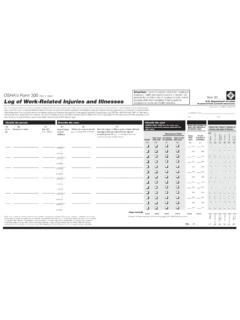
Year 20 Log of Work-Related Injuries and Illnesses
www.osha.govU.S. Department of Labor Occupational Safety and Health Administration OSHA’s Form 300 (Rev. 01/2004) Year 20__ __ Log of Work-Related Injuries and Illnesses You must record information about every work-related death and about every work-related injury or illness that involves loss of consciousness, restricted work activity or job transfer,
DEPARTMENT OF LABOR 29 CFR Part 1904
www.osha.gov2 The final rule also revises the requirements for reporting work-related fatality, injury, and illness information to OSHA. The current regulation requires employers to report …
CRANES AND DERRICKS IN CONSTRUCTION FINAL …
www.osha.govOSHA is making this document, the regulatory text, available for informational purposes only. This action does not affect the effective date of the final rule on Cranes and Derricks in Construction, which will be 90
Preventing Mold-Related Problems in the Indoor …
www.osha.govIntroduction This guide provides basic information about mold, mold sources, and building-related illnesses. Brief discussions are included on building design considerations for healthy indoor air,
HazardCommunicationGuidancefor CombustibleDusts
www.osha.govU.S.DepartmentofLabor OccupationalSafetyandHealthAdministration OSHA3371-08 2009 HazardCommunicationGuidancefor CombustibleDusts Occupational Safety and Health Act of 1970
Related documents
THE NATIONAL STRATEGY FOR PANDEMIC INFLUENZA
www.cdc.govNov 01, 2005 · pandemic influenza, whether it results from the strain currently in birds in Asia or another influenza virus. It outlines how we intend to prepare, detect, and respond to a pandemic. It also outlines the important roles to be played not …

D17-2790191 2017 season summary final at 22 November …
www1.health.gov.auconfirmed influenza notifications since the 2009 pandemic. In particular in 2017, systematic introduction of rapid influenza testing in hospitals in one large state (New South Wales) may have contributed in part to
Pandemic Influenza Plan - Centers for Disease Control and ...
www.cdc.govThe last Pandemic Influenza Plan for the Department of Health and Human Services Update was issued in 2009. Since that time, our nation has experienced, and learned from, the 2009 Influenza A(H1N1) pandemic and the emergence of other influenza viruses of concern, such as H7N9 that emerged in 2013 in China and continues to cause periodic outbreaks.

Pandemic Phase Descriptions and Actions - WHO
www.who.intTitle: GIP A3 FOY Created Date: 4/10/2009 8:06:59 AM