Example: dental hygienist
Provider Toolkit - ACEs Aware
clinical protocols, and payment for screening children and adults for ACEs. Screening for ACEs, assessing for toxic stress, and responding with evidence-based interventions can significantly improve the health and well-being of individuals and families. • Effective January 1, 2020, qualified Medi-Cal providers are eligible for a $29
Tags:
Information
Domain:
Source:
Link to this page:
Documents from same domain

Screening Tools Overview - ACEs Aware
www.acesaware.orgThe Pediatric ACEs and Related Life Events Screener (PEARLS) was developed by the Bay Area Research Consortium on Toxic Stress and Health (BARC), a partnership between the Center for Youth Wellness, the University of California, San Francisco (UCSF), and …
ACE Screening Clinical Workflows, ACEs and Toxic Stress ...
www.acesaware.orgAssociated Health Conditions, the patient is at “high risk” for toxic stress physiology. In both cases, the provider should offer education on how ACEs may lead to a toxic stress response and associated health conditions, as well as practices and interventions demonstrated to buffer the toxic stress response, such as sleep, exercise, nutrition,

Parenting with ACEs
www.acesaware.orgDec 10, 2019 · Parenting with ACEs As an adult, you may still feel the effects of your own Adverse Childhood Experiences (ACEs). What does this mean for your own health? This depends on how many ACEs you experienced as a child. It also depends on whether you’ve had certain positive experiences that help reduce the effects of stress.

Chapter 2 Trauma and Trauma-Informed Care - ACEs Aware
www.acesaware.orgJun 30, 2018 · tionally afflicted by trauma and its effects. Understanding the devastating and mul-tiplicative effects of trauma on health and well-being and addressing the consequences of trauma are crucially important for healthcare providers and the systems in which they work. Preventing trauma and mitigating its adverse effects promote health equity.
Pediatric ACEs and Related Life Events Screener (PEARLS)
www.acesaware.orgPediatric ACEs and Related Life Events Screener (PEARLS) CHILD - To be completed by: Caregiver. At any point in time since your child was born, has your child seen or been present when the following experiences happened? Please include past and present experiences.

TEEN (Self-Report) - ACEs Aware
www.acesaware.orgPediatric ACEs and Related Life Events Screener (PEARLS) TEEN (Self-Report)- To be completed by: Patient. Teen (Self Report) - Identified. At any point in time since you were born, have you seen or been present when the following

Adverse Childhood Experience Questionnaire for Adults
www.acesaware.orgDid your parents or adults in your home ever hit, punch, beat, or threaten to harm each other? who went to jail or prison? home ever swear at you, insult you, or put you down? parent or adult in your home ever hit, beat, kick, physically hurt you in any way? in your family loved you or thought you were special? ...

Adverse Childhood Experience Questionnaire for Adults
www.acesaware.orgAdverse Childhood Experience Questionnaire for Adults California Surgeon General’s Clinical Advisory Committee Our relationships and experiences—even those in childhood—can affect our health and well -being.
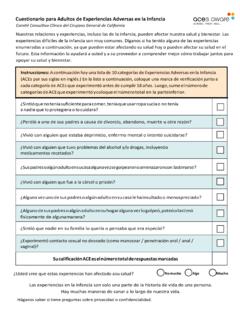
Cuestionario para Adultos de Experiencias Adversas en la ...
www.acesaware.orgCuestionario para Adultos de Experiencias Adversas en la Infancia Comité Consultivo Clínico del Cirujano General de California Nuestras relaciones y experiencias, incluso las de la infancia, pueden afectar nuestra salud y bienestar. Las experiencias difíciles de la infancia son muy comunes. Díganos si ha tenido alguna de las experiencias
Pediatric ACEs and Related Life Events Screener (PEARLS)
www.acesaware.orgor example, a parent/caregiver got a divorce or separated, or a romantic partner moved in or out) Add up the “yes” answers for this first section: Please continue to the other side for the rest of questionnaire. Teen (Parent/Caregiver Report) – Deidentified
Related documents
Affect and Mood Related to School Aged Youth
smhp.psych.ucla.eduAffect and Mood Related to School Aged Youth (Revised 2015) ... The Prevention of Mental Disorders in School-Aged Children: ... changes to stress are normal in otherwise healthy populations. *Adapted from The Classification of Child and Adolescent Mental Diagnoses in …
Caseload and Workload Management - Child Welfare
www.childwelfare.govto secondary traumatic stress (STS), which can occur when a professional experiences stress or symptoms of trauma when working with traumatized children and families. This additional stress could exacerbate any stress they are feeling from high caseloads or workloads. For additional information about STS, visit
Thanks! A Strengths-Based Gratitude Curriculum for Tweens ...
ggsc.berkeley.edusome children may be living with significant challenges. These may include illness, family stress, the loss of a loved one, abuse, neglect, exposure to violence, discrimination, and economic hardship. Children who receive adult support (from their home, school, or community) in dealing with these challenges may have a heightened
The Physical Activity Questionnaire for Older Children ...
www.prismsports.orgactivity for youth from grades 4-12 (approximately ages 8-20). The purpose of the PAQ manual is to ensure that you can easily administer the PAQ measures in research and to provide you with a library of studies utilizing the PAQ-C and the PAQ-A. Physical Activity Questionnaire for Older Children (PAQ-C)
Placement of Children With Relatives - Child Welfare
www.childwelfare.govAssessing the relative’s willingness and suitability to provide care for the child Approving Relative Placements When the state social services department is granted custody of a child, the department assumes responsibility for making a safe and appropriate placement for the child. Statutes and regulations in 20 states and the District
TheImportance ofEducational Partnerships
www.sagepub.comchildren and families. Joyce Epstein (1999) created a Center on School, Family, and Community Partnerships at Johns Hopkins University in Maryland in an effort to inform and promote community partnerships to enhance education for students and families. The center has three goals: (a) creating, assessing, and sharing effective part -
Evaluation of Feeding, Eating, and Swallowing for Children ...
www.aota.orgMost children with cerebral palsy (CP) also have a pediatric feeding disorder (PFD). Evaluating feeding in children with CP is a highly complex process that is best done in a team environment. This article describes the prevalence of PFDs in children with CP and highlights the special clinical considerations of the occupa-
Secondary Traumatic Stress - nctsn.org
www.nctsn.orgSecondary traumatic stress is the emotional duress that results when an indi-vidual hears about the firsthand trauma experiences of another. Its symptoms mimic those of post-traumatic stress disorder (PTSD). Accordingly, individuals af - fected by secondary stress may find themselves re-experiencing personal trauma