Transcription of Providing and Seeking Information on Practices to …
1 Providing and Seeking Information on Practices to Enhance Effectiveness of the RCRA C Program for the Retail Sector Notice of Data Availability 79 FR 8926. February 14, 2014. What is this Federal Register About? This is a notice of data availability regarding the management of hazardous wastes generated in the retail sector. EPA is Seeking ideas and input on how the hazardous waste regulations can be enhanced to better fit with the manner in which the retail sector operates. At this time, no rules have been crafted; EPA is just asking for input on this issue and will accept comments until May 30, 2014. The management of hazardous wastes in the retail sector presents unique challenges that are not present at industrial facilities and service industries. The retail sector handles a large number of diverse products, many of which may potentially become regulated as hazardous waste when discarded.
2 Thus, retailers are required to make numerous hazardous waste determinations at thousands of sites, generally by store employees with limited experience with hazardous waste rules. Over the past five years, US EPA has been reviewing the application of the hazardous waste rules to the retail sector through public hearings, site visits and conference calls. Several retail- related issues have been raised as to how some specific situations should be regulated within the retail sector. The situations are: 1. Episodic generation: The rate of hazardous waste generation at a store can vary considerably depending on product recalls, expiration dates, spills, breakage, and product seasonality. Also of concern is the occurrence of consumer midnight dumping in retail parking lots. Varying generation rates present problems for retailers when complying with the training requirements, accumulation standards, recordkeeping and other hazardous waste regulations.
3 2. Reverse distribution: Reverse distribution is generally a process whereby retailers send consumer products they are unable to sell in their stores back to a central location where they are audited and financial credit for the items may be granted by the manufacturer. The products are then evaluated and a decision is made regarding the final disposition of the item. Items can be donated, liquidated (sold), sent back to a manufacturer, recycled or discarded appropriately. 3. hazardous waste determination : A single store can sell hundreds of thousands of products; should any of these products be discarded, a waste determination would need to done which, considering the magnitude of discarded products at any one time, could require significant resources and expertise. Additionally, the availability of a person knowledgeable of the hazardous waste rules and able to make a waste determination at each retailor is unlikely.
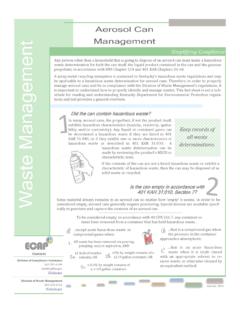
4 Retailors also can incur frequent personnel turnover which may further hamper their implementation of a hazardous waste management program. EPA. would like input as to when and where the waste determination must be made for the retail sector or in other words at what point in their process is a hazardous waste generated. 4. Aerosol can management: Aerosol cans make up a large percentage of the retail sector's hazardous waste stream. Many aerosol cans could be recycled as scrap metal or have their flammable propellants captured for fuel recovery. However, retailers manage aerosol cans as hazardous waste because the recycling activity is not performed at the retail facility. Also, retailors find that it is unclear whether or when aerosol cans exhibit the reactivity characteristic (D003). Thus, the retail sector would like EPA to determine that aerosol cans without flammable propellants and non- hazardous contents are not reactive hazardous waste (D003).
5 They would also like EPA to determine that the recycling exclusions do apply to retail facilities when aerosol cans are sent for recycling, and that all other hazardous waste aerosol cans be allowed to be managed as Universal wastes. Federal Guidance Document and Federal Register notice: Federal Register Notice.