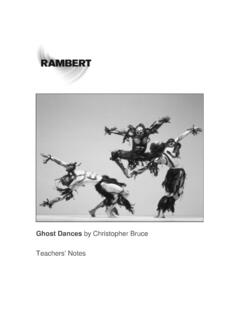
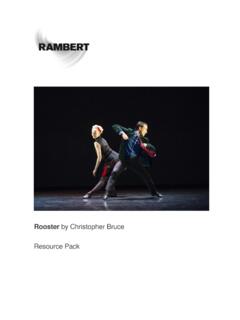
Transcription of Rambert Dance Company 1966 2002
1 Rambert Dance Company 1966 2002 Study pack for teachers of AQA AS/A Level Dance Rambert Dance Company 1966 2002 p2 Study pack to support the teaching of AQA AS/A level Dance Component 2: Critical Engagement Compulsory area of study: Rambert Dance Company (formerly Ballet Rambert ) from 1966 - 2002 This guide has been produced by Rambert , in consultation with AQA, to support the teaching of AS/A level Dance and the compulsory area of study Rambert Dance Company from 1966 - 2002. It includes historical context, and details of 16 key works by the named practitioners from this period in Rambert s history: Glen Tetley, Ashley Page, Christopher Bruce, Robert North, Richard Alston and Siobhan Davies.
2 There are also suggestions for further discussion, essay questions and lesson activities. Practical workshops with Rambert are available in schools or at Rambert s studios. To book, call 020 8630 0615 or email This material is available for use by students and teachers of UK educational establishments, free of charge. This includes downloading and copying of material. All rights reserved. For full details see colleges/educational-use-of-this-website /. Rambert Dance Company 1966 2002 p3 Contents Works Selected from 1966 2002 page 4 Section 1: Pre 1966 the historical context page 5 Section 2.
3 Named practitioners in the area of study Glen Tetley page 10 Pierrot Lunaire Embrace Tiger and Return to Mountain The Tempest Ashley Page page 16 Currulao Soldat Christopher Bruce page 19 Sergeant Early s Dream Hurricane Robert North page 23 Pribaoutki Death and the Maiden Lonely Town, Lonely Street Richard Alston page 26 Soda Lake Wildlife Pulcinella Siobhan Davies page 29 Winnsboro Cotton Mill Blues Embarque Plainsong Section 3: Explore the journey from 1966 2002 page 33 Discussion points, essay questions and lesson activities Rambert Dance Company 1966 2002 p4 Works selected from 1966 -2002 This guide concentrates on a selection of 16 works created by the six practitioners named in the AQA specification - a small selection of the hundreds of works produced by Rambert between 1966 and 2002.
4 Full, up-to-date lists of all Rambert s works, organised chronologically or alphabetically by title, are available on our website. See Rambert s archive is open by appointment for teachers, students, researchers and the public. To arrange a visit email or call 020 8630 0600. Practitioner Work (original Rambert creations except where stated) Glen Tetley Pierrot Lunaire 1962, Rambert premiere 1967 Embrace Tiger and Return to Mountain 1968 The Tempest 1979 Ashley Page Currulao 1990 Soldat 1988 Christopher Bruce Sergeant Early s Dream 1984 Hurricane 2001 (Note: the 2018 A-level Dance specification also requires the study of Rooster by Christopher Bruce in addition to the compulsory area of study.)
5 Rambert Dance Company 1966 -2002, please see the Rooster Education pack for further support) Robert North Pribaoutki 1982 Death and the Maiden 1980, Rambert premiere 1984 Lonely Town, Lonely Street 1981 Richard Alston Wildlife 1984 (originally with Nigel Osborne music) Pulcinella 1987 Soda Lake 1986, Rambert premiered 1986 Siobhan Davies Winnsboro Cotton Mill Blues 1992 Embarque 1988 Plainsong 1991, Rambert premiere 1991 Rambert Dance Company 1966 2002 p5 SECTION 1 Pre 1966 the historical context Rambert is Britain s oldest Dance Company . It was formally established in 1926 by Marie Rambert , who was born in Warsaw, Poland in 1888.
6 Rambert was inspired to Dance when she saw a performance by Isadora Duncan in 1904 in Poland. Although her parents wished her to take up medicine, she began to study Dance in Paris (initially with Isadora Duncan s brother, Raymond), while waiting to take up her Medical Studies. She spent three years studying eurhythmics with Emile Jacques-Dalcroze. In 1912, she was invited by Sergei Diaghilev to assist Vaslav Nijinsky and his dancers with the complex rhythms of Stravinsky s music for Le Sacre du Printemps (The Rite of Spring). It was during this time that she acquired her love of classical ballet.
7 She worked with the Ballets Russes for a season (1912-14) and left when Nijinsky was dismissed. At the outbreak of war in 1914, Rambert moved to London. When she arrived in London she supported herself by giving tuition in Dance and eurhythmics. At the same time she continued with her own ballet studies, as well as performing as a soloist. She married the English playwright Ashley Dukes in 1918. Two years later, she opened a school of dancing in Bedford Gardens, Kensington. Marie Rambert invited Fredrick Ashton to train with her in 1923 and she was ready to perform with her dancers in Ashton s first work A Tragedy of Fashion in 1926.
8 This ballet was received well by the public, but less of with the press. In an interview for the BBC in 1976, Marie Rambert said the press had commented: what a pity dramatic authors have wives who meddle in ballet. Rambert continued The dramatic author was my husband Ashley Dukes, well, I meddled in ballet not because of him but because of my passion for dancing and choreography, neither of which I really could do myself, but I got it out of people. From the 1920s to the 1940s, the Company emerged from Marie Rambert s Ballet Club performing regularly on Sundays at the Mercury Theatre in London s Notting Hill, to become a full time touring Company .
9 The first performances as Ballet Rambert were in 1935. Its popularity meant it outgrew the tiny Mercury Theatre and from 1946 London performances were often at Sadler s Wells Theatre. During World War II, the Company appeared in a range of venues including factory canteens as well as theatres, and in this way made its own contribution to the war effort. The change in its performance activities during and immediately after the War resulted in a new audience. The small but knowledgeable audience of the Ballet Club was replaced by a more general audience whose tastes were less adventurous than those of the Company s earlier supporters.
10 Post-war audiences began to expect longer ballets in addition to the traditional mixed bills of new works. Ballet Rambert performed several classics, including variations of the well-known Giselle (1945- 1965), Coppelia (1956-7) and the first major British productions of La Sylphide (1960) and Don Quixote (1962). Rambert Dance Company 1966 2002 p6 Extensive touring for up to 35 weeks a year meant there was less time to create new works and there was no notable choreographer working with the Company at this time. This would change in 1958, when Norman Morrice became Resident Choreographer and created his first work Two Brothers.