Transcription of RBA Validated Audit Program (VAP) Operations …
1 RBA VAP Operations Manual RBA Public January 2020 Page | 1 RBA Validated Assessment Program (VAP) Operations Manual Revision January 2020 Organizations working with and in the Responsible Business Alliance (RBA) are working to improve sustainability and social responsibility within the global supply chain. These companies recognize a mutual responsibility to ensure working conditions are safe, workers are treated with respect and dignity, and that manufacturing practices are environmentally responsible. The Validated Assessment Program (VAP) is a collaborative approach to auditing to reduce the burden on supply chain companies from multiple requests for social audits. The VAP meets the need for a high quality, consistent and cost-effective standard industry assessment for labor, ethics, health, safety environmental, and management systems practices based on the RBA code of conduct, laws, and regulations.
2 For more information about the Validated Assessment Program (VAP), please contact: RBA Email: RBA Address: 1725 Duke Street, Suite 300, Alexandria VA 22314, USA RBA Website: 2020 January RBA VAP Operations Manual RBA Public January 2020 Page | 2 POST Audit 1. Audit REVIEW Each Validated Audit Report (VAR) is reviewed by the QM both at draft and at final stage before release. The quality assurance process consists of the following: Scope assurance Audit covered entire site and all pertinent Operations Confidentiality assurance that product, customer, worker, or other confidential information is not included in the report Auditing Practices (including review of submitted auditor notes and supporting evidence) Good reporting criteria The RBA Code interpretations Applicable legislation Completeness Triangulation of findings (as noted, not all questions must be triangulated) Accuracy of findings versus Audit notes Conclusions and identification to the RBA Code provision Understandable spelling and grammar Proper use of AP ratings Proper interpretation of AC Consistency of findings across AC Adequate documented proof to substantiate findings Auditor Performance Review After each VA, the QM reviews the work performed by the Auditor.
3 This review includes: Quality How well the auditor applied the RBA Code and interpretations, as well as local law, to the Audit Professionalism How they interacted with all participants of the Audit Timeliness How well the Auditor met the required timelines RBA VAP Operations Manual RBA Public January 2020 Page | 3 This information is used when selecting and assigning Audit Firms to conduct Audits. 2. Audit REPORT A formal VAR is available to the Auditee and Attachment B Companies after the Audit and the associated review is complete. The VAR provides information for the Auditee's management team to improve their CSR programs and performance. VAR findings identify both deficiencies and good practices and are based on objective evidence obtained during the Audit . 3. CORRECTIVE ACTION PLANS Corrective Action Plan (CAP) management is an important part of the VAP.
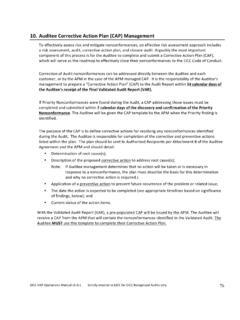
4 The purpose of the CAP is to define corrective actions for resolving any non-conformances identified during the Audit . CAP activities must occur within RBA specified time frames in this manual, to demonstrate closure of any findings identified in the Initial Audit . For members these should be per the Membership Compliance Guidelines. The Auditee is responsible for completion of the corrective and preventive actions listed within the plan. The CAP should include: Determination of root cause(s) Description of the proposed corrective actions to address root cause(s) If Auditee determines that no action will be taken or is necessary in response to a non-conformance, the plan must describe the basis for this determination and why no corrective actions is required Application of a preventive action to prevent future recurrence of the problem or related issue(s) The date the action is expected to be completed Current status of the action items The Auditee must use the CAP template.
5 For the APM Managed CAP process, a pre-populated CAP is issued by the APM. For CMA and AMA CAPs, use the blank CAP template available on RBA web site Priority CAPs will be issued by the QM. RBA VAP Operations Manual RBA Public January 2020 Page | 4 Priority Non-conformance Containment Upon receiving notification of any Priority non-conformance(s) from the Audit Team, the Auditee reviews the non-conformances and initiates containment immediately. Containment is the act, process, or means of immediately reducing a threat or lowering a risk of the situation identified in the Priority non-conformance(s). The following process is used to implement immediate containment: Auditor notifies the auditee of the Priority non-conformance(s) Auditee investigates and determines needed containment activities Auditee documents activities within the CAP template via RBA-ONLINE Auditee implements containment actions so that the risk of the issue is minimized A permanent and systemic solution is then implemented through the CAP process.
6 CAP Management Options for non-priority findings Management of CAPs can be done in one of two methods: QM managed CAP Customer Managed CAP or Auditee Managed CAP QM Managed CAP The CAP can be managed using the payable QM Managed CAP process. The communication on the CAP and its progress is managed by the QM directly with the Auditee using RBA-Online. APM will communicate with all Attachment B Companies (RBA members only). Therefore, only one CAP is required no matter the number of Audit customers. A QM-managed CAP is strongly encouraged for: Auditees who are providing an Audit to multiple customers. Auditees new to the VAP which could use additional guidance on developing or managing their CAP. Auditees that wish to have a quality review by the QM team. The QM is available as a resource, and actions taken suggested in an QM approved CAP will likely meet the expectations of an Auditor during the Closure Audit . Customer Managed CAP or Auditee Managed CAP RBA VAP Operations Manual RBA Public January 2020 Page | 5 The Customer Managed CAP process requires that the Attachment B Company (only Member Companies) manage the CAP, working directly with the Auditee.
7 Or the Auditee can manage their own CAP process can communicate with their customers. Requirements for customer managed CAPs: A copy of the approved CAP must be up-loaded to the RBA-ONLINE The Attachment B Company manages the CAP to meet their expectations or Auditee manages the CAP to meet the expectations of the customer(s) The QM is NOT available as a resource, nor does the QM or APM verify the actions taken will meet the expectations of an auditor during the Closure Audit 4. CLOSURE AUDITS All Priority and Major non-conformances must be closed through a Closure Audit . Completing CAP items, either a QM CAP or an Auditee or Customer CAP does not close issues, as closure only occurs through a Closure Audit . Minor and Risk of non-conformance findings may also be closed through a Closure Audit . The timing of the Closure Audit should be based upon the type of findings in the Initial Audit (Priority, Major, Minor, Risk of Non-conformance and whether there are working hours, recruitment fees, and/or social insurance related findings).
8 Closure Audit Focus There are two types of Closure audits: Priority Audit Closure Audit The focus of both closure Audit types are the issues identified in the Initial Audit . However, if an Auditor identifies any other finding during any Closure Audit , this is to be included as a new issue, following the same process and rules as the Initial Audit . Priority Audit Priority findings are required to be closed by a Priority Audit . RBA VAP Operations Manual RBA Public January 2020 Page | 6 The purpose of a priority Audit is not to achieve conformance for the AC but to remove the condition which triggers the priority rating. Of course, if an AC is verified as conformance during a Priority Audit because the situation is remediated, and the system fixed to ensure consistent conformance with the AC then a Closure Audit for this AC is no longer required Closure Audits for Priority non-conformance(s) are triggered by the APM.
9 The clock starts when the Priority non-conformance is confirmed by the QM and Auditors, which may be: During the Audit During the draft report stage (when more data is analyzed or during the QM review of the draft report) When the rating is changed as per the rating guidance (to correct a mis-rating in draft Audit report) Priority audits take place For all issues other than recruitment fees, working hours and social insurance: 30 days from discovery Recruitment fees: reimbursement to be done within 90 days from discovery, closure could be done with 180 days from discovery Working hours and social insurance: 180 days from discovery Other findings may be closed during the Priority Audit . However, to be closed it must be agreed upon with the APM during the scheduling process to ensure the Priority Audit is properly scoped. Closure Audit Major issues must be closed through a Closure Audit . At the election of the Auditee, minor issues can be closed through the same Closure Audits or through a separately scheduled stand-alone Closure Audit .
10 Closure Audits for non-priority findings are not scheduled on a set timeline, rather, these are triggered by the Auditee or Attachment B Company. Closure Audits can be remote or onsite, depending upon the pre-determined permission level for each finding as stipulated in the AC in appendix 11, at the end of each element. Remote closures are only accepted in cases defined in this manual. A chargeable remote verification assessment may be requested prior to an on-site Audit , making the on-site Audit more efficient and reducing the possibility of having issues stay open after the Closure Audit , which, in the case of major issues, may require an on-site Closure Audit to close the issues. RBA VAP Operations Manual RBA Public January 2020 Page | 7 Closure Audit timing should reflect 3 months of implementation and align with the corrective Action timeframes listed in this document.