Transcription of Refracting Telescopes - Caltech Astronomy
1 RefractingTelescopesENCYCLOPEDIA OFASTRONOMY ANDASTROPHYSICSR efracting TelescopesNobody is sure of the date when the first telescope wasmade. It may be as far back as the early 1550s, when thereis evidence that a telescope of some sort was constructedin England by Leonard Digges, but it is all very uncertain,and the first telescope of which we have definite proof wasbuilt by the Dutch spectacle maker H Lippershey in soon followed and were turned toward the first systematic telescopic series of observations wasmade in early 1610 by Galileo; others had preceded him,but for skill and perseverance Galileo stands alone in thosevery early telescope was, of course, aREFRACTOR.
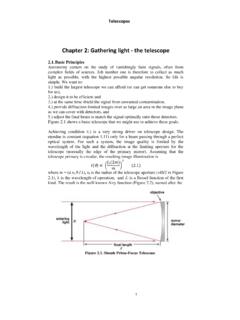
2 It was tiny,and even his most powerful Telescopes magnified no morethan 30 times, so that they were far inferior to modernbinoculars, but they were the direct ancestors of the hugerefracting Telescopes of a refractor, the light from the target object iscollected by a glass lens, known either as an object glass oras an objective. The light is passed down the telescope andbrought to focus, where an image is formed and is enlargedby a second lens, termed an eyepiece or ocular. Note that itis the eyepiece which is responsible for the magnification;the function of the object glass is to collect the light and,naturally, the greater the amount of light collected, thehigher the magnification which can be used.
3 The distancebetween the object glass and the focus is termed the focallength of the telescope . Magnification is given by the focallength of the telescope divided by the focal length of theeyepiece. The focal length of the telescope divided by thediameter of the object glass gives the focal ratio. Thus if a3 in ( cm) refractor has a focal length of 36 in ( cm),its focal ratio is 36/3=12 (in metric, ).Assume now that with our 3 in refractor, with its focallength of 36 in, we use an eyepiece of focal length12in. Themagnification will be 36/12=72, often written as theory, and usually in practice, eyepieces are madewith a standard thread, so that any eyepiece can be usedwith any is, however, one obviouslimitation the amount of light available depends on theaperture of the object glass (or the main mirror ofREFLECTINGTELESCOPES).
4 Suppose, with our 3 in refractor, we use anaperture of18in. The magnification will then be 36/18=288. Unfortunately, every time an image is enlarged itbecomes fainter, and with this power on this telescopethe image would be so faint that it would be is a general rule that the maximum reallysatisfactory magnification is 50 per inch of aperture, sothat for our 3 in telescope the highest power which can beproperly used is 3 50=150. For a higher magnificationit is necessary to have a larger telescope . For example, a6 in refractor of focal length 72 in will have a focal ratio off/12. On this, an eyepiece of focal length14in will give amagnification of 72/14=288, which is quite acceptable.
5 Ifthe focal length of our 6 in refractor is only 54 in, the focalratio will be 54/6=9. This makes for greater convenience,because the tube is shorter, but to make thefratio too lowwill introduce other troubles, and one has to strike a any telescope it is desirable to have severaleyepieces: one to give low magnification and a wide field,suitable for observing objects such as star clusters; onewith a moderate magnification, for views of the Moonand planets; one with high magnification, for use on reallygood, clear nights. With our 3 in,f/12 refractor, suitableeyepieces might well be of focal length 1 in (36/1=36),12in (36/12=72) and14in (36/14=144).
6 The main problem with a refractor is that it introduceswhat is known as chromatic aberration. Light is reallya mixture of all the colors of the rainbow, and the colordepends on the wavelength of the light; red light hasthe longest wavelength for visible radiations, violet theshortest, with orange, yellow, green and blue in a beam of light is passed through a lens, it issplit up, and the different colors are bent or refractedby different amounts red least, violet most. They aretherefore brought to focus at different distances from theobject glass of a refractor, and an object such as a star is seento be surrounded by gaudy colored rings which may looksuperficially attractive but which are most unwelcome tothe false-color trouble can be reduced by what istermed an achromatic object glass, in which there areseveral component lenses made of different kinds of glass.
7 The errors then tend to cancel each other color always remains, but with a good achromaticobjective it is not really in mind that an astronomical refractor will givean inverted fact any refractor will do this,but in a telescope made for terrestrial use an extra lenssystem is put into the optical train to make the image , each time a ray of light passes through glass it isslightly weakened. This does not in the least matter whenlooking at birds, or ships out at sea, but it matters verymuch to an astronomer, who is anxious to collect everyscrap of light available. Therefore, the erecting lens systemis left out, although an erecting eyepiece can always first known Telescopes were refractors; the firstREFLECTORwas not made until around 1669, when IsaacNewton believed that nothing could rid the refractorof severe chromatic aberration, and decided to developan entirely different system (seeNEWTONIAN Telescopes ).
8 Previously, efforts to eliminate false color meant thatrefractors were made with very long focal length. Thisdoes reduce chromatic aberration, but at the expenseof making the Telescopes very unwieldy. For example,Christiaan Huygens, probably the best observer of theearly 17th century, constructed a telescope with anaperture of 2 in and a focal length of 1012feet and usedit to discover Titan, the largest of the satellites of then built a telescope with a focal length of 23 feet, andwith it discovered the true nature of Saturn s ring telescope must have been incredibly awkward to use,and even more so were the refractors made and used byCopyright Nature Publishing Group 2001 Brunel Road, Houndmills, Basingstoke, Hampshire, RG21 6XS, UK Registered No.
9 785998and Institute of Physics Publishing 2001 Dirac House, Temple Back, Bristol, BS1 6BE, UK1 Refracting TelescopesENCYCLOPEDIA OFASTRONOMY ANDASTROPHYSICST able large Refracting (in)Date of completionYerkes 40 inYerkes, Williams Bay, WI, USA401897 Lick 36 inLick, Mount Hamilton, CA, USA361888 Meudon RefractorMeudon, Paris, France331889 Potsdam RefractorPotsdam, Germany311899 Lunette BischoffsheimNice, France301886 Thaw RefractorAllegheny, Pittsburgh, PA, USA301985 Grosser RefraktorArchenhold, Treptow, Germany271896 McCormick RefractorLeander McCormick, Charlottesville, VA, USA26188026 in EquatorialUS Naval Observatory, Washington, DC, USA261873 Thompson RefractorHerstmonceux, England261897 Innes TelescopeJohannesburg, South Africa261926 Vienna RefractorVienna, Austria261880 Newall RefractorAthens.
10 Greece251862 Lowell RefractorLowell, Flagstaff, AZ, USA241895another pioneer observer, Hevelius of Danzig (the townnow known as Gda nsk). One of Hevelius Telescopes hada focal length of no less than 150 feet, but was so subjectto wind disturbance that it could seldom be used to its came the tubeless telescope . Here, the objectglass was fixed to the top of a mast, and the observersighted it by looking along guide wires which could beused to turn the object glass to the right position. Theobserver then held the eyepiece by hand. One of Huygens aerial Telescopes had a focal length of 210 feet, and it issaid that one refractor with a focal length of 600 feet wasplanned, although there is no record that it was these long-focus Telescopes could neverbe really satisfactory, but in 1733 a wealthy amateurastronomer, Chester Moor Hall, constructed the firstachromatic or compound objective, with one componentmade of flint glass and the other of crown glass.