Transcription of Regional Profile 2017 - Doing Business
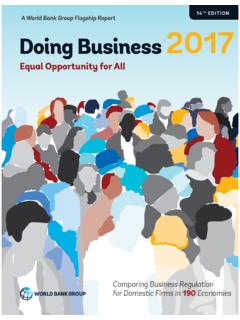
1 Regional Profile 2017 Latin America and Caribbean (LAC) 2 LATIN AMERICA AND CARIBBEAN (LAC) Doing Business 2017 2017 International Bank for Reconstruction and Development / The World Bank 1818 H Street NW, Washington DC 20433 Telephone: 202-473-1000; Internet: Some rights reserved 1 2 3 4 19 18 17 16 This work is a product of the staff of The World Bank with external contributions. The findings, interpretations, and conclusions expressed in this work do not necessarily reflect the views of The World Bank, its Board of Executive Directors, or the governments they represent.
2 The World Bank does not guarantee the accuracy of the data included in this work. The boundaries, colors, denominations, and other information shown on any map in this work do not imply any judgment on the part of The World Bank concerning the legal status of any territory or the endorsement or acceptance of such boundaries. Nothing herein shall constitute or be considered to be a limitation upon or waiver of the privileges and immunities of The World Bank, all of which are specifically reserved. Rights and Permissions This work is available under the Creative Commons Attribution IGO license (CC BY IGO) Under the Creative Commons Attribution license, you are free to copy, distribute, transmit, and adapt this work, including for commercial purposes, under the following conditions: Attribution Please cite the work as follows: World Bank.
3 2017 . Doing Business 2017 : Equal Opportunity for All. Washington, DC: World Bank. DOI: License: Creative Commons Attribution CC BY IGO Translations If you create a translation of this work, please add the following disclaimer along with the attribution: This translation was not created by The World Bank and should not be considered an official World Bank translation. The World Bank shall not be liable for any content or error in this translation. Adaptations If you create an adaptation of this work, please add the following disclaimer along with the attribution: This is an adaptation of an original work by The World Bank.
4 Views and opinions expressed in the adaptation are the sole responsibility of the author or authors of the adaptation and are not endorsed by The World Bank . Third-party content The World Bank does not necessarily own each component of the content contained within the work. The World Bank therefore does not warrant that the use of any third-party-owned individual component or part contained in the work will not infringe on the rights of those third parties. The risk of claims resulting from such infringement rests solely with you.
5 If you wish to re-use a component of the work, it is your responsibility to determine whether permission is needed for that re-use and to obtain permission from the copyright owner. Examples of components can include, but are not limited to, tables, figures, or images. All queries on rights and licenses should be addressed to World Bank Publications, The World Bank Group, 1818 H Street NW, Washington, DC 20433, USA; fax: 202-522-2625; e-mail: ISBN (paper): 978-1-4648-0948-4 ISBN (electronic): 978-1-4648-0984-2 DOI: ISSN: 1729-2638 COVER DESIGN: CORPORATE VISIONS, INC.
6 3 LATIN AMERICA AND CARIBBEAN (LAC) Doing Business 2017 CONTENTS Introduction .. 4 The Business environment .. 5 Starting a Business .. 14 Dealing with construction permits .. 41 Getting electricity .. 72 Registering property .. 99 Getting credit .. 133 Protecting minority investors .. 161 Paying taxes .. 191 Trading across borders .. 224 Enforcing contracts .. 262 Resolving insolvency .. 290 Distance to frontier and ease of Doing Business ranking .. 316 Resources on the Doing Business website .. 319 4 LATIN AMERICA AND CARIBBEAN (LAC) Doing Business 2017 INTRODUCTION Doing Business sheds light on how easy or difficult it is for a local entrepreneur to open and run a small to medium-size Business when complying with relevant regulations.
7 It measures and tracks changes in regulations affecting 11 areas in the life cycle of a Business : starting a Business , dealing with construction permits, getting electricity, registering property, getting credit, protecting minority investors, paying taxes, trading across borders, enforcing contracts, resolving insolvency and labor market regulation. Doing Business 2017 presents the data for the labor market regulation indicators in an annex. The report does not present rankings of economies on labor market regulation indicators or include the topic in the aggregate distance to frontier score or ranking on the ease of Doing Business .
8 In a series of annual reports Doing Business presents quantitative indicators on Business regulations and the protection of property rights that can be compared across 190 economies, from Afghanistan to Zimbabwe, over time. The data set covers 48 economies in Sub-Saharan Africa, 32 in Latin America and the Caribbean, 25 in East Asia and the Pacific, 25 in Eastern Europe and Central Asia, 20 in the Middle East and North Africa and 8 in South Asia, as well as 32 OECD high-income economies.
9 The indicators are used to analyze economic outcomes and identify what reforms have worked, where and why. This economy Profile presents the Doing Business indicators for Afghanistan. To allow useful comparison, it also provides data for other selected economies (comparator economies) for each indicator. The data in this report are current as of June 1, 2016 (except for the paying taxes indicators, which cover the period January December 2015). The Doing Business methodology has limitations. Other areas important to Business such as an economy s proximity to large markets, the quality of its infrastructure services (other than those related to trading across borders and getting electricity), the security of property from theft and looting, the transparency of government procurement, macroeconomic conditions or the underlying strength of institutions are not directly studied by Doing Business .
10 The indicators refer to a specific type of Business , generally a local limited liability company operating in the largest Business city. Because standard assumptions are used in the data collection, comparisons and benchmarks are valid across economies. The data not only highlight the extent of obstacles to Doing Business ; they also help identify the source of those obstacles, supporting policy makers in designing regulatory reform. More information is available in the full report.