Transcription of Regulators - MATHESON
1 RegulatorsIntroduction Regulators are used in gas delivery systems to reduce the pressurefrom a high pressure source to a safe working pressure for use. Apressure regulator should always be used when positive control ofthe pressure in a gas stream is required. A pressure regulator is asmuch a safety device as it is an important tool. All Mathesonregulators are cleaned for oxygen service except as Regulator TypesThere are two basic types of pressure Regulators : a single stagetype and a dual stage type. The outward appearance of the twodistinctly different types is somewhat similar and may be difficultto distinguish. Most pressure Regulators are fitted with two gaugesto monitor pressures (most line Regulators only have one).
2 Established convention in the United States and Canada hassituated the high pressure gauge being connected internally to theinlet side of the regulator (the right side of the regulator whenfacing from the front). This gauge is used to monitor the sourcepressure. The low pressure gauge connected internally to theoutlet side of the regulator is situated on the left side of theregulator when facing from the front. This gauge is used tomonitor the outlet pressure (this is the gauge commonly installedon most Regulators ).On occasion, an outlet valve is affixed to the outlet port of theregulator. This valve is to be used to turn the flow of gas on or offfor brief periods of time. It should never be used to throttle orcontrol the flow of gas emitted from a regulator.
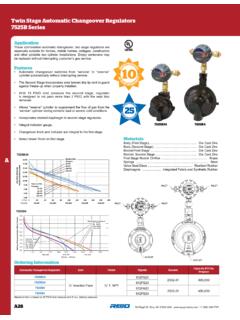
3 This practicecould cause serious damage to both the regulator and its should always be controlled by some other piece ofequipment such as a rotameter or mass flowmeter. DUAL STAGE regulatorsreduce the source pressuredown to the desired deliverypressure in two steps. Eachstage consists of a spring,diaphragm, and controlvalve. The first stage reducesthe inlet pressure to aboutthree times the maximumworking pressure. The finalpressure reduction occurs inthe second stage. The advantage of a dualstage regulator is its ability todeliver a constant pressure,even with a decrease in inletpressure. For example, as acylinder of gas is depleted, the cylinder pressure drops. Underthese conditions, single stage Regulators exhibit a decaying inletcharacteristic ; where the delivery pressure increases as a result ofthe decrease in inlet pressure.
4 In a dual stage regulator, the secondstage compensates for this decrease, providing a constant deliverypressure regardless of inlet pressure conditions. The dual stageregulator is recommended for applications where a continuoussupply of gas is required; such as the gas supplied to analyticalinstruments where constant delivery pressure is STAGE regulatorsperform the same function as thetwo stage regulator using asingle step reduction of sourceto outlet pressure. For thisreason, the outlet pressurecannot be as accuratelycontrolled as the source pressuredecays. We highly recommendsingle stage Regulators only beused in circumstances where theoperator can monitor and adjustthe regulator as needed or wherethe regulator is supplied anearly constant source Regulators are single stage Regulators that are used toprovide point-of-use pressure monitoring and control.
5 Forexample, a lab may have gas cylinders located in a room on thefirst floor. The gas may be piped to instruments located in a lab onthe second floor. In this case, it is difficult to monitor the gaspressure directly at the instruments, since the Regulators arelocated on the cylinders on the first floor. A line regulator may beinstalled near the instruments for convenience of monitoring thedelivery pressure at the point of use. These Regulators are installeddirectly into gas lines, and have a single delivery pressure are used to monitor the pressure within a gas deliverysystem. The basic component of a gauge is a hollow metal tubethat expands and contracts a very exact amount under varyingpressures.
6 This tube is connected to the part of the gauge usuallyscrewed into a regulator and is also connected to a series of gears are further connected to a needle, which is what theuser can view at the front of the RegulatorsGENERAL PURPOSE These products are suitable for applicationswhere cost is an overriding factor. Generally, these products arebest suited to applications involving gases that are less purity level (for pure gases) or unanalyzed , these products should not be used when there is a concern ofmoisture, air or hydrocarbon contamination to the gases PURITY These products are suitable for applications wheremaintaining the purity of a gas or mixture is the overridingconcern.
7 Generally, these products are best suited to applicationsinvolving gases that are greater than purity level (for puregases) or analyzed mixtures. These products are also highlyrecommended when dealing with more hazardous gases that areeither corrosive, toxic or pyrophoric. Typically these products areused in analytical laboratory applications or special processsituations. RegulatorsIntroduction (continued) Regulators Primarily Semiconductor Grade, these products aresuitable and highly recommended for applications where thehighest obtainable purity and the least risk of contamination isabsolutely necessary. Typically, this describes all of theapplications associated with the Semiconductor manufacturingindustry and also has applications in the Pharmaceutical andChemical Processing industries.
8 High Purity FeaturesThe features of a regulator determine the type of service for whichit can be used. A regulator intended for a high purity applicationhas different features than a unit designed for general purpose main features determine the suitability of a regulator forhigh purity applications:Body Type: Regulator bodies may be of forged or barstockconstruction. Barstock bodies are used for high purity applicationsfor the following reasons: Reduced internal volumes:Because barstock bodies aremachined, it is possible to achieve a small internal cavity in theregulator body. The low internal volume makes purging theregulator easy, allowing for removal of contaminants likemoisture and oxygen.
9 Tight grain structure of the metal: The cold drawing processproduces metal barstock with a very tight grain structure. Thistight grain structure prevents the regulator s internal surfacesfrom adsorbing moisture and contaminants, allowing them to bepurged easily. Low Ra surface finish: The machining process allows for verylow Ra (Roughness Average) surface finishes on the low Ra finish minimizes particle shedding, whichcontributes to contamination. Diaphragm Material: Diaphragms may be constructed ofelastomers (neoprene, Viton, etc.) or stainless steel. Stainless steeldiaphragms are used in high purity Regulators because they do notadsorb and release (or offgas ) contaminants. When a regulator isremoved from a cylinder, it is exposed to ambient air.
10 Anelastomeric diaphragm will adsorb moisture and any othercontaminants from the air. When the regulator is put back intoservice, the elastomeric diaphragm releases these contaminants,which are diffused back into the gas delivery system. A stainlesssteel diaphragm is unable to adsorb any contaminants, so it doesnot contribute to system of Seals: The seal between the body of the regulator and thediaphragm is important in maintaining purity. A poor seal createsa leakage point through which contaminants may enter the gasdelivery system. A metal to metal seal (metal regulator bodysealing to a metal diaphragm) is the most reliable, leak-free type ofseal. An elastomeric diaphragm can degrade over time,compromising the integrity of this Leak Testing A complete Helium Leak Test involves the monitoring of both theinboard leakage of an item and the outboard leakage of an leak tests are performed by drawing an internal vacuumon the equipment (under test), while surrounding it with helium,then monitoring the helium leakage rate from the outside to theinside.