Transcription of Rehabilitation Guidelines for Biceps Tenodesis
1 Rehabilitation Guidelines for Biceps TenodesisThe shoulder has two primary joints. One part of the shoulder blade, called the glenoid fossa forms a flat, shallow surface. This is coupled with the humerus (shaped like a golf ball) to make up the joint. The glenoid labrum is a ring of cartilage that turns the flat surface of the glenoid into a slightly deeper socket, which is similar to resting a golf ball on a golf tee instead of a table top, providing more shoulder stability. Another part of the scapula, called the acromium, articulates with the clavicle ( collar bone ) to make the acromioclavicular (AC) joint. The rotator cuff is a group of four muscles: the supraspinatus, infraspinatus, teres minor, and subscapularis. The rotator cuff tendons attach around the humeral head (ball) and connects the humerus to the scapula. The long head of the Biceps originates from the top of the glenoid fossa and labrum (top of the golf tee).
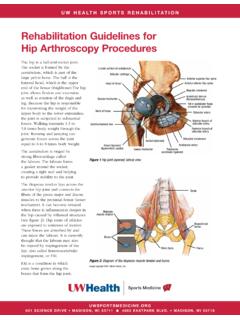
2 It then runs through a groove in the humerus (upper arm bone ) to join the short head of the Biceps and inserts on a bone in the forearm1 (See Figure 1). Because of its position, the long head of the Biceps is also considered to be a secondary stabilizer of the shoulder long head of the Biceps is at risk of injury and degenerative changes due to its proximity to the rotator cuff and the acromium. Since the long head of the Biceps can act as a secondary stabilizer of the shoulder, it is also subject to injury during high speed overhead movements; repetitive overhead movements; or forceful shoulder activities when the elbow is straight. Specific injuries may include inflammation and irritation of the bicep tendon itself; a problem with the bicep tendon in conjunction with one of the rotator cuff tendons; or detachment of part of the tendon from the attachment point (SLAP tear).1 Bicep tendon degeneration and/or tearing can cause significant shoulder discomfort and dysfunction (See Figure 2).
3 A Biceps Tenodesis is a surgical procedure which may be performed for treatment of severe symptoms involving the Biceps tendon, including inflammation or partial tears. It may be performed in isolation or as part of a larger shoulder surgery, including surgery involving the rotator cuff. During the Biceps Tenodesis , the normal attachment of the Biceps tendon on the shoulder socket (glenoid fossa) is cut and reattachment of the tendon is made on the humerus (upper arm bone ). This takes the pressure off the Biceps attachment and places the attachment below the actual shoulder The goal is to eliminate the shoulder pain coming from the bicep tendon. Different techniques are used to perform a Biceps Tenodesis . The surgical techniques can be broken down in to two categories: soft tissue techniques and hardware fixation techniques. Both techniques are effective, and chosen based on surgeon preference and patient indications. The primary soft tissue technique is the open key hole procedure.
4 An open keyhole technique relocates the tendon within the groove in the humerus bone after cutting it from its original location in the The procedure involves the proximal end (the portion closest to the it from its original location in the shoulder.) of the Biceps tendon being rolled into a ball and then sutured Figure 1 Shoulder anatomyImage Copyright 2010 UW Health Sports Medicine ViewLong head of bicepShort head of bicepAcromion621 Science DRive MaDiSon, Wi 53711 HealTH SpoRTS ReHaBiliTaTionThe world-class health care team for the UW Badgers and proud sponsor of UW Athletics621 Science Drive MaDiSon, Wi 53711 Guidelines for Biceps tenodesistogether as a mass. A keyhole is made in the groove of the humerus, the tendon mass is then inserted into the keyhole and pulled downward so that the tendon mass is locked in The Pitt technique uses two needles to pierce the bicep tendon in opposite directions. Sutures are then threaded through the needles to make a suture.
5 This procedure is repeated with the needle placement reversed to create a locking pattern of the sutures. A knot is used to secure the sutures to the transverse ligament in the shoulder instead of to the hardware fixation techniques include screw fixation or endobutton fixation. In the screw fixation the tendon is detached and then place in a hole made at the top of the bicipital groove. Then an interference screw is placed over the tendon, in to the bone , to hold it in place. In the endobutton technique the released tendon is secured to a button, the button is then secured behind the bone by sliding it in to a smaller hole at the top of the bicipital groove. Imagine a drywall type anchor where the pressure is applied from the inside Rehabilitation is vital to optimizing your outcome after surgery. The Rehabilitation Guidelines are tailored to the type of procedure performed, therefore below you will find Rehabilitation Guidelines for soft tissue fixation techniques and Rehabilitation Guidelines for hardware fixation Rehabilitation Guidelines are presented in a criterion based progression.
6 General time frames are given for reference to the average, but individual patients will progress at different rates depending on their age, associated injuries, pre-injury health status, Rehabilitation compliance and injury severity. Specific time frames, restrictions and precautions may also be given to protect healing tissues and the surgical 2a Normal long head of bicep. The muscle has a smooth arc from the shoulder to the 2b and Figure 2c Torn long head of bicep. The muscle has retracted toward the Science Drive MaDiSon, Wi 53711 Guidelines for Biceps tenodesisHardware Fixation Techniques pHaSe i (Surgery to 4 to 6 weeks after surgery)Appointments Rehabilitation appointments begin within 7 to 10 days after surgery and continue 1 to 2 times per week Rehabilitation Goals Protection of the post-surgical shoulder Activation of the stabilizing muscles of the gleno-humeral and scapulo-thoracic jointsPrecautions Sling immobilization required for soft tissue healing Hypersensitivity in axillary nerve distribution is a common occurrence No bicep tension for 6 weeks to protect repaired tissues this includes avoiding long lever arm flexion range of motion and no resisted forearm supination, elbow flexion or shoulder flexion Limit external rotation to 40 for the first 4 weeks No extension or horizontal extension past body for 4 weeksRange of Motion (ROM)
7 Exercises(Please do not exceed the ROM specified for each exercise and time period) Gentle active and active assistive range of motion for the elbow and wrist Pain free, gentle passive range of motion for shoulder flexion, abduction, internal rotation and external rotation to neutralSuggested Therapeutic Exercise Begin week 3 with sub-maximal shoulder isometrics for internal rotation; external rotation; abduction; and adduction Hand gripping Cervical spine and scapular active range of motion Desensitization techniques for axillary nerve distributionCardiovascular Fitness Walking, stationary bike sling on. No treadmill or swimming Avoid running and jumping due to the distractive forces that can occur at landingHardware Fixation Techniques pHaSe ii (begin after meeting phase i criteria, usually 6 to 8 weeks after surgery)Appointments Rehabilitation appointments are 1 time a week for 1 to 2 weeksRehabilitation Goals Full active range of motion Full rotator cuff strength in a neutral positionPrecautions Begin bicep progressive resistive exercises very gradually this includes avoiding long lever arm flexion range of motion and avoiding resisted forearm supination, elbow flexion or shoulder flexion No passive range of motion for abduction and external rotation or extension621 Science Drive MaDiSon, Wi 53711 Guidelines for Biceps tenodesisROM Exercises(Please do not exceed the ROM specified for each exercise and time period)
8 Shoulder active range of motion Shoulder passive range of motion for flexion or abduction if neededSuggested Therapeutic Exercise Scapular squeezes Internal and external rotation in neutral with Theraband resistance make sure patient is not supinating with external rotation movement Ball squeezesCardiovascular Fitness Walking and/or stationary bike without using arms (No Airdyne) No treadmill, swimming or runningHardware Fixation Techniques pHaSe iii (begin after meeting phase ii criteria, usually 8 to 12 weeks after surgery)Appointments Rehabilitation appointments are 1 to 2 times per weekRehabilitation Goals Full active range of motion in all cardinal planes with normal scapulo-humeral movement. 5/5 (full strength) rotator cuff strength at 90 abduction in the scapular plane 5/5 peri-scapular strengthPrecautions All exercises and activities to remain non-provocative and low to medium velocity Avoid activities where there is a higher risk for falling or outside forces to be applied to the arm No Swimming, throwing or sportsSuggested Therapeutic ExerciseMotion Posterior glides if posterior capsule tightness is presentStrength and Stabilization Flexion in prone, horizontal abduction in prone, full can extension, and D1 and D2 diagonals in standing Theraband, cable column, and/or dumbbell (light resistance/high repetitions) in internal rotation and external rotation in 90 of abduction Rowing Balance board in push-up position (with rhythmic stabilization); prone Swiss ball walkouts; rapid alternating movements in supine D2 diagonal.
9 And closed kinetic chain stabilization with narrow base of supportCardiovascular Fitness Walking, biking, Stairmaster and running (if Phase II criteria is met) No swimmingProgression Criteria The patient can progress to Phase IV if they have met the above stated goals and have no apprehension or impingement signs621 Science Drive MaDiSon, Wi 53711 Guidelines for Biceps tenodesisHardware Fixation Techniques pHaSe iv (begin after meeting phase iii criteria, usually 12 weeks after surgery)Appointments Rehabilitation appointments are once every 2 to 3 weeksRehabilitation Goals Patient to demonstrate stability with higher velocity movements and change of direction movements 5/5 (full strength) rotator cuff strength with multiple repetition testing at 90 abduction in the scapular plane Full multi-plane active range of motionPrecautions Progress gradually into provocative exercises by beginning with low velocity, known movement patternsSuggested Therapeutic ExerciseMotion Posterior glides if posterior capsule tightness is presentStrength and Stabilization Dumbbell and medicine ball exercises that incorporate trunk rotation and control with rotator cuff strengthening at 90 abduction Begin working towards more functional activities by emphasizing core and hip strength and control with shoulder exercises Theraband, cable column and dumbbell in internal rotation and external rotation in 90 of abduction Rowing Higher velocity strengthening and control, such as the inertial, plyometrics, and rapid Theraband drills.
10 Plyometrics should start with 2 hands below shoulder height and progress to overhead, then back to below shoulder with one hand, progressing again to overheadCardiovascular Fitness Walking, biking, Stairmaster and running (if Phase II criteria has been met) No SwimmingProgression Criteria Patient may progress to Phase V if they have met the above stated goals and have no apprehension or impingement signs621 Science Drive MaDiSon, Wi 53711 Guidelines for Biceps tenodesispHaSe v (begin after meeting phase iv criteria, usually 20 weeks after surgery)Appointments Rehabilitation appointments are once every 2 to 3 weeksRehabilitation Goals Patient to demonstrate stability with higher velocity movements and change of direction movements that replicate sport specific patterns (including swimming, throwing, etc) No apprehension or instability with high velocity overhead movements Improve core and hip strength and mobility to eliminate any compensatory stresses to the shoulder Cardiovascular endurance for specific sport or work demandsPrecautions Progress gradually into sport specific movement patternsSuggested Therapeutic ExerciseMotion Posterior glides if posterior capsule tightness is presentStrength and Stabilization Dumbbell and medicine ball exercises that incorporate trunk rotation and control with rotator cuff strengthening at 90 abduction and higher velocities Begin working towards more sport specific activities Initiate throwing program, overhead racquet program or return to swimming program depending on the athlete s sport High velocity strengthening and dynamic control, such as the inertial, plyometrics.