Transcription of RELATIONSHIP BETWEEN THE SUBGRADE …
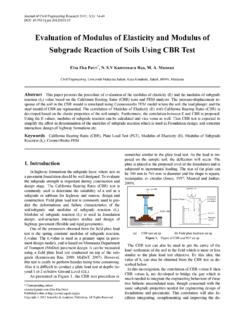
1 Challenge E:Bringing the territories closer together at higher speedsRELATIONSHIP BETWEENTHE SUBGRADE REACTION MODULUSAND THE STRAIN MODULUS OBTAINED USING APLATE LOADING TESTDaeSang Kim1,SeongYongPark2 Biography of 1 FirstName : DaeSang Family Name : KimAffiliation :Principal Researcher, Director of Vehicle and Track Research Division,Korea RailroadResearch Institute, #360-1, Woram-dong, Uiwang-si, Gyeonggi-do, 437-757, 2 FirstName : SeongYong Family Name : ParkAffiliation : Senior Researcher, Hanwha ResearchInstitute of Technology, Hanwha Engineering &Construction,#6 Shinshung-dong,Yousung-gu,Daejeon,305-80 4, KoreaABSTRACT: Plate loading tests (PLTs)have been used to evaluate the compaction quality oftherailroad SUBGRADE in Korea.
2 Two methods to determine the design modulus are being used together;one is an unrepetitive plate loading test (uPLT) that obtains the SUBGRADE reaction modulus (K30) andthe other is a repetitive plate loading test (rPLT) that obtains the strain modulus (Ev). There are somedifferences BETWEEN the two methods, such as,the wayin whichthe design modulusis evaluated, thenumber of loading steps, and the test procedures. Firstly, this paper comparesthetwo test methodsand summarizes the differences BETWEEN them. Secondly, the RELATIONSHIP betweenthetwo moduliwas obtained by usingthe results of30field testsofuPLT testandrPLT testcarried out on thesubgrade under railroad comparisons show thatthetwo tests give large differencesin stress-displacement RELATIONSHIP andthat thecorrelations betweenthetwo moduli didn'tindicateagoodrelationship.
3 Consequently, itwasfound that corrections of twothemoduli for stress and strainlevel are needed to evaluate the RELATIONSHIP betweenthetwo moduli,becausethestress and strainlevel are different whenK30andEv2areevaluated. Therefore,iftherelationship betweenthetwomoduli is developed from the correction procedure, itwillhelp field engineers inthemanagement ofcompaction controlforrailway :Railroad SUBGRADE ,plate loading test (PLT), compaction control, strain modulus, subgradereaction modulus, high-speed railroad withaconcrete slab track systemwasconstructedfrom Daegu to Busan inKorea.
4 The concrete slab track isconsideredto bearelativelymaintenance-free trackconstructionandin Koreathereisamoveawayfromthe use ofballasted track towardthe use ofconcrete slabtrack, for mainline railway track systems. However, in spite ofthemany advantages of concrete slabtrack,ithas asignificantlimitationonthepermittedresi dual settlementoftheembankment(or sub-grade)after construction,comparedtoballasted settlementswill result ina largemaintenancecostfor theconcreteslabtrack,if the track , thebest way to minimize maintenanceoftheslab track,is to controltheresidual settlement below sometolerable level after do so,it is necessaryto control the SUBGRADE qualitybymaintaining a highdensity.
5 However, it is not easy to control the SUBGRADE density during construction,owing to the variable nature of the soil fill and the compaction effort the bestapproach isto useaplate loading test (PLT)toguaranteethesubgrade quality to some are several methods for evaluatingthebearing capacity of foundations. The PLT is one of themost popular methods of evaluating bearing capacity. It is classified depending on the wayin whichthe test isperformed. We could get different moduli according to the test methods. The subgradereaction modulus (K30) obtained from theuPLT testhas been popularforuse recently,the strain modulus (Ev) was newlyintroducedfromEuropeto evaluatethebearing capacityduringrailroad construction.
6 The Koreanstandardspecifies theuse of bothmodulifordemonstratingcompliance with thedesign , it is verybeneficialforKoreato compare the twomoduli andto establish therelationships BETWEEN E:Bringing the territories closer together at higher OF Loading Test(uPLT)The uPLTtestconsists of applying a static load in uniform increments on a circular plate that is inclose contact with the surface to be tested and measuringthedeflection for each load increment. Inthe uPLTtest, a major portion of the total deformation occurs within a depth that is two times thediameter of the plate, as schematically shown in Fig.
7 1 (Ping and Ge, 1997). From the relationshipbetween the average normal stress and the settlement of the plate, the stiffness of the soil isdetermined as the gradient of the secant line at the point corresponding to of settlement. TheuPLTtestuses three plate diametersfor testing, 30cm, 40cmand75cm, and a 35 kPa load incrementforeach loadstep ofthetest (KSF 2310).The SUBGRADE reaction modulusK30(having 30cm diameter)is calculated using the following equation:030Ks (ats= mm)(1) 0= pressure on circular plateB=platediameters= surface deformation(a) Major deformation elementin a PLT(Ping and Ge, 1997)(b) Definition of the SUBGRADE reaction modulus (K)Fig.
8 1 Schematic diagram of a PLT : (a) Major deformation element in a PLT (Ping and Ge, 1997), (b)Definition of the SUBGRADE reaction modulus(K)Here,0 represents the average normal stress andsdenotes the settlement of the loading and Goodier(1951)make a stress-settlement relation expressed asEq.(2). Thisequation wasbased onthe Boussinesq theory(1885), which defines the RELATIONSHIP BETWEEN thesettlement of a smooth, rigid circular footing and normal stress applying on a homogeneous (1)2srEs (2)whereEs= elastic modulus;0 =average normal stress;r= radius of the plate;s=settlementofthe plate associated with the pressure; and = Poisson s Plate Loading Test (rPLT)The rPLTtestuses the same circular plate as the uPLTtest.
9 However, there are differencesinthe,number of loading cycles, maximum loading, load incrementandsteps,loading time for each step,andthe way to determinethe modulus. The uPLTtesthas only one loading stage, whereas the rPLTtesthas two loadingstagesand one unloading stage. The rPLTtesthasashort test timeowing totheloading time ineachloadingstagebeingless than one minute. TheloadincrementoftherPLTtestforoneloads tep is 80 to 90 kPa with a maximum normal stress of 500 kPacomparedwith 35kPaforoneload s 0 0Ks (s= mm)Challenge E:Bringing the territories closer together at higher speedsFig.
10 2 shows a typical normal stress-settlement curve obtained from the rPLTtest. The uPLTtesthas only one loading stage, whereas the rPLTtesthas the sequence of plasticsettlementwas not recovered during the unloading stageandis relativelybigger thanthe permanent plastic settlementin the second loading , thetest methodof therPLT testmakes it possible to accurately obtain the elastic deformation modulus by minimizingtheplastic other big difference betweenthetwo test methods isthe methodto obtainthestrain moduli(Ev1andEv2) in the first and second loading stageof therPLT testuses a fitting method,whereas theuPLT testusesa secant the fitting method, thesettlement, s, can beexpressed by the quadratic form of normal stress,0 , as in Eq.