Transcription of Relaxation Exercises - Students
1 Relaxation Exercises The ability to fully relax and calm one's mind and body is crucial and is the foundation of any program undertaken to overcome anxiety, phobias, panic, and stress related disorders. Relaxation is more than just sitting in front of the TV or in the bathtub. These activities may be relaxing, but they don't make as profound a difference in dealing with anxiety as regular, daily, active, deep muscle Relaxation . As stated in the text, The Anxiety and Phobia Workbook, by Edmond J. Bourne, PhD: "Deep Relaxation refers to a distinct physiological state that is the exact opposite of the way your body reacts under stress or during a panic attack. ( Relaxation ) involves a series of physiological changes including the following: o Decrease in heart rate o Decrease in respiration rate o Decrease in blood pressure o Decrease in skeletal muscle tension o Decrease in metabolic rate and oxygen consumption o Decrease in analytical thinking o Increase in skin resistance o Increase in alpha wave activity in the brain "Regular practice of deep Relaxation for 20-30 minutes on a daily basis can produce over time, a generalization of Relaxation to the rest of your life.
2 That is, after several weeks of practicing deep Relaxation once per day, you will tend to feel more relaxed all the time." "Numerous other benefits of deep Relaxation have been documented over the past 20 years. These include [the following]: o Reduction of generalized anxiety and frequency and severity of panic attacks o Preventing stress from becoming cumulative. o Increased energy level and productivity o Improved concentration and memory. o Reduction of insomnia and fatigue. o Prevention and/or reduction of psychosomatic disorders such as hypertension, migraines, headaches, asthma, ulcers, and so on. o Increased self-confidence and reduced self-blame. For many people, stress and excessive self-criticism or feelings of inadequacy go hand in hand.
3 You can perform better, as well as feel better, when you are relaxed. o Increased availability of feelings. Muscle tension is one of the chief impediments to an awareness of your feelings." I have found that the text cited above, The Anxiety and Phobia Workbook, by Edmond J. Bourne, is a tremendous source for further information about Relaxation , stress management and numerous other practices to help people feel better overall. When I work with Students for issues relating to an inability to fully relax (test anxiety, stress-related symptoms, difficulty sleeping, panic disorder) I ask each student to bring in a blank cassette tape. What I then do is record for him or her the following Relaxation script.
4 I have found that when the student has the convenience to plop a pre-made tape into a recorder, he or she is much more likely to begin practicing Relaxation Exercises . The recording that I make is a very basic breathing, Relaxation and visualization recording. The whole exercise takes about 25 minutes. I encourage you to read through the following script to get an idea of the simplicity of such Exercises . If you would like to record a tape for yourself, please go right ahead! You can download the script from our website at or come by our office to pick up a recorded CD, Joyce Thomas, Director of Counseling located in the Information Commons West, room 219. You may also wish to visit any bookstore and take a look at all of the Relaxation tapes that can be found in the self-help sections.
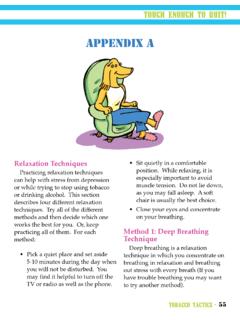
5 There are so many different forms of Relaxation , and there may be one that you would prefer trying. No matter what you prefer, DO SOMETHING toward making Relaxation a regular part of your daily life. When doing any Relaxation Exercises be sure to do the following: 1. Find a quiet location, where you won't be distracted for the full length of your Relaxation practice. 2. Initially, you will need to practice Relaxation every day for at least twenty minutes per day. 3. Try and practice on an empty stomach since Relaxation can be disrupted by food digestion. 4. Get into a comfortable position. You do not have to lie down, but you do want to be sure that your whole body is supported and that you have ample space to move all parts of your body.
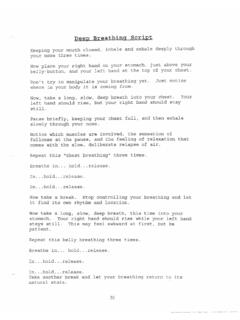
6 5. Loosen tight clothing 6. "Assume a passive, detached attitude." "Be here now." If your mind wanders, gently bring it back to the here and now. Deep Abdominal Breathing Exercises 1. Become aware of the level of tension you're feeling in your body. Place one hand on your abdomen right beneath your rib cage. 2. Inhale slowly and deeply through your nose into the "bottom" of your lungs---in other words, send the air as low down as you can. If you're breathing from your abdomen, your hand should actually rise. And your chest should move only slightly. Another way to think of it is "belly breathing" or "happy baby breathing." 3. When you've taken in a full breath, pause for a moment and then exhale SLOWLY through your nose or mouth, depending on your preference.
7 Be sure to exhale fully. 4. As you exhale, allow your whole body to just let go (you might visualize your arms and legs going loose and limp like a rag doll). 5. Do ten slow, full, abdominal breaths. Try to keep your breathing smooth and regular, without gulping in a big breath or letting your breath out all at once. Remember to pause briefly at the end of each inhalation. Count to ten, progressing with each exhalation. If you start to feel light-headed while practicing abdominal breathing, stop for thirty seconds, and then start up again. 6. Extend the exercise if you wish by doing two or three "sets" of abdominal breaths, remembering to count up to ten for each set. Five full minutes of abdominal breathing will have a pronounced effect in reducing anxiety or early symptoms of panic.
8 7. Another short exercise you may wish to try is the following breathing/visualization exercise : "Think about your breathing. Notice the passage of air through your nose, into your lungs, the swelling of your chest. Forget all else; consider only the air and the quiet. As you breathe out, feel the air flow gently over your lips; imagine it moving a feather softly and gently. You are your breathing, forget all else. Concentrate on the breath moving easily in and out. You have nothing to do but breathe, and feel the air refreshing you." Progressive Muscle Relaxation 1. If you are doing the progressive muscle Relaxation exercise separate from the deep breathing exercise above, please begin by taking three, deep abdominal breaths, exhaling slowly each time.
9 As you exhale, imagine that tension throughout your body begins to flow away. 2. Clench your fists. Hold (7-10 seconds) and then release (15-20 seconds). Use these same time intervals for all other muscle groups. When tightening a particular muscle group, do so vigorously, without straining. When you release your muscle group, do so abruptly and feel the sensation of Relaxation in that particular muscle group.) 3. Tighten your biceps by drawing your forearms up toward your shoulders and "making a muscle" with both arms. Hold and then relax. 4. Tighten your triceps - the muscles on the undersides of your upper arms - by extending your arms out straight and locking your elbows. Hold and then relax.
10 5. Tense the muscles in your forehead by raising your eyebrows as far as you can. Hold and then relax. Imagine your forehead muscles becoming smooth and limp as they relax. 6. Tense the muscles around your eyes by clenching your eyelids tightly shut. Hold and then relax. Imagine sensations of deep Relaxation spreading all around the area of your eyes. 7. Tighten your jaws by opening your mouth so widely that you stretch the muscles around the hinges of your jaw. Hold and then relax. Let your lips part and allow your jaw to hang loose. 8. Tighten the muscles in the back of your neck by pulling your head way back, as if you were going to touch your head to your back (be gentle with this muscle group to avoid injury).