Example: tourism industry
Remainder Theorem and Factor Theorem - mrsk.ca
Remainder Theorem and Factor Theorem Remainder Theorem: When a polynomial f (x) is divided by x − a, the remainder is f (a)1. Find the remainder when 2x3+3x2 −17 x −30 is divided by each of the following: (a) x −1 (b) x − 2 (c) x −3 (d) x +1 (e) x + 2 (f) x + 3 Factor Theorem: If x = a is substituted into a polynomial for x, and the remainder is 0, then x − a is a factor of the ...
Tags:
Information
Domain:
Source:
Link to this page:
Documents from same domain
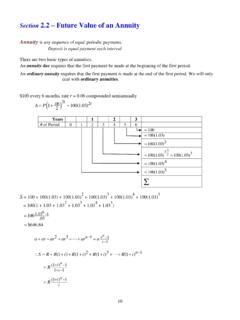
Section 2.2 Future Value of an Annuity - mrsk.ca
mrsk.ca10 Section 2.2 – Future Value of an Annuity Annuity is any sequence of equal periodic payments. Deposit is equal payment each interval There are two basic types of annuities. An annuity due requires that the first payment be made at the beginning of the first period. An ordinary annuity requires that the first payment is made at the end of the …
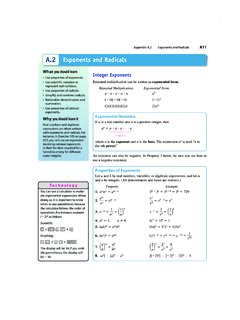
A.2 Exponents and Radicals - mrsk.ca
mrsk.caThe properties of exponents listed on the preceding page apply to all integers and not just to positive integers as shown in the examples in this section. Using Properties of Exponents

Function Inverses Date Period - mrsk.ca
mrsk.caKuta Software - Infinite Algebra 2 Name_____ Function Inverses Date_____ Period____ State if the given functions are inverses.

Section 2.2 Arc Length and Sector Area
mrsk.ca16 Exercises Section 2.2 – Arc Length and Sector Area 1. The minute hand of a clock is 1.2 cm long. How far does the tip of the minute hand travel in 40 minutes? 2. Find the radian measure if angle , if is a central angle in a circle of radius r = 4 inches, …

Section 2.3 Solving Right Triangle Trigonometry
mrsk.ca13 Section 2.3 – Solving Right Triangle Trigonometry Example In the right triangle ABC, A = 40 and c = 12 cm. Find a, b, and B. Solution 12 0 aa c a 0 7cm 0 b c 12 b b 0 2cm B = 90 - A = 90 - 40 50 Example A circle has its center at C and a radius of 18 inches. If triangle ADC is a right triangle and A = 35 . Find x, the distance from A to B.

angular velocity - mrsk.ca
mrsk.ca22 Angular Speed Definition If P is a point moving with uniform circular motion on a circle of radius r, and the line from the center of the circle through P sweeps out a central angle in an amount of time t, then the angular velocity, (omega), of P is given by the formula t n s Example A point on a circle rotates through 3 4 radians in 3 sec. Give the angular velocity of the point.
Related documents
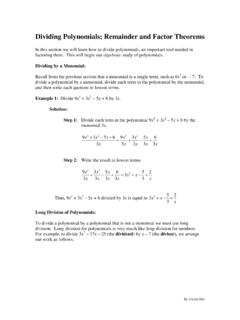
Dividing Polynomials; Remainder and Factor Theorems
www.alamo.eduThe Remainder and Factor Theorems: Synthetic division can be used to find the values of polynomials in a sometimes easier way than substitution. This is shown by the next theorem. If the polynomial P(x) is divided by x – c, then the remainder is the value P(c). Example 5: Use synthetic division and the Remainder Theorem to evaluate P(c) if

11.Remainder and Factor Theorem (A)
irp-cdn.multiscreensite.comremainder and factor theorems to factorise and to solve polynomials that are of degree higher than 2. Before doing so, let us review the meaning of basic terms in division. Terms in division We are familiar with division in arithmetic. The number that is to be divided is called the dividend. The dividend is divided by the divisor.
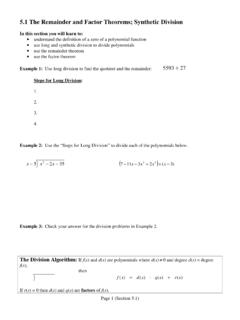
5.1 The Remainder and Factor Theorems.doc; Synthetic …
users.math.msu.eduPage 2 (Section 5.1) Example 4: Perform the operation below. Write the remainder as a rational expression (remainder/divisor). 2 1 2 8 2 3 5 4 3 2 + − + + x x x x x Synthetic Division – Generally used for “short” division of polynomials when the divisor is in the form x – c. (Refer to page 506 in your textbook for more examples.)
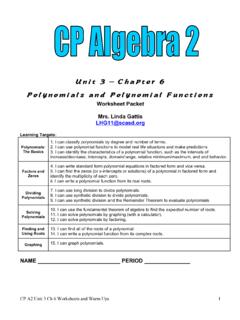
Unit 3 Chapter 6 Polynomials and Polynomial Functions
www.scasd.orgLT 7. I can use long division to divide polynomials. LT 8. I can use synthetic division to divide polynomials. LT 9. I can use synthetic division and the Remainder Theorem to evaluate polynomials. WS# 7 Practice 6-3 Dividing Polynomials Divide using long division. Check your answers. 19. (x2 − 13x − 48) ÷ (x + 3) 20. (2x2 + x − 7) ÷ (x ...
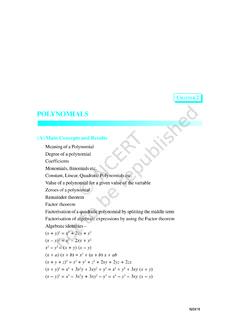
POLYNOMIALS - NCERT
ncert.nic.inConstant, Linear, Quadratic Polynomials etc. Value of a polynomial for a given value of the variable Zeroes of a polynomial Remainder theorem Factor theorem Factorisation of a quadratic polynomial by splitting the middle term Factorisation of algebraic expressions by using the Factor theorem Algebraic identities – (x + y)2 = x2 + 2xy + y2
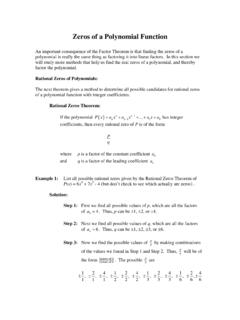
Zeros of a Polynomial Function - Alamo Colleges District
www.alamo.eduremainder is 0, note the quotient you have obtained. 3. Repeat: Repeat Steps 1 and 2 for the quotient. Stop when you reach a quotient that is quadratic or factors easily, and use the quadratic formula or factor to find the remaining zeros. Example 2: Find all real zeros of the polynomial P(x) = 2x4 + x3 – 6x2 – 7x – 2. Solution:

Cyclic Redundancy Code (CRC) Polynomial Selection For ...
users.ece.cmu.edupolynomials are so that they can be used by new applica-tions and emerging standards. 3. Previous work Previous published work on CRC effectiveness has been limitedby the computationalcomplexityof determin-ing the weights of various polynomials. Only a few de-tailed surveys of polynomials have been published.

POLYNOMIALS - NCERT
ncert.nic.inPOLYNOMIALS 31 Now observe the polynomials p(x) = 4x + 5, q(y) = 2y, r(t) = t + 2 and s(u) = 3 – u.Do you see anything common among all of them? The degree of each of these polynomials is one. A polynomial of degree one is called a linear polynomial. Some more linear polynomials in one variable are 2 x – 1, 2 y + 1, 2 – u.Now , try and