Example: stock market
POLYNOMIALS - NCERT
Constant, Linear, Quadratic Polynomials etc. Value of a polynomial for a given value of the variable Zeroes of a polynomial Remainder theorem Factor theorem Factorisation of a quadratic polynomial by splitting the middle term Factorisation of algebraic expressions by using the Factor theorem Algebraic identities – (x + y)2 = x2 + 2xy + y2
Tags:
Information
Domain:
Source:
Link to this page:
Documents from same domain
ntse exam notification - National Council Of …
ncert.nic.inExamination: The tentative pattern of written examination will be as follows: Stage-I & Il : examination at the State/UT level will comprise of three papers i.e.
14 Effects Electric Current and Its - National …
ncert.nic.in76 EXEMPLAR PROBLEMS 3. Three bulbs A, B, C are connected in a circuit as shown in Figure 14.2. When the switch is ‘ON’ (a) bulb C will glow first. (b) bulb B and C will glow simulaneously and bulb A will
SEMICONDUCTOR AND SIMPLE CIRCUITSnot to be …
ncert.nic.in469 Semiconductor Electronics: Materials, Devices and Simple Circuits semiconductors. However , after 1990, a few semiconductor devices using organic semiconductors and semiconducting polymers have been
ENVIRONMENTAL CHEMISTRY - National Council …
ncert.nic.in400 CHEMISTRY (c) Hydrocarbons: Hydrocarbons are composed of hydrogen and carbon only and are formed by incomplete combustion of fuel …
LAWS OF MOTION
ncert.nic.inLAWS OF MOTION 91 In practice, the ball does come to a stop after moving a finite distance on the horizontal plane, because of the opposing force of friction which
DESIGN OF THE QUESTION PAPER Mathematics …
ncert.nic.inDESIGN OF THE QUESTION PAPER, SET-I 207 (A) 18 5 (B) 17 5 (C) 17 8 (D) 1 7. In the adjoining figure, PA and PB are tangents from a point P to a circle with centre O.
CHAPTER 10
ncert.nic.in(A) Main Concepts and Results Circle, radius, diameter , chord, segment, cyclic quadrilateral. • Equal chords of a circle (or of congruent circles) subtend equal angles at the
INDIA : CLIMATE, VEGETATION AND WILDLIFE
ncert.nic.inINDIA : CLIMATE, VEGETATION AND WILDLIFE 59 year. Therefore, they always appear gr een and are called evergreen forest as you may notice in Figure
Objectives Polymers - National Council of …
ncert.nic.in427 Polymers C:\Chemistry-12\Unit-15.pmd 28.02.07 Polymers can also be classified on the basis of mode of polymerisation into two sub groups.
TEXTBOOK IN GEOGRAPHY FOR CLASS IX
ncert.nic.inFOREWORD The National Curriculum Framework, (NCF) 2005, recommends that children’s life at school must be linked to their life outside the school. This principle
Related documents
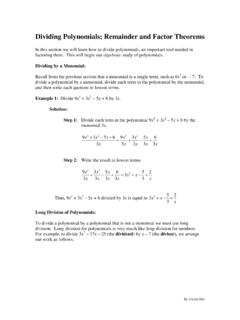
Dividing Polynomials; Remainder and Factor Theorems
www.alamo.eduThe Remainder and Factor Theorems: Synthetic division can be used to find the values of polynomials in a sometimes easier way than substitution. This is shown by the next theorem. If the polynomial P(x) is divided by x – c, then the remainder is the value P(c). Example 5: Use synthetic division and the Remainder Theorem to evaluate P(c) if

11.Remainder and Factor Theorem (A)
irp-cdn.multiscreensite.comremainder and factor theorems to factorise and to solve polynomials that are of degree higher than 2. Before doing so, let us review the meaning of basic terms in division. Terms in division We are familiar with division in arithmetic. The number that is to be divided is called the dividend. The dividend is divided by the divisor.
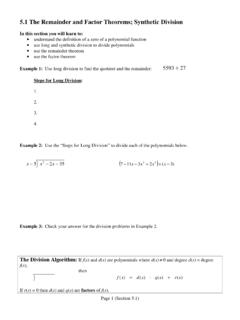
5.1 The Remainder and Factor Theorems.doc; Synthetic …
users.math.msu.eduPage 2 (Section 5.1) Example 4: Perform the operation below. Write the remainder as a rational expression (remainder/divisor). 2 1 2 8 2 3 5 4 3 2 + − + + x x x x x Synthetic Division – Generally used for “short” division of polynomials when the divisor is in the form x – c. (Refer to page 506 in your textbook for more examples.)
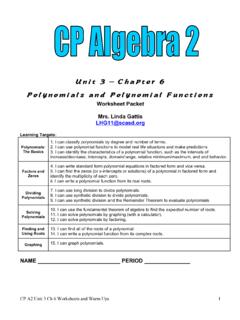
Unit 3 Chapter 6 Polynomials and Polynomial Functions
www.scasd.orgLT 7. I can use long division to divide polynomials. LT 8. I can use synthetic division to divide polynomials. LT 9. I can use synthetic division and the Remainder Theorem to evaluate polynomials. WS# 7 Practice 6-3 Dividing Polynomials Divide using long division. Check your answers. 19. (x2 − 13x − 48) ÷ (x + 3) 20. (2x2 + x − 7) ÷ (x ...
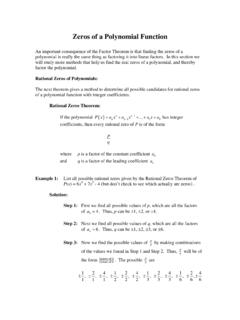
Zeros of a Polynomial Function - Alamo Colleges District
www.alamo.eduremainder is 0, note the quotient you have obtained. 3. Repeat: Repeat Steps 1 and 2 for the quotient. Stop when you reach a quotient that is quadratic or factors easily, and use the quadratic formula or factor to find the remaining zeros. Example 2: Find all real zeros of the polynomial P(x) = 2x4 + x3 – 6x2 – 7x – 2. Solution:

Remainder Theorem and Factor Theorem - mrsk.ca
mrsk.caRemainder Theorem and Factor Theorem Remainder Theorem: When a polynomial f (x) is divided by x − a, the remainder is f (a)1. Find the remainder when 2x3+3x2 −17 x −30 is divided by each of the following: (a) x −1 (b) x − 2 (c) x −3 (d) x +1 (e) x + 2 (f) x + 3 Factor Theorem: If x = a is substituted into a polynomial for x, and the remainder is 0, then x − a is a factor of the ...

Cyclic Redundancy Code (CRC) Polynomial Selection For ...
users.ece.cmu.edupolynomials are so that they can be used by new applica-tions and emerging standards. 3. Previous work Previous published work on CRC effectiveness has been limitedby the computationalcomplexityof determin-ing the weights of various polynomials. Only a few de-tailed surveys of polynomials have been published.

POLYNOMIALS - NCERT
ncert.nic.inPOLYNOMIALS 31 Now observe the polynomials p(x) = 4x + 5, q(y) = 2y, r(t) = t + 2 and s(u) = 3 – u.Do you see anything common among all of them? The degree of each of these polynomials is one. A polynomial of degree one is called a linear polynomial. Some more linear polynomials in one variable are 2 x – 1, 2 y + 1, 2 – u.Now , try and