Transcription of Respiratory assist device (RAD) coverage guidelines
1 Respiratory assist device (RAD) coverage guidelinesMedicare revision effective date: January 1, coverage (first 3 months of therapy)MEDICAL RECORDS* document: Symptoms characteristic of sleep-associated hypoventilation ( daytime hypersomnolence, excessive fatigue, morning headache, cognitive dysfunction, dyspnea, etc.) and Patient meets all coverage criteria for one (1) of the following disorders:Documentation of a neuromuscular disease ( amyotrophic lateral sclerosis) or a severe thoracic cage abnormality ( post-thoracoplasty for tuberculosis [TB]).One of the following: Arterial blood gas (ABG) PaC02, done while awake and breathing the usual Fi02 is 45 mm Hg. Sleep oximetry demonstrates oxygen saturation 88% for 5 minutes of nocturnal recording time (minimum recording time of 2 hours), done while breathing the patient s prescribed recommended FiO2.
2 For neuromuscular disease only, maximal inspiratory pressure is < 60 cm H2O, or forced vital capacity (FVC) is < 50% obstructive pulmonary disease (COPD) does not contribute significantly to patient s pulmonary or E0471 Based on the treating physician s judgmentI. Restrictive thoracic disordersABG PaC02 is 52 mm Hg while patient is awake and breathing the prescribed oximetry study demonstrates oxygen saturation 88% for 5 cumulative minutes of nocturnal recording time (minimum recording time of 2 hours), done while breathing oxygen at 2 liters per minute (LPM) or the patient s usual FiO2 (whichever is higher).Prior to initiating therapy, sleep apnea and treatment with CPAP has been considered and ruled out. (Note: Formal sleep testing is not required if there is sufficient information in the medical record to demonstrate that the patient does not suffer from some form of sleep apnea [obstructive sleep apnea (OSA), central sleep apnea (CSA) and/or complex sleep apnea (CompSA)] as the predominant cause of awake hypercapnia or nocturnal arterial oxygen desaturation).
3 E0470II. Severe COPDORS ituation 1 An E0471 started any time after a period of initial use of E0470 is covered if: An ABG PaCO2, done while awake and breathing the patient s prescribed FiO2, shows the patient s PaCO2 worsens 7mm Hg compared to original result above, and A facility-based polysomnogram (PSG) demonstrates oxygen saturation 88% for 5 cumulative minutes of nocturnal recording time (minimum recording time of 2 hours) while using an E0470 that is not caused by obstructive upper airway events (apnea hypopnea index [AHI] < 5).Situation 2 An E0471 will be covered no sooner than 61 days after initial issue of the E0470 if: An ABG PaCO2 is done while awake and breathing the patient s prescribed FiO2, still remains 52 mm Hg, and Sleep oximetry while breathing with the E0470 demonstrates oxygen saturation 88% for 5 cumulative minutes of nocturnal recording time (minimum recording time of 2 hours), done while breathing oxygen at 2 LPM or the patient s prescribed FiO2 (whichever is higher).
4 E0471* The patient s medical records include the physician s office records, hospital records, nursing home records, home health agency records, records from other healthcare professionals and test reportsE0471An initial ABG PaCO2, done while awake and breathing the patient s prescribed FIO2, is 45 mm HgSpirometry shows an FEV1/FVC 70% An ABGs PaCO2, done during sleep or immediately upon awakening, and while breathing the patient s prescribed FiO2, shows the patient s PaCO2 worsened 7mm Hg compared to the original result, or A facility-based PSG or home sleep testing (HST)* demonstrates oxygen saturation 88% for 5 minutes of nocturnal recording (minimum recording time of 2 hours) that is not caused by obstructive upper airway events (AHI < 5).E0470 III. Central or complex sleep apneaPrior to initiating therapy, a complete facility-based, attended PSG was performed documenting.
5 Diagnosis of either CSA or CompSA, and Significant improvement of the sleep-associated hypoventilation with use of an E0470 or E0471 on the settings the physician prescribed for initial use at home while breathing the usual HypoventilationE0470 or E0471 Based on the treating physician s judgmentCovered E0470 is being usedSpirometry shows an FEV1/FVC 70% An ABGs PaCO2, done while awake and breathing the patient s prescribed FiO2, shows the patient s PaCO2 worsens 7 mm Hg compared to the ABG result performed to qualify the patient for the E0470 device , or A facility-based PSG or HST* demonstrates oxygen saturation 88% for 5 minutes of nocturnal recording time (minimum recording time of 2 hours) that is not caused by obstructive upper airway events (AHI < 5 while using an E0470).Continued coverage (beyond the first 3 months of therapy)MEDICAL RECORDS document: Patient was re-evaluated by the treating physician on/after the 61st day of therapy Progress of relevant symptoms Patient usage of the device (average 4 hours per 24 hours)and SUPPLIER RECORDS documentation includes: Signed and dated physician statement completed no sooner than 61 days after initiating use of the device declaring: Patient is consistently using device an average of 4 hours per 24 hour period, and Patient is benefiting from its use.
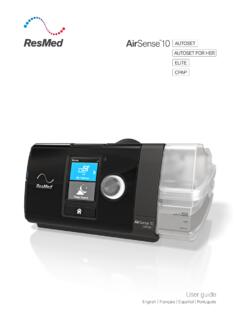
6 * Not all types of HST are appropriate for the evaluation of CSA or CompSA as necessary parameters are not monitored The patient s medical records include the physician s office records, hospital records, nursing home records, home health agency records, records from other healthcare professionals and test reports The signed physician statement must be obtained and kept on file by the supplierResMed E0470 and E0471 DevicesE0470 Bilevel without a backup rate: AirCurve 10 VAuto AirCurve 10 S S9 VPAP COPDE0471 Bilevel with a backup rate: AirCurve 10 ST AirCurve 10 ASV AirCurve 10 ST-A Stellar The reimbursement information is being provided on an as is basis with no express or implied warranty of any kind and should be used solely for your internal informational purposes only. The information does not constitute professional or legal advice on reimbursement and should be used at your sole liability and discretion.
7 All coding, coverage policies and reimbursement information are subject to change without notice. ResMed does not represent or warrant that any of the information being provided is true or correct, and you agree to hold ResMed harmless in the event of any loss, damage, liabilities or claims arising from the use of the reimbursement information provided to you. Before filing any claims, it is the provider s sole responsibility to verify current requirements and policies with the The fractional concentration of oxygen delivered to the beneficiary for inspiration. The beneficiary s prescribed FiO2 refers to the oxygen concentration the beneficiary normally breathes when not undergoing testing to qualify for coverage of a Respiratory assist device (RAD). That is, if the beneficiary does not normally use supplemental oxygen, their prescribed FiO2 is that found in room air.
8 FEV1. Forced expired volume in 1 second. CSA. Central Sleep Apnea is defined by all of the following: 1. An apnea-hypopnea index (AHI) greater than or equal to 5; and 2. The sum total of central apneas plus central hypopneas is greater than 50% of the total apneas and hypopneas; and 3. A central apnea central hypopnea index (CAHI) is greater than or equal to 5 per hour; and4. The presence of at least one of the following: Difficulty initiating or maintaining sleep, frequent awakenings, or non-restorative sleep Awakening short of breath Sleepiness Snoring Witnessed apnea5. There is no evidence of daytime or nocturnal hypoventilation. CompSA. Complex sleep apnea is a form of central apnea specifically identified by all of the following: 1. With use of a positive airway pressure device without a backup rate (E0601 or E0470), the polysomnogram (PSG) shows a pattern of apneas and hypopneas that demonstrates the persistence or emergence of central apneas or central hypopneas upon exposure to CPAP (E0601) or a bilevel device without backup rate (E0470) device when titrated to the point where obstructive events have been effectively treated (obstructive AHI less than 5 per hour).
9 2. After resolution of the obstructive events, the sum total of central apneas plus central hypopneas is greater than 50% of the total apneas and hypopneas; and 3. After resolution of the obstructive events, a CAHI greater than or equal to 5 per The cessation of airflow for at least 10 seconds. Hypopnea. An abnormal Respiratory event lasting at least 10 seconds associated with at least a 30% reduction in thoracoabdominal movement or airflow as compared to baseline, and with at least a 4% decrease in oxygen saturation. AHI. Apnea hypopnea index and is the average number of episodes of apnea and hypopnea per hour of sleep without the use of a positive airway pressure device . CAHI. Central apnea-central hypopnea index and is the average number of episodes of central apnea and central hypopnea per hour of sleep without the use of a positive airway pressure device .
10 For CompSA, the CAHI is determined during the use of a positive airway pressure device after obstructive events have disappeared. If the AHI or CAHI is calculated based on less than 2 hours of continuous recorded sleep, the total number of recorded events used to calculate the AHI or CAHI must be at least the number of events that would have been required in a 2-hour period ( greater than or equal to 10 events). OSA. Obstructive sleep apnea TB. TuberculosisReference: Centers for Medicare & Medicaid Services. Local coverage Determination (LCD): Respiratory assist Devices (L33800), retrieved Aug 1, 2019 from by ResMed Corp, 9001 Spectrum Center Boulevard, San Diego, CA 92123 USA. (858) 836-5000 or (800) 424-0737 (toll free). See for other ResMed locations worldwide. AirCurve, S9, Stellar and VPAP are trademarks and/or registered trademarks of the ResMed family of companies.