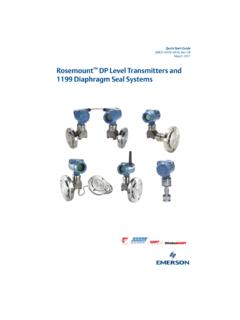
Transcription of Rosemount Annubar® Primary Flow Element Flow Test Data ...
1 Manual 00821-0100-4809, Rev BAJuly 2009 Rosemount Annubar Primary Flow Element Flow Test Data BookRosemount 485 AnnubarRosemount 585 AnnubarReference Manual 00821-0100-4809, Rev BAJuly AnnubarFlow Test Data BookRosemount Annubar Primary Flow Element Flow Test Data sher- Rosemount satisfies all obligations coming from legislation to harmonize product requirements in the European UnionNOTICERead this manual before working with the product. For personal and system safety, and for optimum product performance, make sure to thoroughly understand the contents before installing, using, or maintaining this Central1-800-999-9307 (7:00 to 7:00 CST)National Response Center1-800-654-7768 (24 hours a day)Equipment service needsInternational1-(952) 906-8888 The products described in this document are NOT designed for nuclear-qualified applications.
2 Using non-nuclear qualified products in applications that require nuclear-qualified hardware or products may cause inaccurate readings. For information on Rosemount nuclear-qualified products, contact an Emerson Process Management Sales Manual 00821-0100-4809, Rev BAJuly 2009 TOC-1 Rosemount AnnubarFlow Test Data BookSECTION 1 Annubar TechnologyRosemount Annubar Primary Flow Element ..1-1 Testing..1-1 Mechanical and Structural Testing ..1-2In-House Performance Testing ..1-2 Independent Laboratory Testing ..1-2On-Site Performance tests ..1-2 Rosemount Annubar Flow Element Test Advantages..1-2 SECTION 2 How the Annubar WorksOverview.
3 2-1 Design and Performance ..2-2 Rosemount 485 Annubar Sensor Design ..2-2 Rosemount 585 Annubar Sensor Design ..2-5 SECTION 3 Flow Coefficient Reynolds Number IndependenceFlow Coefficient Overview ..3-1 Benefits..3-1 Rosemount Annubar Reynolds Number Ranges ..3-2 SECTION 4 Annubar Flow TheoryNomenclature ..4-1 Flow Equation Derivation ..4-2 Blockage Equation Derivation..4-3 Conclusion ..4-5 SECTION 5 Test Facilities and ProceduresOverview..5-1 Testing Laboratories ..5-1 Rosemount Boulder, Colorado Flow Laboratory..5-1 Alden Research Laboratories (ARL) ..5-1 SwRI Gas Research Institute (GRI), Meter Research Facility (MRF).
4 5-1 Utah water Research Laboratories (UWRL) ..5-1 Colorado Engineering Experimental Sation Inc (CEESI)..5-1 Gravimetric Procedure ..5-2 Testing Performed by Sensor Size ..5-3485 Sensor Size 1 ..5-4485 Sensor Size 2 ..5-10485 Sensor Size 3 ..5-26585 Sensor Size 11 ..5-28585 Sensor Size 22 ..5-39585 Sensor Size 44 ..5-49 SECTION 6 ReferencesTable of ContentsReference Manual00821-0100-4809, Rev BAJuly 2009 Rosemount Annubar Flow Test Data BookTOC-2 Reference Manual 00821-0100-4809, Rev BAJuly AnnubarFlow Test Data BookSection 1 Annubar TechnologyRosemount Annubar Primary Flow Element .. page 1-1 Rosemount Annubar Flow Element Test Advantages.
5 Page 1-2 The Rosemount Annubar Primary flow Element maintains the traditional strengths of Averaging Pitot Tubes (APTs) with improved performance. The strengths of the Rosemount Annubar include: Low permanent pressure loss A flow coefficient independence of Reynolds number Simple installation, including a gear drive insertion and retraction device The highest signal to noise ratio of any APT (Model 485) 485 Uncalibrated Accuracy: 485 Calibrated Accuracy: up to 585 Uncalibrated Accuracy: 585 Calibrated Accuracy: up to Integral temperature measurement Direct transmitter mounting capabilityROSEMOUNT ANNUBAR Primary FLOW ELEMENTThe Rosemount 485 Annubar Primary flow Element is the fifth generation Annubar.
6 This design is comprised of three separate tubes that are drawn to produce a unique geometrical shape that produces a high and low pressure signal and contains an integral thermowell. The geometry change to the sensor required testing to establish a characterization curve and to determine a new flow Rosemount 585 Annubar Primary flow Element is machined from a single piece of barstock in a diamond shape with sharp edges to produce a flow coefficient that is more linear to Reynold s number than other performed on the Annubar Primary flow elements are divided into five major categories: Research and development testing Mechanical and structural testing In-house performance testing Independent laboratory testing On-site performance testingAll categories are on-going and continue to be a part of the current Emerson test program for the Annubar Primary flow Manual00821-0100-4809, Rev BAJuly 20091-2 Rosemount Annubar Flow Test Data BookMechanical and Structural TestingMaterial and structural testing at.
7 Hauser Laboratories MicroMotion Laboratory Eden Prairie Flow Laboratory In-House Performance TestingHundreds of flow tests were performed in the Emerson flow laboratory in 2-in. to 12-in. pipeline, using independently certified magnetic meters as Primary reference meters. Baseline K-values, signal noise, cavitation, high and low Reynolds number limitations, methods of installations, static modeling, and straight-run requirements are just a few of the in-house performance tests that were performed on the Rosemount Annubar Laboratory TestingRosemount Annubar Primary flow Element models were tested at four independent laboratories: Alden Research Laboratory (ARL) Colorado Engineering Experiment Station, Inc.
8 (CEESI) Southwest Research Institute (SwRI) Utah water Research Lab (UWRL)Certified flow-data sheets were supplied from each of these facilities in pipelines ranging from 2-in. to 24-in. over a wide range of Reynolds numbers. A representative sample of independent tests conducted at Emerson and independent laboratories are Section 5: Test Facilities and Performance TestsEmerson Process Management has a field service department that performs on-site performance tests and in-line calibrations for customers with unique installations or ANNUBAR FLOW Element TEST ADVANTAGESE merson test procedures incorporate the following criteria and advantages: Flow test data were collected over a flow turndown range of 10:1 in most cases All coefficients are (95% confidence) of the published K-value of a particular 485 Annubar flow Element .
9 All coefficients are (95% confidence) of the published K-value of a particular 585 Annubar flow performed mechanical and structural testing485585 Material hardnessXMoments of inertiaXXFatigue lifeXXFluid loading due to lift and drag forcesXStatic bend testsXAllowable stress limitsXXFailure analysisXXVibration analysisXXReference Manual 00821-0100-4809, Rev BAJuly AnnubarFlow Test Data BookSection 2 How the Annubar WorksOverview .. page 2-1 Design and Performance .. page 2-2 OVERVIEWThe Rosemount Annubar Primary flow Element is a device used to measure the flow of a liquid, gas or steam fluid that flows through a pipe.
10 It enables flow measurement by creating a differential pressure (DP) that is proportional to the square of the velocity of the fluid in the pipe, in accordance with Bernoulli's theorem. This DP is measured and converted into a flow rate using a secondary device, such as a DP pressure transmitter. The flow is related to DP through the following 2-1where:Q = Flow RateK = Annubar Flow CoefficientDP = Differential PressureFor a more complete discussion on the flow equation, refer to Section 4: Annubar Flow Annubar generates a DP by creating blockage in the pipe and acting as an obstruction to the fluid. The velocity of the fluid is decreased and stalled as it reaches the front surface the Annubar sensor, creating the impact/high pressure.