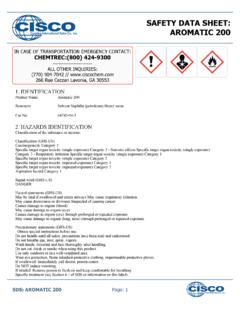
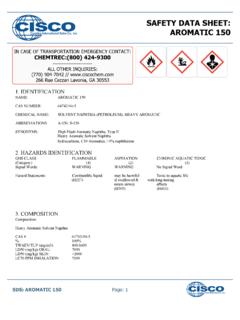
Transcription of SAFETY DATA SHEET: AROMATIC 100
1 SAFETY data sheet : AROMATIC 1001. IDENTIFICATIONCHEMICAL NAME:Solvent Naphtha; Light AromaticProduct Description: AROMATIC HydrocarbonIntended Use: Solvent2. HAZARDS IDENTIFICATIONThis material is considered to be hazardous according to regulatory guidelinesPOTENTIAL PHYSICAL / CHEMICAL EFFECTSC ombustible. Material can release vapors that readily form flammable mixtures. Vapor accumulation could flash and/or explode ifignited. Material can accumulate static charges which may cause an incendiary electrical HEALTH EFFECTSR epeated exposure may cause skin dryness or cracking. If swallowed, may be aspirated and cause lung damage. May be irritating tothe eyes, nose, throat, and lungs. May cause central nervous system HAZARDST oxic to aquatic organisms, may cause long-term adverse effects in the aquatic Hazard ID: Health: 1 Flammability: 2 Reactivity: 0 HMIS Hazard ID: Health: 1 Flammability: 2 Reactivity: 0 NOTE: This material should not be used for any other purpose than the intended use in Section 1 without expert advice.
2 Healthstudies have shown that chemical exposure may cause potential human health risks which may vary from person to COMPOSITIONCHEMICAL NAME CAS NumberConcentration*Solvent Naphtha (Petroleum), Light Aromatic64742-95-6100%Hazardous Constituent(s) Contained in Complex Substance(s)CUMENE98-82-8< (1,2,4-TRIMETHYLBENZENE)95-63-6< < * All concentrations are percent by weight unless material is a gas. Gas concentrations are in percent by volumeIN CASE OF TRANSPORTATION EMERGENCY CONTACT:CHEMTREC:(800) 424-9300-----------------------ALL OTHER INQUIRIES:(770) 904-7042 // Rue Cezzan Lavonia, GA 30553 Page: 1 SDS: AROMATIC 1004. FIRST AID MEASURESINHALATIONR emove from further exposure. For those providing assistance, avoid exposure to yourself or others. Use adequate respiratoryprotection. If respiratory irritation, dizziness, nausea, or unconsciousness occurs, seek immediate medical assistance. If breathinghas stopped, assist ventilation with a mechanical device or use mouth to mouth CONTACTWash contact areas with soap and water.
3 Remove contaminated clothing. Launder contaminated clothing CONTACTF lush thoroughly with water. If irritation occurs, get medical immediate medical attention. Do not induce TO PHYSICIANIf ingested, material may be aspirated into the lungs and cause chemical pneumonitis. Treat FIRE FIGHTING MEASURESEXTINGUISHING MEDIAA ppropriate Extinguishing Media: Use water fog, foam, dry chemical or carbon dioxide (CO2) to extinguish Extinguishing Media: Straight Streams of WaterFIRE FIGHTINGFire Fighting Instructions: Evacuate area. Prevent runoff from fire control or dilution from entering streams, sewers, or drinkingwater supply. Firefighters should use standard protective equipment and in enclosed spaces, self-contained breathing apparatus(SCBA). Use water spray to cool fire exposed surfaces and to protect Fire Hazards: Vapors are flammable and heavier than air. Vapors may travel across the ground and reach remote ignitionsources causing a flashback fire danger.
4 Hazardous material. Firefighters should consider protective equipment indicated in Combustion Products: Oxides of carbon, Incomplete combustion products, Smoke, FumeFLAMMABILITY PROPERTIESF lash Point [Method]: >42C (108F) [ ASTM D-56]Flammable Limits (Approximate volume % in air): LEL: UEL: Temperature: 479 C (894 F)6. ACCIDENTAL RELEASE MEASURESNOTIFICATION PROCEDURESIn the event of a spill or accidental release, notify relevant authorities in accordance with all applicable regulations. In the event of aspill or accidental release, notify relevant authorities in accordance with all applicable regulations. US regulations require reportingreleases of this material to the environment which exceed the applicable reportable quantity or oil spills which could reach anywaterway including intermittent dry creeks. The National Response Center can be reached at (800) MEASURESA void contact with spilled material. Warn or evacuate occupants in surrounding and downwind areas if required due to toxicity orflammability of the material.
5 See Section 5 for fire fighting information. See the Hazard Identification Section for SignificantHazards. See Section 4 for First Aid Advice. See Section 8 for Personal Protective MANAGEMENTPage: 2 SDS: AROMATIC 100 Land Spill: Eliminate all ignition sources (no smoking, flares, sparks or flames in immediate area). Stop leak if you can do it withoutrisk. All equipment used when handling the product must be grounded. Do not touch or walk through spilled material. Prevent entryinto waterways, sewer, basements or confined areas. A vapor suppressing foam may be used to reduce vapors. Use clean non-sparking tools to collect absorbed material. Absorb or cover with dry earth, sand or other non-combustible material and transfer tocontainers. Large Spills: Water spray may reduce vapor; but may not prevent ignition in closed spaces. Recover by pumping or withsuitable Spill: Stop leak if you can do it without risk. Eliminate sources of ignition. Warn other shipping.
6 If the Flash Point exceeds theAmbient Temperature by 10 degrees C or more, use containment booms and remove from the surface by skimming or with suitableabsorbents when conditions permit. If the Flash Point does not exceed the Ambient Air Temperature by at least 10C, use booms as abarrier to protect shorelines and allow material to evaporate. Seek the advice of a specialist before using spill and land spill recommendations are based on the most likely spill scenario for this material; however, geographicconditions, wind, temperature, (and in the case of a water spill) wave and current direction and speed may greatly influence theappropriate action to be taken. For this reason, local experts should be consulted. Note: Local regulations may prescribe or limitaction to be PRECAUTIONSL arge Spills: Dike far ahead of liquid spill for later recovery and disposal. Prevent entry into waterways, sewers, basements orconfined HANDLING AND STORAGEHANDLINGA void contact with skin.
7 Potentially toxic/irritating fumes/vapors may be evolved from heated or agitated material. Use only withadequate ventilation. Use proper bonding and/or grounding procedures. Prevent small spills and leakage to avoid slip can accumulate static charges which may cause an electrical spark (ignition source).Loading/Unloading Temperature: [Ambient ]Transport Temperature: [Ambient ] Transport Pressure: [Ambient ]Static Accumulator: This material is a static container closed. Handle containers with care. Open slowly in order to control possible pressure release. Store in a cool, well-ventilated area. Storage containers should be grounded and bonded. Drums must be grounded and bonded and equipped with self-closing valves, pressure vacuum bungs and flame arresters. Storage Temperature: [Ambient ]Storage Pressure: [Ambient ]Suitable Containers/Packing: Railcars; Tank Trucks; Barges; Drums; TankersSuitable Materials and Coatings: Carbon Steel; Stainless Steel; Copper Bronze; Inorganic Zinc Coatings; EpoxyPhenolic; Polyamide Epoxy; Amine Epoxy; VitonUnsuitable Materials and Coatings: Vinyl Coatings; Butyl Rubber; Natural Rubber; Ethylene-proplyene-diene monomer (EPDM);Polyethylene; Polystyrene; Polypropylene; PVC; Polyacrylonitrile8.
8 EXPOSURE CONTROLS AND PERSONAL PROECTIONEXPOSURE LIMIT VALUESE xposure limits/standards (Note: Exposure limits are not additive) SOURCEFORMLIMIT/STANDARDNOTE SOURCECUMENETWA 245 MG/M3 50 PPMSKINOSHA Z1 CUMENETWA 50 PPMN/AACGIHPSEUDOCUMENETWA 25 PPMN/AACGIH(1, )SOLVENT, NAPHTHA (PETROLEUM)Page: 3 SDS: AROMATIC 100 LIGHT AROMATICVAPORRCP-TWA 19 ppm/100 mg/m3 TotalN/A HydrocarbonsXYLENESTWA 435 MG/M3 100 PPMN/AOSHA Z1 XYLENESSTEL 100 PPMN/AACGIHXYLENESTWA 100 PPMN/AACGIHNOTE: Limits/standards shown for guidance only. Follow applicable CONTROLSThe level of protection and types of controls necessary will vary depending upon potential exposure measures to consider:Adequate ventilation should be provided so that exposure limits are not exceeded. Use explosion-proof ventilation PROTECTIONP ersonal protective equipment selections vary based on potential exposure conditions such as applications,handling practices, concentration and ventilation.
9 Information on the selection of protective equipment for use with this material, asprovided below, is based upon intended, normal Protection: If engineering controls do not maintain airborne contaminant concentrations at a level which is adequate toprotect worker health, an approved respirator may be appropriate. Respirator selection, use, and maintenance must be in accordancewith regulatory requirements, if applicable. Types of respirators to be considered for this material include:Half-face filter respiratorFor high airborne concentrations, use an approved supplied-air respirator, operated in positive pressure mode. Supplied airrespirators with an escape bottle may be appropriate when oxygen levels are inadequate, gas/vapor warning properties are poor, or ifair purifying filter capacity/rating may be Protection: Any specific glove information provided is based on published literature and glove manufacturer data . Workconditions can greatly affect glove durability; inspect and replace worn or damaged gloves.
10 The types of gloves to be considered forthis material include:If prolonged or repeated contact is likely, chemical resistant gloves are recommended. If contact with forearms is likely, weargauntlet style Protection: If contact is likely, SAFETY glasses with side shields are and Body Protection: Any specific clothing information provided is based on published literature or manufacturer data . Thetypes of clothing to be considered for this material include:If prolonged or repeated contact is likely, chemical, and oil resistant clothing is Hygiene Measures: Always observe good personal hygiene measures, such as washing after handling the material andbefore eating, drinking, and/or smoking. Routinely wash work clothing and protective equipment to remove contaminants. Discardcontaminated clothing and footwear that cannot be cleaned. Practice good PHYSICAL AND CHEMICAL PROPERTIEST ypical physical and chemical properties are given INFORMATIONPHYSICAL STATELIQUIDFORMCLEARCOLORCOLORLESSODORAR OMATICODOR THRESHOLDN/DIMPORTANT HEALTH, SAFETY , AND ENVIRONMENTAL INFORMATIONR elative Density (at C ): : 4 SDS: AROMATIC 100 Density (at 15 oC): 873 kg/m3 ( lbs/gal, kg/dm3)Flash Point [Method]: >42C (108F) [ ASTM D-56]Flammable Limits (Approximate volume % in air): LEL: UEL: Temperature: 479 C (894 F)Boiling Point / Range: 161C (322F) - 171C (340F)Vapor Density (Air = 1): at 101 kPaVapor Pressure: kPa ( mm Hg) at 20 CEvaporation Rate (n-butyl acetate = 1): pH:Log Pow (n-Octanol/Water Partition Coefficient): N/ASolubility in Water: NegligibleViscosity: cStOTHER INFORMATIONF reezing Point: -14 C (7 F)Melting Point: N/DMolecular Weight 121 Hygroscopic NOCoefficient of Thermal Expansion V/VDEGC10.