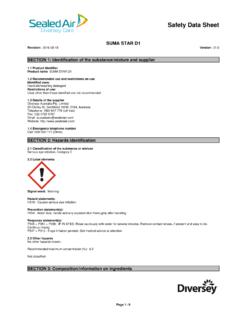
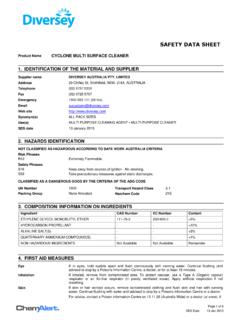
Transcription of Safety Data Sheet - General Sanitation
1 RevealRevision: 2015-04-23 Version: data SheetSECTION 1: Identification of the substance/mixture and supplier Product identifierProduct name: Recommended use and restrictions on useIdentified uses: Floor of use: Uses other than those identified are not Details of the supplierDiversey Australia Pty. Limited29 Chifley St, Smithfield, NSW, 2164, AustraliaTelephone: (02) 9757 0300 Fax: (02) 9725 5767 Email: Emergency telephone numberCall 1800 033 111 (24hrs)SECTION 2: Hazards identification Classification of the substance or mixtureClassified as hazardous according to Safe Work Australia eye damage, Category 1 Skin irritation, Category Label elementsSignal word: DangerHazard statements: H315 - Causes skin - Causes serious eye statement(s): P264 - Wash face, hands and any exposed skin thoroughly after - Wear protective gloves and eye or face 1 / 10 Response statement(s): P302 + P352 - IF ON SKIN: Wash with plenty of soap and + P313 - If skin irritation occurs: Get medical advice or + P351 + P338 - IF IN EYES: Rinse cautiously with water for several minutes.
2 Remove contact lenses, if present and easy to - Immediately call a POISON CENTRE, doctor or - Specific treatment (see supplemental first aid instructions on this label).P362 - Take off contaminated Other hazardsNo other hazards 3: Composition/information on ingredients Safety data Substances / MixturesIngredient(s)CAS numberEC numberClassificationWeight percent2-aminoethanol141-43-5205-483-3 Skin Corr. 1B (H314)Acute Tox. 4 (H302)Acute Tox. 4 (H312)Acute Tox. 4 (H332)STOT SE 3 (H335)Aquatic Chronic 3(H412)3-102-butoxyethanol111-76-2203-90 5-0 Acute Tox. 4 (H302)Acute Tox. 4 (H312)Acute Tox. 4 (H332)Skin Irrit. 2 (H315)Eye Irrit. 2 (H319)1-3sodium xylene sulphonate1300-72-7215-090-9 Eye Irrit. 2 (H319)1-3 Non-hazardous ingredients are the remainder and add up to 100%.Workplace exposure limit(s), if available, are listed in subsection the full text of the H and AUH phrases mentioned in this Section, see Section 4: First aid measures Description of first aid measuresInhalationGet medical attention or advice if you feel contact:Wash skin with plenty of lukewarm, gently flowing water.
3 Take off immediately all contaminatedclothing and wash it before re-use. If skin irritation occurs: Get medical advice or contact:Immediately rinse eyes cautiously with lukewarm water for several minutes. Remove contact lenses,if present and easy to do. Continue rinsing. Immediately call a POISON CENTRE, doctor :Rinse mouth. Immediately drink 1 glass of water. Get medical attention or advice if you feel of first aider:Consider personal protective equipment as indicated in subsection aid facilities: Eyewash facilities should be considered in a workplace where Most important symptoms and effects, both acute and delayedInhalation:No known effects or symptoms in normal contact:Causes contact:Causes severe or permanent :No known effects or symptoms in normal Indication of any immediate medical attention and special treatment neededNo information available on clinical testing and medical monitoring.
4 Specific toxicological information on substances, if available, can be foundin section Information Center: Call 13 11 26 (Australia Wide).SECTION 5: Firefighting measures Extinguishing mediaCarbon dioxide. Dry powder. Water spray jet. Fight larger fires with water spray jet or alcohol-resistant Special hazards arising from the substance or mixtureNo special hazards Advice for firefightersAs in any fire, wear self contained breathing apparatus and suitable protective clothing including gloves and eye/face Hazchem codeNone allocatedSECTION 6: Accidental release measures Personal precautions, protective equipment and emergency proceduresWear suitable gloves and eye/face Environmental precautionsDo not allow to enter drainage system, surface or ground water. Dilute with plenty of Methods and material for containment and cleaning upAbsorb with liquid-binding material (sand, diatomite, universal binders, sawdust).
5 Reference to other sectionsFor personal protective equipment see subsection For disposal considerations see section 2 / 10 Safety data SHEETR evealSECTION 7: Handling and storage Precautions for safe handlingMeasures to prevent fire and explosions:No special precautions required to protect the environment:For environmental exposure controls see subsection on General occupational hygiene:Handle in accordance with good industrial hygiene and Safety practice. Keep away from food, drink and animal feeding stuffs. Do not mix withother products unless adviced by Sealed Air. Wash hands before breaks and at the end of workday. Wash face, hands and any exposed skinthoroughly after handling. Take off immediately all contaminated clothing. Wash contaminated clothing before reuse. Use personal protectiveequipment as required.
6 Avoid contact with skin and eyes. Use only with adequate Conditions for safe storage, including any incompatibilitiesStore in accordance with local and national regulations. Keep only in original container. Store in a closed conditions to avoid see subsection For incompatible materials see subsection Specific end use(s)No specific advice for end use 8: Exposure controls/personal protection Control parametersWorkplace exposure limitsAir limit values, if available:Ingredient(s)Long term value(s)(TWA) Short term value(s)(STEL) Peak value(s) 2-aminoethanol3 mg/m36 ppm15 mg/m32-butoxyethanol20 mg/m350 ppm242 mg/m3 Biological limit values, if Exposure controlsThe following information applies for the uses indicated in subsection available, please refer to the product information Sheet for application and handling use conditions are assumed for this Safety measures for handling the undiluted product:Appropriate engineering controls.
7 No special requirements under normal use organisational controls: Avoid direct contact and/or splashes where possible. Train protective equipment Eye / face protection: Safety glasses or goggles (EN 166).Hand protection: Chemical-resistant protective gloves (EN 374).Verify instructions regarding permeability and breakthrough time, as provided by the specific local use conditions, such as risk of splashes, cuts, contact time and gloves for prolonged contact:Material: butyl rubberPenetration time: >= 480 minMaterial thickness: >= mmSuggested gloves for protection against splashes:Material: nitrile rubberPenetration time: >= 30 minMaterial thickness: >= mmIn consultation with the supplier of protective gloves a different type providing similar protection maybe protection: No special requirements under normal use protection: No special requirements under normal use exposure controls: No special requirements under normal use 9.
8 Physical and chemical properties Page 3 / 10 Safety data Information on basic physical and chemical propertiesPhysical State: LiquidColour: Clear, PurpleOdour: Product specificOdour threshold: Not applicableSolubility in / Miscibility with Water: Fully miscibleDecomposition temperature: Not Other informationSECTION 10: Stability and reactivity ReactivityNo reactivity hazards known under normal storage and use Chemical stabilityStable under normal storage and use Possibility of hazardous reactionsNo hazardous reactions known under normal storage and use Conditions to avoidNone known under normal storage and use Incompatible materialsReacts with Hazardous decomposition productsNone known under normal storage and use 11: Toxicological information Information on toxicological effectsNo data is available on the mixtureSubstance data , where relevant and available, are listed toxicityAcute oral toxicityIngredient(s)Endpoint Value(mg/kg) Species Method Exposuretime (h) 2-aminoethanolLD 501515 RatOECD 401 (EU )-2-butoxyethanolLD 501746 RatMethod not given-sodium xylene sulphonateLD 50> 7200 RatMethod not given-Acute dermal toxicityIngredient(s)Endpoint Value(mg/kg) Species Method Exposuretime (h) 2-aminoethanolLD 501025 RabbitMethod not given-2-butoxyethanolLD 506411 Method not given-sodium xylene sulphonateLD 50> 2000 RabbitMethod not given-Method / remarkpH: 12 (neat)Melting point/freezing point ( C): Not determinedInitial boiling point and boiling range ( C): Not determinedFlash point ( C).
9 Not combustion: Not determinedEvaporation rate: Not determinedFlammability (solid, gas): Not determinedUpper/lower flammability limit (%): Not determinedVapour pressure: Not determinedVapour density: Not determinedRelative density: g/cm (20 C)Autoignition temperature: Not determinedViscosity: Not determinedExplosive properties: Not properties: Not oxidisingSurface tension (N/m): Not determinedPage 4 / 10 Corrosion to metals: Not corrosiveSAFETY data SHEETR evealAcute inhalative toxicityIngredient(s)Endpoint Value(mg/l) Species Method Exposuretime (h) 2-aminoethanolNo mortalityobservedRatNon guideline test62-butoxyethanolLC 50> 2 (mist)RatMethod not given4sodium xylene sulphonateLC 0> (mist)RatMethod not given4 Irritation and corrosivitySkin irritation and corrosivityIngredient(s)Result Species Method Exposure time 2-aminoethanolCorrosiveRabbitOECD 404 (EU )2-butoxyethanolIrritantRabbitMethod not givensodium xylene sulphonateMild irritantRabbitOECD 404 (EU )Eye irritation and corrosivityIngredient(s)Result Species Method Exposure time 2-aminoethanolSevere damageRabbitOECD 405 (EU )2-butoxyethanolIrritantRabbitOECD 405 (EU )sodium xylene sulphonateIrritantRabbitOECD 405 (EU )
10 Respiratory tract irritation and corrosivityIngredient(s)Result Species Method Exposure time 2-aminoethanolIrritating torespiratory tractMethod not given2-butoxyethanolNo data availablesodium xylene sulphonateNo data availableSensitisationSensitisation by skin contactIngredient(s)Result Species Method Exposure time (h) 2-aminoethanolNot sensitisingGuinea pigOECD 406 (EU ) /GPMT-2-butoxyethanolNot sensitisingGuinea pigOECD 406 (EU ) /GPMT-sodium xylene sulphonateNot sensitisingGuinea pigOECD 406 (EU ) /GPMT-Sensitisation by inhalationIngredient(s)Result Species Method Exposure time 2-aminoethanolNo data available-2-butoxyethanolNo data available-sodium xylene sulphonateNo data available-CMR effects (carcinogenicity, mutagenicity and toxicity for reproduction)MutagenicityIngredient(s)Re sult (in-vitro) Method(in-vitro) Result (in-vivo) Method(in-vivo) 2-aminoethanolNo evidence for mutagenicity, negativetest resultsOECD 471 ( ) OECD473 OECD 476(Mouselymphoma)No evidence for mutagenicity, negativetest resultsOECD 474 ( )2-butoxyethanolNo evidence for mutagenicity, negativetest resultsOECD 471 ( )No data availablesodium xylene sulphonateNo data availableNo evidence for mutagenicity, negativetest resultsOECD 474 ( )CarcinogenicityIngredient(s)Effect 2-aminoethanolNo evidence for carcinogenicity, weight-of-evidence2-butoxyethanolNo evidence for carcinogenicity, negative test resultssodium xylene sulphonateNo evidence for carcinogenicity, negative test resultsToxicity for reproductionIngredient(s)Endpoint Specific effect Value(mg/kg bw/d)