Transcription of 0.1N SODIUM THIOSULPHATE (TEST KIT) - General …
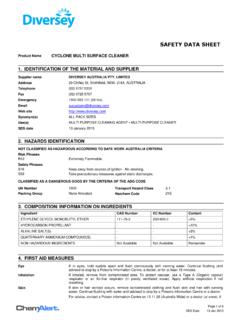
1 1. IDENTIFICATION OF THE MATERIAL AND SUPPLIER29 Chifley St, Smithfield, NSW, AUSTRALIA, 2164(02) 9757 03001800 033 111 (24 hrs)(02) 9725 AUSTRALIA PTY. SODIUM THIOSULPHATE (TEST KIT)TEST REAGENT FOR FIELD TEST SODIUM THIOSULPHATE (TEST KIT)08 Mar 2010 FaxSupplier NameAddressTelephoneEmergencyEmailWeb SiteSynonym(s)Use(s)SDS DateProduct NameNOT CLASSIFIED AS HAZARDOUS ACCORDING TO ASCC CRITERIA2. HAZARDS IDENTIFICATIONNOT CLASSIFIED AS A DANGEROUS GOOD BY THE CRITERIA OF THE ADG CODENone AllocatedNone AllocatedNone AllocatedNone AllocatedNone AllocatedNone AllocatedUN GroupDG ClassHazchem CodeSubsidiary Risk(s)EPG3. COMPOSITION/ INFORMATION ON INGREDIENTSI ngredientFormulaCAS >60% SODIUM THIOSULPHATE (H2-O) in eyes, hold eyelids apart and flush the eye continuously with running water. Continue flushing until advised tostop by a Poisons Information Centre on 13 11 26 (Australia Wide) or a doctor, or for at least 15 skin or hair contact occurs, remove contaminated clothing and flush skin and hair with running water.
2 Continueflushing with water until advised to stop by a Poisons Information Centre on 13 11 26 (Australia Wide) or a inhaled, remove from contaminated area. Apply artificial respiration if not advice, contact a Poisons Information Centre on 13 11 26 (Australia Wide) or a doctor (at once). If swallowed,do not induce to DoctorTreat symptomaticallyFirst Aid FacilitiesEye wash facilities and safety shower should be FIRST AID MEASURESPage 1 of4 Reviewed: 08 Mar 2010 Printed: 10 Mar SODIUM THIOSULPHATE (TEST KIT)Product NameFire andExplosionEvacuate area and contact emergency services. Toxic gases may be evolved in a fire situation. Remain upwindand notify those downwind of hazard. Wear full protective equipment including Self Contained BreathingApparatus (SCBA) when combating fire. Use waterfog to cool intact containers and nearby storage contamination of drains or flammable.
3 May evolve toxic gases (sulphur oxides) when heated to CodeNone Allocated5. FIRE FIGHTING MEASURESS pillageContact emergency services where appropriate. Use personal protective equipment. Clear area of all unprotectedpersonnel. Ventilate area where possible. Contain spillage, then cover / absorb spill with non-combustibleabsorbant material (vermiculite, sand, or similar), collect and place in suitable containers for in a cool, dry, well ventilated area, removed from oxidising agents, acids, active metals, heat or ignitionsources and foodstuffs. Ensure containers are adequately labelled, protected from physical damage and sealedwhen not in use carefully read the product label. Use of safe work practices are recommended to avoid eye or skincontact and inhalation. Observe good personal hygiene, including washing hands before eating.
4 Prohibit eating,drinking and smoking in contaminated ACCIDENTAL RELEASE MEASURES7. STORAGE AND HANDLING8. EXPOSURE CONTROLS/ PERSONAL PROTECTIONE xposure StdsNo exposure standard(s) biological limit LimitsEngineeringControlsAvoid inhalation. Use in well ventilated areas. Where an inhalation risk exists, mechanical extraction ventilation splash-proof goggles and rubber or PVC gloves. When using large quantities or where heavy contaminationis likely, wear: coveralls. In a laboratory situation, wear: a laboratory PHYSICAL AND CHEMICAL PROPERTIESA ppearanceCLEAR COLOURLESS LIQUIDS olubility (Water)SOLUBLEO dourODOURLESSS pecific Gravity1 (Approximately)pH9 (Approximately)% VolatilesNOT AVAILABLEV apour Pressure25 mm Hg @ 20 C (Approximately)FlammabilityNON FLAMMABLEV apour DensityNOT AVAILABLEF lash PointNOT RELEVANTB oiling Point100 C (Approximately)Upper Explosion LimitNOT RELEVANTM elting PointNOT AVAILABLEL ower Explosion LimitNOT RELEVANTE vaporation RateNOT AVAILABLEC hemical StabilityStable under recommended conditions of to AvoidAvoid heat, sparks, open flames and other ignition STABILITY AND REACTIVITYM aterial to AvoidIncompatible with oxidising agents (eg.)
5 Hypochlorites), acids (eg. nitric acid), metals, heat and evolve toxic gases (sulphur oxides) when heated to ReactionsPolymerization is not expected to 2 of4 Reviewed: 08 Mar 2010 Printed: 10 Mar SODIUM THIOSULPHATE (TEST KIT)Product NameHealth HazardSummaryUse safe work practices to avoid eye or skin contact and inhalation. Over exposure may result in may result in irritation, lacrimation, pain and exposure may result in irritation of the nose and throat, with coughing. High level exposure may result indizziness, nausea and headache. Due to the low vapour pressure, an inhalation hazard is not anticipated withnormal may result in irritation, redness, rash and may result in nausea, abdominal pain and DataSODIUM THIOSULPHATE PENTAHYDRATE (10102-17-7) LD50 (Intraperitoneal): 5600 mg/kg (mouse) LD50 (Intravenous): 2350mg/kg (mouse) LDLo (Intravenous): 3000 mg/kg (dog) TDLo (Ingestion): 300mg/kg/7days (human)11.
6 TOXICOLOGICAL INFORMATIONE nvironmentLimited ecotoxicity data was available for this product at the time this report was prepared. Ensure appropriatemeasures are taken to prevent this product from entering the ECOLOGICAL INFORMATIONW aste DisposalFor small amounts absorb with sand, vermiculite or similar and dispose of to an approved landfill site. Contact themanufacturer for additional information if larger amounts are involved. Prevent contamination of drains andwaterways as aquatic life may be threatened and environmental damage may of in accordance with relevant local DISPOSAL CONSIDERATIONS14. TRANSPORT INFORMATIONNOT CLASSIFIED AS A DANGEROUS GOOD BY THE CRITERIA OF THE ADG CODENone AllocatedNone AllocatedNone AllocatedNone AllocatedNone AllocatedNone AllocatedShipping NameUN GroupDG ClassHazchem CodeSubsidiary Risk(s)EPGNone AllocatedPoison ScheduleA poison schedule number has not been allocated to this product using the criteria in the Standard for the UniformScheduling of Drugs and Poisons (SUSDP).
7 AICSAll chemicals listed on the Australian Inventory of Chemical Substances (AICS).15. REGULATORY INFORMATIONA dditionalInformationRESPIRATORS: In General the use of respirators should be limited and engineering controls employed to avoidexposure. If respiratory equipment must be worn ensure correct respirator selection and training is that some respirators may be extremely uncomfortable when used for long periods. The use of airpowered or air supplied respirators should be considered where prolonged or repeated use is STANDARDS - TIME WEIGHTED AVERAGE (TWA) or WES (WORKPLACE EXPOSURESTANDARD) (NZ): Exposure standards are established on the premise of an 8 hour work period of normalintensity, under normal climatic conditions and where a 16 hour break between shifts exists to enable the body toeliminate absorbed contaminants.
8 In the following circumstances, exposure standards must be reduced: strenuouswork conditions; hot, humid climates; high altitude conditions; extended shifts (which increase the exposure periodand shorten the period of recuperation).ABBREVIATIONS:ADB - Air-Dry - Biological Exposure Indice(s)CAS# - Chemical Abstract Service number - used to uniquely identify chemical - Central Nervous - European INventory of Existing Commercial chemical - International Agency for Research on - moles per litre, a unit of OTHER INFORMATIONPage 3 of4 Reviewed: 08 Mar 2010 Printed: 10 Mar SODIUM THIOSULPHATE (TEST KIT)Product Namemg/m3 - Milligrams per cubic - Not Otherwise - National Toxicology - Occupational safety and Health - relates to hydrogen ion concentration using a scale of 0 (high acidic) to 14 (highly alkaline).ppm - Parts Per - Registry of Toxic Effects of Chemical - Time Weighted Average or Exposure EFFECTS FROM EXPOSURE:It should be noted that the effects from exposure to this product will depend on several factors including: frequencyand duration of use; quantity used; effectiveness of control measures; protective equipment used and method ofapplication.
9 Given that it is impractical to prepare a Chem Alert report which would encompass all possiblescenarios, it is anticipated that users will assess the risks and apply control methods where PROTECTIVE EQUIPMENT GUIDELINES:The recommendation for protective equipment contained within this Chem Alert report is provided as a guide such as method of application, working environment, quantity used, product concentration and theavailability of engineering controls should be considered before final selection of personal protective equipment StatusThis document has been compiled by RMT on behalf of the manufacturer of the product and serves as themanufacturer's safety Data Sheet ('SDS').It is based on information concerning the product which has been provided to RMT by the manufacturer orobtained from third party sources and is believed to represent the current state of knowledge as to the appropriatesafety and handling precautions for the product at the time of issue.
10 Further clarification regarding any aspect ofthe product should be obtained directly from the RMT has taken all due care to include accurate and up-to-date information in this SDS, it does not provideany warranty as to accuracy or completeness. As far as lawfully possible, RMT accepts no liability for any loss,injury or damage (including consequential loss) which may be suffered or incurred by any person as aconsequence of their reliance on the information contained in this ByRisk Management Technologies5 Ventnor Ave, West PerthWestern Australia 6005 Phone: +61 8 9322 1711 Fax: +61 8 9322 1794 Email: Mar 2010 End of ReportSDS Date:Page 4 of4 Reviewed: 08 Mar 2010 Printed: 10 Mar 2010 RMT