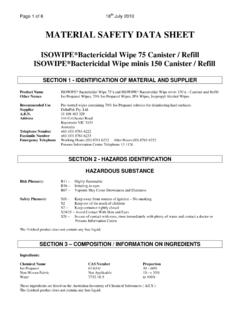
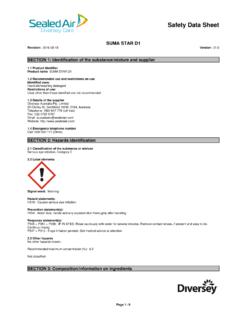
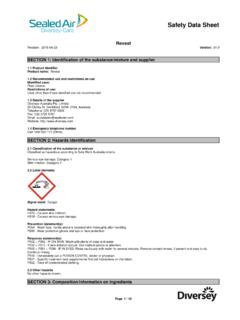
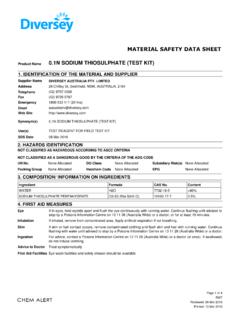
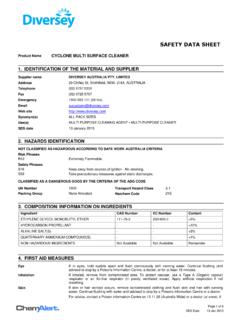
Transcription of Material Safety Data Sheet - General Sanitation
1 CS: :1 Material Safety data Sheet4ofInfosafe No LPYKDO ctober 2013 ISSUED by COLGATEI ssue Date :COLD POWER ULTRA REGULARP roduct Name :Classified as hazardous1. IDENTIFICATION OF THE Material AND SUPPLIERCOLD POWER ULTRA REGULARP roduct NameColgate-Palmolive Pty Ltd (ABN 002 792 163)Company NameAustralia: Level 14, 345 George Street, SydneyNSW 2000 AustraliaAddressAUS 1800 638 556, NZ: 0800 764766 Emergency : AUS (02) 9229 5600 NZ: 04 576 6700 Fax: AUS (02) 9229 5700, NZ: 04 568 8835 Telephone/Fax NumberLaundry washing Use Name Product CodeOther NamesCOLD POWER REGULARCOLD POWER REGULAR ULTRA CONCENTRATENew Zealand Address: Level 4, 45 Knights Road, Lower Information2. HAZARDS IDENTIFICATIONC lassified as hazardous Classified as Hazardous according to criteria of National Occupational Health & Safety Commission, Australia (NOHSC).
2 Not Classified as Dangerous Goods according to the Australian Code for the Transport of Dangerous Goods by Road and Rail. (7th edition)Hazard ClassificationClassified as hazardous R36 Irritating to Phrase(s)S25 Avoid contact with eyes. S26 In case of contact with eyes, rinse immediately with plenty of water and seek medical Phrase(s)3. COMPOSITION/INFORMATION ON INGREDIENTS Name Risk Phrase CAS Proportion Hazard SymbolIngredientsR36 Sodium carbonate 497-19-8 30-<60 % XiR38, R41 Sodium silicate 1344-09-8 <10 % XiAlcohols, C12-14, ethoxylated68439-50-9 <10 %CI FLUORESCENT BRIGHTENER 71 (CI 40625)16090-02-1 <1 %Calcium carbonate 471-34-1 <1 %Sodium chloride 7647-14-5 <1 %Free Oil (unreacted) 67774-74-7 < %Ingredients determined not to be hazardousBalance4.
3 FIRST AID MEASURESIf inhaled, remove to fresh area. Keep at rest until recovered. If symptoms persist seek medical not induce vomiting. Wash out mouth thoroughly with water. If symptoms develop seek medical affected area thoroughly with water. If irritation develops, discontinue use. If symptoms persist seek medical in eyes, hold eyelids apart and flush the eyes continuously with running water. Continue flushing for several minutes until all contaminants are washed out completely. Seek medical washroom Aid FacilitiesTreat to DoctorFor advice in an emergency, contact a Poisons Information Centre (Phone Australia 13 1126; New Zealand 0800 POISON / 0800 764 766) or a doctor at Information5.
4 FIRE FIGHTING MEASURESP rint Date: 1/11/2013CS: : :2 Material Safety data Sheet4ofInfosafe No LPYKDO ctober 2013 ISSUED by COLGATEI ssue Date :COLD POWER ULTRA REGULARP roduct Name :Classified as hazardousFoam, dry chemical powder, carbon dioxide, water spray or water Extinguishing MediaUnder fire conditions this product may emit toxic and/or irritating fumes including carbon monoxide, carbon dioxide and oxides of from Combustion ProductsNon-flammable powderSpecific HazardsFire fighters should wear Self-Contained Breathing Apparatus (SCBA) and full protective clothing to prevent exposure to vapours, fumes or products of in connection with Fire6. ACCIDENTAL RELEASE MEASURESA void accidents, clean up immediately.
5 Wear appropriate personal protective equipment and clothing to prevent inhalation and eye exposure. Sweep up Material avoiding dust generation or where possible use dustless methods such as vacuum to collect the Material and transfer into suitable labelled containers for subsequent recycling or disposal. If contamination of sewers or waterways occurs inform the local water authorities and EPA in accordance with local regulations. Dispose of waste according to applicable local and national Procedures7. HANDLING AND STORAGEUse only in a well ventilated area. Keep containers sealed when not in use. Prevent the build up of dust in the work atmosphere. Avoid inhalation of dust, and skin or eye contact. Maintain high standards of personal hygiene Washing hands prior to eating, drinking, smoking or using toilet for Safe HandlingStore in a cool, dry well-ventilated area away from heat, sources of ignition, oxidising agents and foodstuffs, and out of direct sunlight.
6 Keep containers closed when not in use and securely sealed and protected against physical damage. Inspect regularly for deficiencies such as damage or for Safe StorageNot corrosive to EXPOSURE CONTROLS/PERSONAL PROTECTIONNo exposure standards have been established for this Material , however, the TWA exposure standards for dust not otherwise specified is 10 mg/m . As with all chemicals, exposure should be kept to the lowest possible levels. TWA (Time Weighted Average): The average airborne concentration of a particular substance when calculated over a normal eight-hour working day, for a five-day week. Source: Safe Work AustraliaNational Exposure StandardsNo biological limit Limit ValuesNormally not required.
7 Use in a well ventilated area. Industrial applcations: Provide sufficient ventilation to keep airborne levels below the exposure limits. Where dusts are generated, particularly in enclosed areas, and natural ventilation is inadequate, a local exhaust ventilation system is ControlsNot required for domestic use. Industrial applcations: If engineering controls are not effective in controlling airborne exposure then an approved respirator with a replaceable dust/particulate filter should be used. Reference should be made to Australian/New Zealand Standards AS/NZS 1715, Selection, Use and Maintenance of Respiratory Protective Devices; and AS/NZS 1716, Respiratory Protective Devices, in order to make any necessary changes for individual ProtectionThe use of chemical goggles or Safety glasses with side shield protection is recommended if there is a risk of eye exposure.
8 Final choice of appropriate eye/face protection will vary according to individual circumstances methods of handling or engineering controls and according to risk assessments undertaken. Eye protection should conform with Australian/New Zealand Standard AS/NZS 1337 - Eye Protectors for Industrial ProtectionWear impervious gloves PVC, nitrile or butyl rubber gloves. Final choice of appropriate gloves will vary according to individual circumstances. Reference should be made to AS/NZS 2161 Occupational protective gloves- Selection, use and ProtectionUnder industrial conditions, suitable protective work wear, cotton overalls buttoned at neck and wrist is recommended. Chemical resistant apron Body ProtectionPrint Date: 1/11/2013CS: : :3 Material Safety data Sheet4ofInfosafe No LPYKDO ctober 2013 ISSUED by COLGATEI ssue Date :COLD POWER ULTRA REGULARP roduct Name :Classified as hazardousis recommended where large quantities are PHYSICAL AND CHEMICAL PROPERTIESW hite powderAppearancePleasant, fragrant availableMelting PointNot availableBoiling PointSolubleSolubility in (1% solution)pH ValueNot applicableVapour PressureNot applicableVapour Density (Air=1)Not applicableFlash PointNon-flammable powderFlammabilityNot availableAuto-Ignition TemperatureNot applicableExplosion Limit - UpperNot applicableExplosion Limit - Lower10.
9 STABILITY AND REACTIVITYS table under normal conditions of use and StabilityExtremes of temperature and direct sunlight. Dust to AvoidStrong oxidising MaterialsThermal decomposition may result in the release of toxic and/or irritating fumes, including carbon monoxide, carbon dioxide and oxides of Decomposition ProductsWill not Polymerization11. TOXICOLOGICAL INFORMATIONNo toxicity data available for this InformationInhalation of product dusts may cause irritation of the nose, throat and respiratory of this product may irritate the gastric tract causing nausea and contact may cause mechanical irritation resulting in redness and to eyes. On eye contact this product will cause tearing, stinging, blurred vision, and or prolonged exposure to this Material may cause skin sensitisation in some individuals.
10 Inhalation of enzyme dust or aerosols resulting from handling may induce sensitisation and may cause allergic reactions in sensitized individuals. Prolonged skin contact may cause minor irritation. The preparation is irritating to Effects12. ECOLOGICAL INFORMATIONNo ecological data are available for this availablePersistence / DegradabilityNot availableMobilityPrint Date: 1/11/2013CS: : :4 Material Safety data Sheet4ofInfosafe No LPYKDO ctober 2013 ISSUED by COLGATEI ssue Date :COLD POWER ULTRA REGULARP roduct Name :Classified as hazardousNot availableBioaccumulative PotentialPrevent this Material entering waterways, drains and Protection13. DISPOSAL CONSIDERATIONSThe disposal of the spilled or waste Material must be done in accordance with applicable local and national Considerations14.