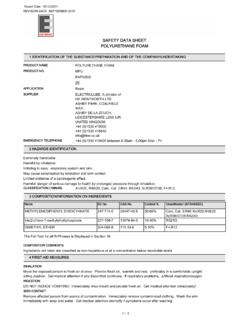
Transcription of SAFETY DATA SHEET Polyurethane Coating
1 Revision date: 12/03/2020 Revision: data SHEETP olyurethane CoatingAccording to Regulation (EC) No 1907/2006, Annex II, as amended. Commission Regulation (EU) No 2015/830of 28 May 1: Identification of the substance/mixture and of the Product identifierProduct namePolyurethane CoatingProduct numberPUC-a, EPUC400, Relevant identified uses of the substance or mixture and uses advised againstIdentified usesAppliance advised againstNo specific uses advised against are Details of the supplier of the SAFETY data sheetSupplierELECTROLUBE. A division of HK WENTWORTH LTDASHBY PARK, COALFIELD WAY,ASHBY DE LA ZOUCH, LEICESTERSHIRE LE65 1 JRUNITED KINGDOM+44 (0)1530 419600+44 (0)1530 Emergency telephone numberEmergency telephoneIN CASE OF EMERGENCY CALL:+44 1865 407333 (24hr, Provided by Carechem 24)+353 (0)1 809 2166 (Beaumont Hospital, Republic of Ireland only, 8am-10pm, 7 days a week)SECTION 2.
2 Hazards Classification of the substance or mixtureClassification (EC 1272/2008)Physical hazardsAerosol 1 - H222, H229 Health hazardsSTOT SE 3 - H336 STOT RE 1 - H372 Environmental hazardsAquatic Chronic 2 - Label elementsHazard pictograms Signal wordDanger1/25 Revision date: 12/03/2020 Revision: CoatingHazard statementsEUH208 Contains 2-butanone oxime, 4,5-Dichloro-2-octyl-2H-isothiazol-3-one . May producean allergic Extremely flammable Pressurised container: may burst if May cause drowsiness or Causes damage to organs through prolonged or repeated Toxic to aquatic life with long lasting statementsP210 Keep away from heat, hot surfaces, sparks, open flames and other ignition sources.
3 Do not spray on an open flame or other ignition Do not pierce or burn, even after Do not breathe +P412 Protect from sunlight. Do not expose to temperatures exceeding 50 C/122 Dispose of contents/ container in accordance with national (petroleum), hydrodesulfurized heavy, Hydrocarbons, C9-C12, n-alkanes,isoalkanes, cyclics, aromatics (2-25%)Supplementary precautionarystatementsP264 Wash contaminated skin thoroughly after Do not eat, drink or smoke when using this Avoid release to the Get medical advice/ attention if you feel Collect Other hazardsThis product does not contain any substances classified as PBT or 3.
4 Composition/information on MixturesPetroleum gases, liquefied30-60%CAS number: 68476-85-7EC number: 270-704-2 ClassificationFlam. Gas 1 - H220 Naphtha (petroleum), hydrodesulfurized heavy10-30%CAS number: 64742-82-1EC number: 265-185-4 REACH registration number: 01-2119458049-33-XXXXC lassificationFlam. Liq. 3 - H226 STOT SE 3 - H336 STOT RE 1 - H372 Asp. Tox. 1 - H304 Aquatic Chronic 2 - H4112/25 Revision date: 12/03/2020 Revision: CoatingHydrocarbons, C9-C12, n-alkanes, isoalkanes, cyclics,aromatics (2-25%)10-30%CAS number: 64742-82-1EC number: 919-446-0 REACH registration number: 01-2119458049-33-XXXXC lassificationFlam.
5 Liq. 3 - H226 STOT SE 3 - H336 STOT RE 1 - H372 Asp. Tox. 1 - H304 Aquatic Chronic 2 - H4112-butanone number: 96-29-7EC number: 202-496-6 REACH registration number: 01-2119539477-28-XXXXC lassificationAcute Tox. 4 - H312 Eye Dam. 1 - H318 Skin Sens. 1 - H317 Carc. 2 - H351 Cobalt bis(2-ethylhexanoate)< number: 136-52-7EC number: 205-250-6 REACH registration number: 01-2119524678-29-XXXXM factor (Acute) = 1 ClassificationEye Irrit. 2 - H319 Skin Sens. 1 - H317 Repr. 2 - H361fAquatic Acute 1 - H400 Aquatic Chronic 3 - H4124,5-Dichloro-2-octyl-2H-isothiazol-3 -one< number: 64359-81-5EC number: 264-843-8M factor (Acute) = 100M factor (Chronic) = 100 ClassificationAcute Tox.
6 4 - H302 Acute Tox. 4 - H312 Acute Tox. 2 - H330 Skin Corr. 1C - H314 Eye Dam. 1 - H318 Skin Sens. 1A - H317 STOT SE 3 - H335 Aquatic Acute 1 - H400 Aquatic Chronic 1 - H4103/25 Revision date: 12/03/2020 Revision: CoatingThe full text for all hazard statements is displayed in Section 4: First aid Description of first aid measuresGeneral informationGet medical attention immediately. Show this SAFETY data SHEET to the medical affected person from source of contamination. Move affected person to fresh air andkeep warm and at rest in a position comfortable for breathing.
7 Maintain an open tight clothing such as collar, tie or belt. When breathing is difficult, properly trainedpersonnel may assist affected person by administering oxygen. Place unconscious person ontheir side in the recovery position and ensure breathing can take mouth thoroughly with water. Remove any dentures. Give a few small glasses of wateror milk to drink. Stop if the affected person feels sick as vomiting may be dangerous. Do notinduce vomiting unless under the direction of medical personnel. If vomiting occurs, the headshould be kept low so that vomit does not enter the lungs.
8 Never give anything by mouth to anunconscious person. Move affected person to fresh air and keep warm and at rest in aposition comfortable for breathing. Place unconscious person on their side in the recoveryposition and ensure breathing can take place. Maintain an open airway. Loosen tight clothingsuch as collar, tie or contactRinse with contactRinse immediately with plenty of water. Remove any contact lenses and open eyelids wideapart. Continue to rinse for at least 10 of first aidersFirst aid personnel should wear appropriate protective equipment during any rescue.
9 Washcontaminated clothing thoroughly with water before removing it from the affected person, orwear gloves. It may be dangerous for first aid personnel to carry out Most important symptoms and effects, both acute and delayedGeneral informationSee Section 11 for additional information on health hazards. The severity of the symptomsdescribed will vary dependent on the concentration and the length of single exposure may cause the following adverse effects: Headache. Nausea, nervous system depression. Drowsiness, dizziness, disorientation, vertigo. to the physical nature of this product, it is unlikely that ingestion will contactRepeated exposure may cause skin dryness or contactMay be slightly irritating to eyes.
10 May cause Indication of any immediate medical attention and special treatment neededNotes for the doctorTreat 5: Firefighting Extinguishing mediaSuitable extinguishing mediaThe product is flammable. Extinguish with alcohol-resistant foam, carbon dioxide, dry powderor water fog. Use fire-extinguishing media suitable for the surrounding extinguishingmediaDo not use water jet as an extinguisher, as this will spread the Special hazards arising from the substance or mixture4/25 Revision date: 12/03/2020 Revision: CoatingSpecific hazardsContainers can burst violently or explode when heated, due to excessive pressure aerosol containers may be propelled from a fire at high speed.