Transcription of SAFETY DATA SHEET - Sprayway, Inc
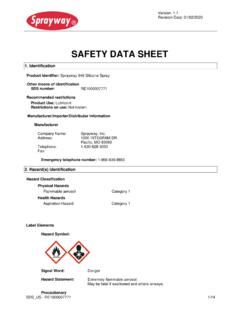
1 SAFETY data SHEET1. IdentificationProduct number1000000640 Product identifierAMMONIATED GLASS CLEANERC ompany informationSprayway, S. Westgate DriveAddison, IL 60101 United StatesCompany phoneGeneral Assistance 1-630-628-3000 Emergency telephone US1-866-836-8855 Emergency telephone outsideUS1-952-852-4646 Version #01 Recommended useCleanerRecommended restrictionsNone Hazard(s) identificationCategory 1 Flammable aerosolsPhysical hazardsNot hazardsNot hazardsNot defined hazardsLabel elementsSignal wordDangerHazard statementExtremely flammable statementPreventionKeep away from heat/sparks/open flames/hot surfaces. - No smoking. Do not spray on an openflame or other ignition source. Pressurized container: Do not pierce or burn, even after hands after from sunlight. Do not expose to temperatures exceeding 50 C/122 of waste and residues in accordance with local authority (s) not otherwiseclassified (HNOC)Static accumulating flammable liquid can become electrostatically charged even in bonded andgrounded equipment.
2 Sparks may ignite liquid and vapor. May cause flash fire or Composition/information on ingredientsMixturesCAS number%Chemical nameCommon name and - - 1074-98-6 Propane1 - NitriteOther components below reportable levels90 - - 1*Designates that a specific chemical identity and/or percentage of composition has been withheld as a trade First-aid measuresInhalationMove to fresh air. Call a physician if symptoms develop or / 10 Product name: AMMONIATED GLASS CLEANERP roduct #: 1000000640 Version #: 01 Issue date: 05-30-2015 SDS USSkin contactTake off immediately all contaminated clothing. Rinse skin with water/shower. Get medicalattention if irritation develops and contactImmediately flush eyes with plenty of water for at least 15 minutes. Remove contact lenses, ifpresent and easy to do. Get medical attention if irritation develops and the unlikely event of swallowing contact a physician or poison control center.
3 Rinse importantsymptoms/effects, acute anddelayedDirect contact with eyes may cause temporary of immediatemedical attention and specialtreatment neededProvide general supportive measures and treat informationEnsure that medical personnel are aware of the material(s) involved, and take precautions toprotect Fire-fighting measuresSuitable extinguishing mediaWater fog. Foam. Carbon dioxide (CO2). Dry chemical powder, carbon dioxide, sand or earth maybe used for small fires extinguishingmediaDo not use water jet as an extinguisher, as this will spread the hazards arising fromthe chemicalContents under pressure. Pressurized container may explode when exposed to heat or flame. Thisproduct is a poor conductor of electricity and can become electrostatically charged. If sufficientcharge is accumulated, ignition of flammable mixtures can occur. To reduce potential for staticdischarge, use proper bonding and grounding procedures.
4 This liquid may accumulate staticelectricity when filling properly grounded containers. Static electricity accumulation may besignificantly increased by the presence of small quantities of water or other contaminants. Materialwill float and may ignite on surface of water. During fire, gases hazardous to health may protective equipmentand precautions for firefightersFirefighters must use standard protective equipment including flame retardant coat, helmet withface shield, gloves, rubber boots, and in enclosed spaces, containers from fire area if you can do so without risk. Containers should be cooled withwater to prevent vapor pressure build up. For massive fire in cargo area, use unmanned hoseholder or monitor nozzles, if possible. If not, withdraw and let fire burn methodsUse standard firefighting procedures and consider the hazards of other involved materials. Movecontainers from fire area if you can do so without risk.
5 In the event of fire and/or explosion do notbreathe fire hazardsExtremely flammable Accidental release measuresPersonal precautions,protective equipment andemergency proceduresKeep unnecessary personnel away. Keep people away from and upwind of spill/leak. Keep out oflow areas. Eliminate all ignition sources (no smoking, flares, sparks, or flames in immediate area).Wear appropriate protective equipment and clothing during clean-up. Do not touch damagedcontainers or spilled material unless wearing appropriate protective clothing. Ventilate closedspaces before entering them. Use appropriate containment to avoid environmental by mechanical means such as vacuum truck to a salvage tank or other suitable containerfor recovery or safe disposal. Local authorities should be advised if significant spillages cannot becontained. For personal protection, see section 8 of the and materials forcontainment and cleaning upRefer to attached SAFETY data sheets and/or instructions for use.
6 Eliminate all ignition sources (nosmoking, flares, sparks, or flames in immediate area). Keep combustibles (wood, paper, oil, etc.)away from spilled material. Stop leak if you can do so without risk. Move the cylinder to a safe andopen area if the leak is irreparable. Cover with plastic SHEET to prevent spreading. Absorb invermiculite, dry sand or earth and place into containers. Prevent entry into waterways, sewer,basements or confined areas. Following product recovery, flush area with Spills: Wipe up with absorbent material ( cloth, fleece). Clean surface thoroughly toremove residual contamination. For waste disposal, see section 13 of the precautionsAvoid discharge into drains, water courses or onto the ground. Use appropriate containment toavoid environmental / 10 Product name: AMMONIATED GLASS CLEANERP roduct #: 1000000640 Version #: 01 Issue date: 05-30-2015 SDS US7.
7 Handling and storagePrecautions for safe handlingMinimize fire risks from flammable and combustible materials (including combustible dust andstatic accumulating liquids) or dangerous reactions with incompatible materials. Handlingoperations that can promote accumulation of static charges include but are not limited to: mixing,filtering, pumping at high flow rates, splash filling, creating mists or sprays, tank and containerfilling, tank cleaning, sampling, gauging, switch loading, vacuum truck operations. Pressurizedcontainer: Do not pierce or burn, even after use. Do not use if spray button is missing or not spray on a naked flame or any other incandescent material. Do not smoke while using oruntil sprayed surface is thoroughly dry. Do not cut, weld, solder, drill, grind, or expose containers toheat, flame, sparks, or other sources of ignition. All equipment used when handling the productmust be grounded.
8 Use non-sparking tools and explosion-proof equipment. Do not re-use emptycontainers. Do not get in eyes, on skin, or on clothing. Avoid breathingdust/fume/gas/mist/vapors/spray . Avoid prolonged exposure. Use only in well-ventilated appropriate personal protective equipment. Observe good industrial hygiene additional information on equipment bonding and grounding, refer to the Canadian ElectricalCode in Canada, (CSA ), or the American Petroleum Institute (API) Recommended Practice2003, "Protection Against Ignitions Arising out of Static, Lightning, and Stray Currents" or NationalFire Protection Association (NFPA) 77, "Recommended Practice on Static Electricity" or NationalFire Protection Association (NFPA) 70, "National Electrical Code".Conditions for safe storage,including any incompatibilitiesLevel 1 container. Protect from sunlight and do not expose to temperatures exceeding50 C/122 F.
9 Do not puncture, incinerate or crush. Do not handle or store near an open flame,heat or other sources of ignition. This material can accumulate static charge which may causespark and become an ignition source. Avoid spark promoters. Ground/bond container andequipment. These alone may be insufficient to remove static electricity. Store in a well-ventilatedplace. Refrigeration recommended. Store away from incompatible materials (see Section 10 of theSDS).8. Exposure controls/personal protectionOccupational exposure limitsUS. OSHA Table Z-1 Limits for Air Contaminants (29 CFR )ValueComponentsTypePEL240 mg/m32-Butoxyethanol (CAS111-76-2)50 ppmPEL1800 mg/m3 Propane (CAS 74-98-6)1000 ppmUS. ACGIH Threshold Limit ValuesValueComponentsTypeTWA20 ppm2-Butoxyethanol (CAS111-76-2)STEL1000 ppmButane (CAS 106-97-8)US. NIOSH: Pocket Guide to Chemical HazardsValueComponentsTypeTWA24 mg/m32-Butoxyethanol (CAS111-76-2)5 ppmTWA1900 mg/m3 Butane (CAS 106-97-8)800 ppmTWA1800 mg/m3 Propane (CAS 74-98-6)1000 ppmBiological limit valuesACGIH Biological Exposure IndicesValueComponentsDeterminantSpecime n Sampling Time200 mg/gButoxyaceticacid (BAA),with hydrolysisCreatinine inurine*2-Butoxyethanol (CAS111-76-2)* - For sampling details, please see the source / 10 Product name: AMMONIATED GLASS CLEANERP roduct #: 1000000640 Version #: 01 Issue date: 05-30-2015 SDS USExposure guidelinesUS - California OELs: Skin designation2-Butoxyethanol (CAS 111-76-2)Can be absorbed through the - Minnesota Haz Subs: Skin designation applies2-Butoxyethanol (CAS 111-76-2)Skin designation - Tennesse OELs.
10 Skin designation2-Butoxyethanol (CAS 111-76-2)Can be absorbed through the NIOSH Pocket Guide to Chemical Hazards: Skin designation2-Butoxyethanol (CAS 111-76-2)Can be absorbed through the OSHA Table Z-1 Limits for Air Contaminants (29 CFR )2-Butoxyethanol (CAS 111-76-2)Can be absorbed through the engineeringcontrolsExplosion-proof general and local exhaust ventilation. Good general ventilation (typically 10 airchanges per hour) should be used. Ventilation rates should be matched to conditions. Ifapplicable, use process enclosures, local exhaust ventilation, or other engineering controls tomaintain airborne levels below recommended exposure limits. If exposure limits have not beenestablished, maintain airborne levels to an acceptable protection measures, such as personal protective equipmentEye/face protectionWear SAFETY glasses with side shields (or goggles).Hand protectionWear appropriate chemical resistant protectionOtherWear appropriate chemical resistant protectionIf permissible levels are exceeded use NIOSH mechanical filter / organic vapor cartridge or anair-supplied hazardsWear appropriate thermal protective clothing, when hygieneconsiderationsWhen using do not smoke.