Transcription of Safety Data Sheet - trinitymfg.com
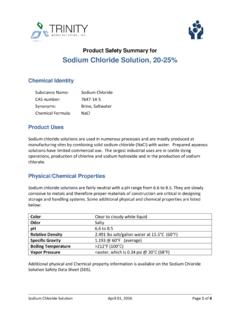
1 Safety data Sheet Sodium Chloride Solution, 20-25% Sodium Chloride Solution, 20-25% April 27, 2016 Page 1 of 8 1. IDENTIFICATION Product identifier Sodium Chloride Solution, 20-25% Other means of identification: Product code 520-USA-TMI Recommended use Textile dying operations; production of sodium chlorate Recommended restrictions None known. Manufacturer/Importer/Supplier/Distribut or information: Supplier name Trinity Manufacturing, Inc. Address 11 EV Hogan Drive, PO Box 1519 Hamlet, NC, 28345, USA Telephone 800-632-6228 or 910-419-6551 (Customer Service) E-mail Emergency phone number FOR CHEMICAL EMERGENCY (Spill, Leak, Fire, Exposure, or Accident) Call CHEMTREC Day or Night Within USA and Canada: 1-800-424-9300 (24/7) Outside USA and Canada: +1-703-527-3887 (collect calls accepted) 2. HAZARDS IDENTIFICATION GHS Classification Based on available data , this material is not considered a hazardous chemical or mixture per classification under 2012 OSHA Hazard Communication Standard (29 CFR ) GHS Signal Word None GHS Hazard Statements Physical hazards Not classified as a hazardous chemical or mixture Health hazards Not classified as a hazardous chemical or mixture Environmental hazards Not classified as an environmentally hazardous substance GHS Precautionary Statements There are no Precautionary Statements assigned.
2 Label Elements None required Signal word None Unknown acute toxicity 0% of the mixture consists of ingredients of unknown toxicity. Hazard(s) Not Otherwise None classified (HNOC) Supplemental Information Chloride ions increase the conductivity of water and accelerate corrosion on metal objects such as pumps and infrastructure. Brine solutions are slowly, but persistently corrosive to metals. Dispose of contents/container in accordance with local, state, and federal regulations. Sodium Chloride Solution, 20-25% April 27, 2016 Page 2 of 8 3. COMPOSITION/INFORMATION ON INGREDIENTS Chemical Name Common Name and Synonyms CAS Number % by Weight Sodium Chloride Salt, Saltwater, Brine, Halite, Saline 7647-14-5 20 - 25 Water 7732-18-5 75 - 80 4. FIRST AID MEASURES Inhalation No effects expected. If inhalation occurs and you feel unwell, move to fresh air. Skin contact Irrigate with water.
3 If irritation occurs, protect skin from further contact. Eye contact Rinse cautiously with water for several minutes. Remove contact lenses, if present and easy to do. Continue rinsing. If irritation develops and persists, get medical attention. Ingestion No effect expected. Rinse mouth. Provide fluids if thirsty. If large amounts are ingested, get medical advice/attention. Most important symptoms/effects, Direct contact with eyes may cause temporary irritation and redness to conjunctiva. Direct acute and delayed contact with skin may cause redness or dry skin. Inhaling mists or vapors of this material may cause mild respiratory irritation. Ingesting may cause increased thirst. Ingesting large amounts can cause electrolyte imbalance. No delayed/chronic effects have been identified. Indication of immediate Treat symptomatically. Treatment for overexposure should be directed at controlling the medical attention and special symptoms and clinical condition of the patient.
4 Unless symptoms reappear, no further treatment needed treatment is required. Notes to Physician This is a concentrated salt solution of sodium chloride. This material is recognized as non-toxic. Health effects are typically reversible within the day of exposure. Correct any fluid/electrolyte imbalance for large ingestions. 5. FIRE-FIGHTING MEASURES Suitable extinguishing media Does not burn. Use extinguishing agents suitable for surrounding fire. Unsuitable extinguishing media No information available. Specific hazards arising from Hazardous combustion products: Hydrogen chloride gas, Sodium oxides. the substance or mixture Special protective equipment Wear NIOSH-approved self-contained breathing apparatus pressure-demand, and precautions for firefighters and full protective gear. Specific methods Use standard firefighting procedures and consider the hazards of other involved materials.
5 General fire hazards Product is not combustible. 6. ACCIDENTAL RELEASE MEASURES Personal precautions, Handle in accordance with good industrial hygiene and Safety practice. As a precaution, protective equipment and avoid contact with skin and eyes. Use personal protective equipment. See section 8 of the emergency procedures SDS for personal protection. Methods and materials for Stop leak if possible without personal risk. Mop up or absorb in any available absorbent. Containment and cleaning Up Liquid material may be removed with a properly rated vacuum truck. Collect spilled material in appropriate container for disposal. Small amounts of residual can be flushed to sewer with plenty of water. Environmental precautions Avoid liquid entering sanitary sewer or storm drains or other waterways. Small amounts of residue may be flushed to sewer with plenty of water. Section 12 has additional information.
6 Sodium Chloride Solution, 20-25% April 27, 2016 Page 3 of 8 7. HANDLING AND STORAGE Precautions for safe handling Handle in accordance with good industrial hygiene practice. Avoid contact with skin and eyes. Wash after handling. Wear personal protective equipment as described in Section 8. Conditions for safe storage Store at ambient temperature and pressure. Keep in properly labeled and closed containers. Keep separate from fresh water supply or outlets. Maintain good housekeeping. Incompatibilities or None known. Materials to Avoid 8. EXPOSURE CONTROLS / PERSONAL PROTECTION Occupational exposure limits No occupational exposure limits have been established for this material or its components. Non-Regulatory exposure limits This product does not contain any components that have advisory occupational exposure limits. Biological limit values No biological exposure limits have been established for sodium chloride.
7 Appropriate engineering controls No airborne limits have been established for this product. Ensure that suitable eyewash flushing facilities are proximal to the workstation location. Individual protection measures: Eye/face protection Wear Safety glasses with side shields (or goggles). Skin and body protection Standard industrial work clothes or coveralls, and Safety footwear are minimum protection. Hand protection Wear chemical resistant gloves when handling product. Protective material types Butyl rubber, Natural rubber, Neoprene, Nitrile, Vinyl. Respiratory protection Under normal conditions, no respiratory protection is necessary. A NIOSH-approved respirator with N95 cartridges may be worn to minimize exposure to nuisance mists or vapors. General hygiene When using, do not eat, drink or smoke. Always observe good personal hygiene considerations measures, such as washing with soap after handling the material and before eating, drinking, and/or smoking.
8 Routinely wash work clothing and protective equipment to remove contaminants. 9. PHYSICAL AND CHEMICAL PROPERTIES Physical state Liquid Appearance Clear to opaque (cloudy white) Color Clear, colorless Odor Salty Odor threshold No data available pH typical; pH 10 for electrolyzer-only feed Melting point/freezing point -21 C to C (-6 F to 60 F) Initial boiling point/boiling range > 100 C (212 F) Flash point Not flammable Evaporation rate No data available Flammability (solid, gas) Not applicable Lower Flammability limit Not flammable Upper Flammability limit Not flammable Sodium Chloride Solution, 20-25% April 27, 2016 Page 4 of 8 Vapor pressure No data available Vapor density (air = 1) No data available Relative density (water = 1) 20% concentration specific gravity @ C (60 F) 25% concentration specific gravity @ C (60 F) Solubility(ies): Solubility in water g/100 mL @ 0 C ( 32 F) Partition coefficient Not applicable (n-octanol/water) Auto-ignition temperature Not applicable Decomposition temperature Not data available Viscosity No data available Other information.
9 Weight per gallon 20% concentration lbs @ C (60 F) lbs salt/gallon water 25% concentration lbs @ C (60 F) lbs salt/gallon water Flammability class (NFPA) Not flammable Molecular formula Na+Cl + H2O Molecular weight g/mol (sodium chloride) Percent volatile 100 % (water component) VOC (Weight %) 0 % 10. STABILTY AND REACTIVITY Reactivity The product is stable and non-reactive under normal conditions of use, storage and transport. Chemical stability Material is stable under normal temperatures and pressures. Possibility of hazardous reactions Hazardous polymerization will not occur. Hydrogen chloride gas is generated if mixed with a concentrated nonvolatile acid such as sulfuric acid. Conditions to avoid: Brine solution will slowly corrode metal in the presence of air. Hazardous decomposition When heated above 801 C (1474 F), will emit hydrogen chloride gas and sodium oxides.
10 Products (produced as a result of use, storage, spill and heating) 11. TOXICOLOGICAL INFORMATION Information on likely routes of exposure, including signs and symptoms related to the physical, chemical, and toxicological characteristics: Skin contact Prolonged and repeated skin contact may cause redness and dry skin. Eye contact Direct contact with eyes may cause mild irritation. Inhalation Prolonged inhalation may cause slight respiratory tract irritation. Ingestion May cause increased thirst. Massive ingestion may cause fluid/electrolyte imbalance, nausea, vomiting, diarrhea, weakness headache convulsions, and coma. Component Toxicity data : Component LD50 - Dermal LD50 - Oral LC50 - Inhalation Sodium Chloride > 10,000 mg/kg (Rabbit) 3550 mg/kg (Rat) 42 mg/L (Rat) 1-hr, aerosol Water Not listed > 90 mL/kg (Rat) Not listed Sodium Chloride Solution, 20-25% April 27, 2016 Page 5 of 8 Information on toxicological effects: Acute Toxicity At reasonably possible exposures, sodium chloride is relatively not toxic to human health.