Example: marketing
Section 3: Crystal Binding
There are several types of bonding, depending on the physical origin and nature of the bonding force involved. The four main types are: Van der Waals (or molecular) bonding, ionic bonding, covalent bonding and metallic bonding. Although the nature of the attractive energy is different in different solids, the origin of the repulsive
Tags:
Information
Domain:
Source:
Link to this page:
Documents from same domain
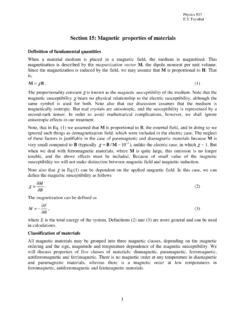
Section 15: Magnetic properties of materials
unlcms.unl.eduhave, according to Newton's second law, 2 F0 =mω0 r (22) where F0 is the attractive Coulomb force between the nucleus and the electron, and ω0 is the angular velocity. Fig. 1 Atomic origin of diamagnetism. The Lorentz force FL opposes the Coulomb force F0; v is the electron velocity.
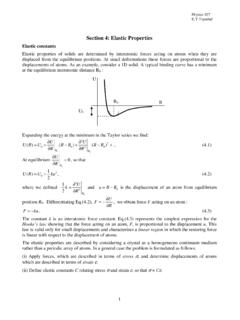
Section 4: Elastic Properties
unlcms.unl.eduThe elastic properties are described by considering a crystal as a homogeneous continuum medium rather than a periodic array of atoms. In a general case the problem is formulated as follows: (i) Apply forces, which are described in terms of stress σ, and determine displacements of atoms which are described in terms of strain ε.
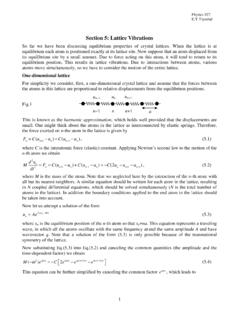
Section 5: Lattice Vibrations - University of Nebraska ...
unlcms.unl.eduPhysics 927 E.Y.Tsymbal 3 The physical distinction between the two velocities is that vp is the velocity of the propagation of the plane wave, whereas the vg is the velocity of the propagation of the wave packet. The latter is the velocity for the propagation of energy in the medium.
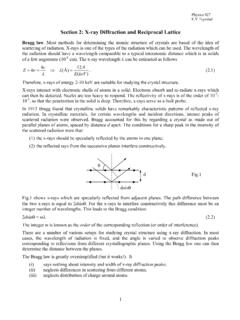
Section 2: X-ray Diffraction and Reciprocal Lattice
unlcms.unl.eduPhysics 927 E.Y.Tsymbal Diffraction condition and reciprocal lattice.Later von Layer introduced a different approach for x-ray diffraction. He regarded a crystal as composed of identical atoms placed at the lattice sites T and assumed that each atom …
Section 16: Magnetic properties of materials (continued)
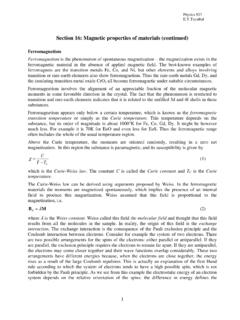
unlcms.unl.eduSection 16: Magnetic properties of materials (continued) Ferromagnetism Ferromagnetism is the phenomenon of spontaneous magnetization – the magnetization exists in the ferromagnetic material in the absence of applied magnetic field. The best-known examples of ferromagnets are the transition metals Fe, Co, and Ni, but other elements and alloys ...
Section 1: Crystal Structure
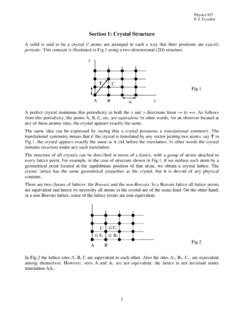
unlcms.unl.eduWigner-Seitz primitive cell. All the space of the crystal may be filled by these primitive cells, by translating the unit cell by the lattice vectors. y x a1 a2 a T Fig.4 . Physics 927 E.Y.Tsymbal 3 The unit cell can be primitive and non-primitive (or conventional). The unit cell discussed above is

Section 7: Free electron model - UNLcms: UNL Content ...
unlcms.unl.eduThe wavefunctions (7.10) are the eigenfunctions of the momentum p =−i∇, which can be easily seen by differentiating (7.10) : pψk (r) =−i∇ψk (r) =kψk (r). (7.13) The eigenvalue of the momentum is k . The velocity of the electron is defined by v =p/m =k /m.

HL-93 vs HS20 - University of Nebraska–Lincoln
unlcms.unl.edulevel of reliability in an LRFD-format specification. AASHTO chose this reliability to be 3.5 @ inventory level And 2.5 @ operating level Calibration continued Only the strength limit states of the LRFD Specifications are calibrated based upon the theory of structural reliability, wherein statistical load and resistance data are required.
Section 4: Electrostatics of Dielectrics
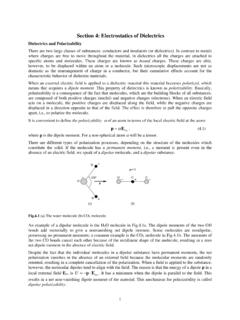
unlcms.unl.eduThis property of dielectrics is known as polarizability. Basically, polarizability is a consequence of the fact that molecules, which are the building blocks of all substances, are composed of both positive charges (nuclei) and negative charges (electrons). When an electric field
Related documents
The University of the State of New York REGENTS HIGH ...
www.jmap.orgforce? (1) covalent bonding (3) ionic bonding (2) hydrogen bonding (4) metallic bonding 15 Which statement describes a reaction at equilibrium? (1) The mass of the products must equal the mass of the reactants. (2) The entropy of the reactants must equal the entropy of the products. (3) The rate of formation of the products must

Part II: Sample Preparation for AFM Particle Characterization
nanoparticles.orgAPTES (aminopropyltriethoxy silane) to facilitate chemical bonding between particle and substrate. Functionalized surfaces might either promote adsorption or allow covalent bonding. Sometimes hydrophobic substrates are preferable in air-AFM, this way formation of a water monolayer can be avoided12. HPOG or spin-coating of polymers is a ...

11 0620 41 2RP - GCE Guide
papers.gceguide.com6 LES 2020 062041N20 (e) Ammonia is produced in the Haber process. The equation for the reaction is shown. N 2 (g) + 3H 2 (g) → 2NH 3 (g) (i) In the Haber process, a temperature of 450°C and a pressure of 200 atmospheres are used in the presence of finely‑divided iron. A larger equilibrium yield of ammonia would be produced if a lower temperature and a