Transcription of Section 3 The Battery - Autoshop 101
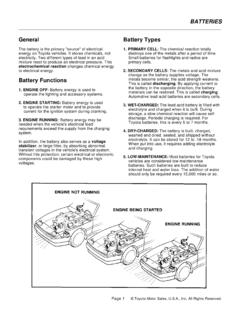
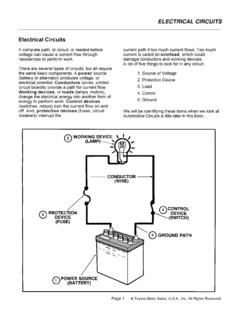
1 Section 3. The Battery The Battery The Battery is the main source of electrical energy on Toyota vehicles. The Battery powers these major electrical systems: Starting Ignition Charging Lighting Accessories The Battery The Battery is the main source of electrical energy in the vehicle. Fig. 3-01. TL623f301. Electrical Circuit Diagnosis - Course 623 3-1. Section 3. Battery Engine off The Battery provides energy to operate lighting and Functions accessories. Engine starting The Battery provides energy to operate the starter motor and ignition system during starting.
2 Engine running The charging system provides most of the energy required with the engine running; the Battery acts as a voltage stabilizer to protect voltage sensitive circuits, particularly digital circuits. Battery Functions The Battery provides energy to operate lights and accessories and to start the engine. It also serves as a voltage stabilizer. Fig. 3-02. TL623f302. 3-2 TOYOTA Technical Training The Battery Battery Type Lead Acid Virtually all automotive batteries are lead acid batteries. Two different metals, both lead compounds, are immersed in an acid electrolyte.
3 The chemical reaction produced provides electrical energy. Low Maintenance/No Maintenance Some manufacturers use this terminology. Low maintenance" means that electrolyte can be added. No maintenance" means that the Battery is sealed. Vented Most batteries have removable vented caps that are used to check electrolyte level and add distilled water as necessary to restore the level. The caps also allow hydrogen gas, a byproduct of Battery charging, to escape during charging. Sealed Some lead acid batteries are sealed, that is, there are no removable caps to check electrolyte or replenish it.
4 Some of these batteries have a small eye" to indicate charge level. Still others are sealed, but include connections to external vent tubes. NOTE For all types of batteries, always follow the manufacturers'. recommendations for charging and testing. Lead-Acid Battery Lead-acid batteries are called by different names: vented, sealed, low maintenance, and no maintenance. Fig. 3-03. TL623f300. Electrical Circuit Diagnosis - Course 623 3-3. Section 3. Battery Construction Battery Case The Battery case holds and protects all of the internal components and contains the electrolyte.
5 Fig. 3-04. TL623f300. Battery Case The Battery case and Form a sealed container. Protect the internal parts. Keep the internal parts in proper alignment. Prevent electrolyte leakage. 3-4 TOYOTA Technical Training The Battery Plates Two types of plates are used in a Battery : positive and negative. Positive Positive plates are made of antimony covered with an active layer of lead dioxide (PbO2). Negative Negative plates are made of lead covered with an active layer of sponge lead (Pb). Only the surface layers on both plates take part in the chemical reaction.
6 Plate surface area As the surface area of the plates increases, so does the current capacity of the Battery . Surface area is determined by the size of each plate, as well as the total number of plates in a Battery . Generally speaking, the larger the Battery , the higher is its current capacity. Surface area has no effect on Battery voltage. Positive and Negative Plates Positive plates are covered with lead dioxide (PbO2); negative plates are made of lead (Pb). Fig. 3-05. TL623f305c Electrical Circuit Diagnosis - Course 623 3-5.
7 Section 3. Separators The plates are separated by thin porous insulators. These allow electrolyte to pass freely between the plates, but prevent the plates from touching each other and shorting out. Insulators Insulator plates keep positive and negative plates from touching each other and shorting out. Fig. 3-06. TL623f306c 3-6 TOYOTA Technical Training The Battery Cells A typical lead acid Battery is organized into cells. Each cell .. Consists of multiple positive and negative plates immersed in their own electrolyte reservoir.
8 Produces about volts, regardless of Battery size. Automotive batteries are rated at 12 volts. To make up this voltage, six cells, each producing volts, are connected in series. 6 x volts = volts As a result, actual Battery voltage is typically closer to volts. Cells are connected in series with heavy internal straps. A positive and a negative terminal post provide connection points for the vehicle's Battery cables. Battery Cells A typical automotive Battery contains six cells connected in series. Each cell produces volts.
9 Fig. 3-07. TL623f307. Electrical Circuit Diagnosis - Course 623 3-7. Section 3. Venting System On some batteries, vent caps allow a controlled release of hydrogen gas. This gas forms naturally during Battery recharging, whether by the vehicle's alternator or by an external charger. Battery Vent Caps Vent caps allow the controlled release of hydrogen gas as the Battery charges. Fig. 3-08. TL623f308c 3-8 TOYOTA Technical Training The Battery Electrolyte The electrolyte is a mixture of sulfuric acid (H2SO4) and water (H2O).
10 The electrolyte reacts chemically with the active material on the plates to produce a voltage (electrical pressure). Battery Electrolyte Acid in the electrolyte reacts chemically with the positive plate's lead oxide (PbO2) and the negative plate's sponge lead (Pb). to produce a voltage. Fig. 3-09. TL623f309c Electrical Circuit Diagnosis - Course 623 3-9. Section 3. How Batteries The function of a lead acid cell is based on a simple chemical reaction. Work When two dissimilar metals are immersed in an acid solution, a chemical reaction produces a voltage.