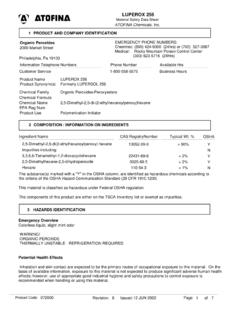
Transcription of SIGMA-ALDRICH MATERIAL SAFETY DATA SHEET …
1 SIGMA-ALDRICH MATERIAL SAFETY data SHEET Date Printed: 03/03/2004 Date Updated: 04/22/2003 Version Section 1 - Product and Company Information Product Name TETRAHYDROFURAN, +%, HPLC GRADE,INHIBITOR-FREE (POLY-COATED BOTTLE) Product Number 439215 Brand aldrich Company SIGMA-ALDRICH Street Address 3050 Spruce Street City, State, Zip, Country SAINT LOUIS MO 63103 US Technical Phone: 314 771 5765 Emergency Phone: 414 273 3850 Ext. 5996 Fax: 800 325 5052 Section 2 - Composition/Information on Ingredient Substance Name CAS # SARA 313 TETRAHYDROFURAN 109-99-9 No Formula C4H8O Synonyms Agrisynth THF * Butane, 1,4-epoxy- * Butane, alpha,delta-oxide * Cyclotetramethylene oxide * Diethylene oxide * 1,4-Epoxybutane * Furanidine * NCI-C60560 * Oxacyclopentane * Oxolane * RCRA waste number U213 * Tetrahydrofuraan (Dutch) * Tetrahydrofuran (ACGIH:OSHA) * Tetrahydrofuranne (French) * Tetraidrofurano (Italian) * Tetramethylene oxide RTECS Number: LU5950000 Section 3 - Hazards Identification EMERGENCY OVERVIEW Flammable (USA) Highly Flammable (EU).
2 Harmful. May form explosive peroxides. Harmful if swallowed. Irritating to eyes, respiratory system and skin. Limited evidence of a carcinogenic effect. Possible Carcinogen (US). Target organ(s): Central nervous system. Liver. HMIS RATING HEALTH: 2* FLAMMABILITY: 3 REACTIVITY: 1 NFPA RATING HEALTH: 2 FLAMMABILITY: 3 REACTIVITY: 1 *additional chronic hazards present. For additional information on toxicity, please refer to Section 11. Section 4 - First Aid Measures ORAL EXPOSURE If swallowed, wash out mouth with water provided person is conscious. Call a physician. INHALATION EXPOSURE If inhaled, remove to fresh air. If not breathing give artificial respiration. If breathing is difficult, give oxygen. DERMAL EXPOSURE In case of contact, immediately wash skin with soap and copious amounts of water.
3 EYE EXPOSURE In case of contact, immediately flush eyes with copious amounts of water for at least 15 minutes. Section 5 - Fire Fighting Measures FLAMMABLE HAZARDS Flammable Hazards: Yes Organic Peroxide: Yes EXPLOSION HAZARDS Vapor may travel considerable distance to source of ignition and flash back. Container explosion may occur under fire conditions. FLASH POINT F -17 C Method: closed cup EXPLOSION LIMITS Lower: % Upper: % AUTOIGNITION TEMP 321 C FLAMMABILITY N/A EXTINGUISHING MEDIA Suitable: Carbon dioxide, dry chemical powder, or appropriate foam. FIREFIGHTING Protective Equipment: Wear self-contained breathing apparatus and protective clothing to prevent contact with skin and eyes. Specific Hazard(s): Flammable liquid. Vapor may travel considerable distance to source of ignition and flash back.
4 Emits toxic fumes under fire conditions. Specific Method(s) of Fire Fighting: Use water spray to cool fire-exposed containers. Section 6 - Accidental Release Measures PROCEDURE TO BE FOLLOWED IN CASE OF LEAK OR SPILL Evacuate area. Shut off all sources of ignition. PROCEDURE(S) OF PERSONAL PRECAUTION(S) Wear respirator, chemical SAFETY goggles, rubber boots, and aldrich - 439215 Page 2 heavy rubber gloves. METHODS FOR CLEANING UP Cover with dry-lime, sand, or soda ash. Place in covered containers using non-sparking tools and transport outdoors. Ventilate area and wash spill site after MATERIAL pickup is complete. Section 7 - Handling and Storage HANDLING User Exposure: Avoid breathing vapor. Avoid contact with eyes, skin, and clothing. Avoid prolonged or repeated exposure. STORAGE Suitable: Keep container closed.
5 Keep away from heat, sparks, and open flame. Store under nitrogen. SPECIAL REQUIREMENTS Test for peroxide formation periodically and before distillation. Do not distill to dryness. Section 8 - Exposure Controls / PPE ENGINEERING CONTROLS SAFETY shower and eye bath. Use nonsparking tools. Mechanical exhaust required. PERSONAL PROTECTIVE EQUIPMENT Respiratory: Government approved respirator. Hand: Compatible chemical-resistant gloves. Eye: Chemical SAFETY goggles. GENERAL HYGIENE MEASURES Wash thoroughly after handling. Wash contaminated clothing before reuse. EXPOSURE LIMITS, RTECS Country Source Type Value USA ACGIH STEL 250 PPM USA ACGIH TWA 200 PPM USA MSHA Standard-air TWA 200 PPM (590 MG/M3) USA OSHA. PEL 8H TWA 200 PPM (590 MG/M3) New Zealand OEL Remarks: check ACGIH TLV USA NIOSH TWA 200 PPM STEL 250 PPM EXPOSURE LIMITS Country Source Type Value Poland NDS 600 MG/M3 Poland NDSCh 750 MG/M3 Poland NDSP - Section 9 - Physical/Chemical Properties Appearance Physical State: Liquid Color.
6 Colorless Property Value At Temperature or Pressure Molecular Weight AMU aldrich - 439215 Page 3 pH N/A BP/BP Range 65 - 67 C 760 mmHg MP/MP Range -108 C Freezing Point N/A Vapor Pressure 143 mmHg 20 C Vapor Density g/l Saturated Vapor Conc. N/A SG/Density g/cm3 Bulk Density N/A Odor Threshold N/A Volatile% N/A VOC Content N/A Water Content N/A Solvent Content N/A Evaporation Rate N/A Viscosity N/A Surface Tension N/A Partition Coefficient Log Kow: 20 C Decomposition Temp. N/A Flash Point F -17 C Method: closed cup Explosion Limits Lower: % Upper: % Flammability N/A Autoignition Temp 321 C Refractive Index Optical Rotation N/A Miscellaneous data N/A Solubility N/A N/A = not available Section 10 - Stability and Reactivity STABILITY Stable: Stable.
7 Materials to Avoid: Oxidizing agents, Oxygen. HAZARDOUS DECOMPOSITION PRODUCTS Hazardous Decomposition Products: Nature of decomposition products not known. HAZARDOUS POLYMERIZATION Hazardous Polymerization: Will not occur Section 11 - Toxicological Information ROUTE OF EXPOSURE Skin Contact: Causes skin irritation. Skin Absorption: May be harmful if absorbed through the skin. Eye Contact: Causes eye irritation. Inhalation: MATERIAL is irritating to mucous membranes and upper respiratory tract. May be harmful if inhaled. Ingestion: Harmful if swallowed. TARGET ORGAN(S) OR SYSTEM(S) Central nervous system. Liver. Kidneys. SIGNS AND SYMPTOMS OF EXPOSURE Can cause CNS depression. Exposure can cause: Coughing, chest pains, difficulty in breathing. Exposure to high airborne concentrations can cause anesthetic effects.
8 To the best of our knowledge, the chemical, physical, and toxicological properties aldrich - 439215 Page 4 have not been thoroughly investigated. TOXICITY data Oral Rat 1650 mg/kg LD50 Inhalation Rat 21,000 ppm LC50 Remarks: Behavioral:Sleep. Lungs, Thorax, or Respiration:Respiratory stimulation. Gastrointestinal:Nausea or vomiting. Intraperitoneal Rat 2900 MG/KG LD50 Intraperitoneal Mouse 1900 MG/KG LD50 Oral Guinea pig 2300 mg/kg LD50 CHRONIC EXPOSURE - CARCINOGEN Result: This product is or contains a component that has been reported to be possibly carcinogenic based on its IARC, ACGIH, NTP, or EPA classification. Species: Rat Route of Application: Inhalation Dose: 1800 PPM Exposure Time: 6H/2Y Frequency: I Result: Tumorigenic:Equivocal tumorigenic agent by RTECS criteria.
9 Kidney, Ureter, Bladder:Tumors. Species: Mouse Route of Application: Inhalation Dose: 1800 PPM Exposure Time: 6H/2Y Frequency: I Result: Tumorigenic:Carcinogenic by RTECS criteria. Liver:Tumors. NTP CARCINOGEN LIST Rating: Clear evidence. Species: Mouse Route: Inhalation CHRONIC EXPOSURE - TERATOGEN Species: Rat Dose: 5000 PPM/6H aldrich - 439215 Page 5 Route of Application: Inhalation Exposure Time: (6-19D PREG) Result: Effects on Embryo or Fetus: Fetotoxicity (except death, , stunted fetus). CHRONIC EXPOSURE - REPRODUCTIVE HAZARD Species: Mouse Dose: 1800 PPM/6H Route of Application: Inhalation Exposure Time: (6-17D PREG) Result: Effects on Fertility: Post-implantation mortality ( , dead and/or resorbed implants per total number of implants).
10 Section 12 - Ecological Information ACUTE ECOTOXICITY TESTS Test Type: LC50 Fish Species: Pimephales promelas (Fathead minnow) Time: 96 h Value: 2,160 mg/l Test Type: EC50 Daphnia Species: Daphnia magna Time: 24 h Value: 5,930 mg/l Section 13 - Disposal Considerations APPROPRIATE METHOD OF DISPOSAL OF SUBSTANCE OR PREPARATION Contact a licensed professional waste disposal service to dispose of this MATERIAL . Burn in a chemical incinerator equipped with an afterburner and scrubber but exert extra care in igniting as this MATERIAL is highly flammable. Observe all federal, state, and local environmental regulations. Section 14 - Transport Information DOT Proper Shipping Name: Tetrahydrofuran UN#: 2056 Class: 3 Packing Group: Packing Group II Hazard Label: Flammable liquid PIH: Not PIH IATA Proper Shipping Name: Tetrahydrofuran IATA UN Number: 2056 Hazard Class: 3 Packing Group: II Section 15 - Regulatory Information EU DIRECTIVES CLASSIFICATION Symbol of Danger: F Xi Indication of Danger: Highly Flammable.