Transcription of Simple Network Management Protocol (SNMP) Primer
1 Dc00cc0118 Customer SupportPage 1 Simple Network ManagementProtocol ( snmp ) PrimerPurposeThis document introduces the history, purpose, basic functionality and common uses ofSNMP technology and how snmp interacts with the Xerox multifunction ComponentsBy the 1980s, wide area networks (networks that span large geographical areas) hadgrown from a set of small, sparsely connected, independent networks, to largegeographically dispersed interconnected networks. The large networks are more difficultto diagnose and require a means of remote diagnosis and answered the industry s remote diagnostic requirements for wide area Protocol allows Network elements to communicate information to an snmp systemthrough Protocol Data Units (PDU s).
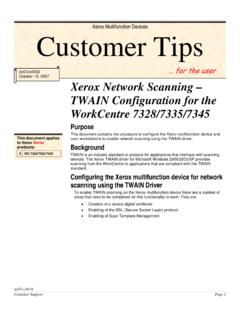
2 PDUs are communication functions that allowNetwork Administrators to operate on a set of data within each of the Network 1 illustrates the relationship between these snmp system components. snmp Manager snmp Agent Management Information Base (MIB)Requesting and Setting MIBV aluesSNMP ManagerSending Responses andTrapsSNMP AgentFigure 1: Relationship Between snmp System ComponentsXerox Multifunction for the userdc00cc0118 July 22, 2003 This document appliesto these Xeroxproducts:xWC Pro 32/40 ColorxWC Pro 65/75/90xWC Pro 35/45/55xWC M35/M45/M55xDC 555/545/535xDC 490/480/470/460xDC 440/432/425/420xDC 340/332xDC 265/255/240xDC 230/220 DCCS 50dc00cc0118 Page 2 Customer SupportSNMP ManagerThe snmp Manager is software that runs on a host computer.
3 The System Administratoruses the snmp Manager to communicate with the Agent to manage the informationstored in the Network element. The snmp Agent runs on each Network element and isable to access specific items in the MIB as they are defined on that device. The Agentexchanges information with the Manager by using Protocol data units (PDUs) explainedin the " snmp Protocol " section of this document. The Manager s main role is to pollAgents for specific requested information. The Manager is configured to passively listento the Network for specific traffic (Traps) and take the appropriate , an Agent is a program that resides on the networked device and listens forrequests from a Manager, then sends out the appropriate PDU response messages tothe Agent can also send unsolicited Traps to the Manager.
4 Traps are messages alertingthe snmp Manager to a condition on the Network . Traps can indicate incorrect use ofauthentication, printer re-starts, link status, closing of a TCP connection, or loss of aconnection to a neighbor communication Information Base (MIB)An snmp Agent uses a database of information when the snmp Manager requestsvalues from it. This collection of data is referred to as the Management Information Base(MIB). The information in the MIB follows the Structure of Management Information (SMI).SMI is the standard that defines the structure of a MIB so that any process that queriesthe receives an expected can think of the MIB as a tree.
5 The base of the tree contains the most genericinformation. As you climb the tree, more detailed information about each separate aspectof an element is revealed until all information pieces about a device are exposed. Each ofthese pieces is known as an Object ID (OID). The lowest level of the tree is usuallyreferred to as Internet. The major branches are named after the more specific types ofdevices such as host, printer, private data, and MIB uses the Abstract Syntax Notation 1, ( ) naming convention to name all thevariables. guarantees a unique and absolute name space to access MIBvariables. For example, the naming convention for the MIB variable that counts incomingIP datagrams, ipInReceives, MIBs provide variables that can be stored (set) or read (get), to change parameters orprovide information on Network devices and interfaces.
6 The snmp Agent contains MIBvariables with values that the snmp Manager can request or change. A Manager can geta value from an Agent or set a value in that Agent. The Agent gathers data from the MIBin response to the Manager s request to get or set of MIBsThere are three types of MIBs: Public: Public MIBs follow the standard MIBs and can be accessed by any vendorthat uses snmp as the vehicle of communication. Private: MIB implementation can be extended to accommodate the addition of newobjects. This flexibility allows different vendors to create objects to manage thespecific and unique entities of their products. Private MIBs can be published andmade available to the public if desired.
7 Private MIBs follow standard SMIconventions. Thus, when appropriate access is granted, it is possible for differentvendors to manage other vendor s private SupportPage 3 Public/Experimental: The Public/Experimental MIB is used by vendors to is a Simple means of communicating between Network managers and networkelements. The architectures of the PDU and MIB structures are very Simple . It is thissimplicity that gives snmp its flexibility and ProtocolProtocol Data Units (PDUs) represent the basic vocabulary through which SNMPM anagers and agents communicate information. PDU s are asynchronous in nature. Thismeans communication between the Manager and Agent is broken into two messages,request and Version 1defines five types of PDUs.
8 GetRequest getNextRequest getResponse setRequest TrapThe getRequest and getNextRequest PDU operations retrieve data from networkelements (see Figure 2 and 3). The setRequest operation allows for the modification ofdata on the Network element (see Figure 4). The response to these PDUs is returned withthe getResponse command. The last PDU, Trap, allows the Network element tobroadcast data under certain conditions (Figure 5).These five operations accomplish three primary tasks for the client software: A client PC can read a piece of information. A client can change a piece of information. A device initiates the communication of information to the client when it uses theTrap OperationsEach of these PDUs operate on a set of data contained within the MIB.
9 The name of avalue in a MIB is an Object Identifier (OID).getRequest OperationSNMPM anagerSNMP AgentgetRequest (OID)getResponse (Data)(1)(2)Figure 2: snmp getRequest Operation1. getRequest informs the snmp Agent to obtain the value of an object identifier(OID).2. getResponse returns the value associated with the OID from the snmp -Agent' 4 Customer SupportgetNextRequest OperationSNMPM anagerSNMP AgentgetNextRequest (OID)getResponse (Data)(1)(2)Figure 3: snmp getNextRequest Operation1. getNextRequest informs the snmp Agent to obtain the value of the next OIDfollowing the requested getResponse returns the value associated with the next OID from the snmp -Agent's technique is used to "walk" the MIB to allow a client to interrogate each valuecontained within the MIB.
10 When there is no "next" OID, the snmp Agent returns an OperationSNMP ManagerSNMP AgentsetRequest (OID,data)getResponse (Data)(1)(2)Figure 4: snmp setRequest Operation1. setRequest tells the snmp Agent to modify the value of an OID to a specific getResponse returns the value that was set by the snmp Agent, or an error, if theManager has insufficient permissions, or the OID is not SupportPage 5 Trap OperationSNMPM anagerSNMP AgentTrap (OID,value,timeStamp)(1)Figure 5: snmp Trap OperationThe Trap allows an snmp Agent to communicate a changed value when the valuecrosses a pre-specified snmp Agent can be configured to send Trap information to the designated SNMPM anager(s).