Transcription of SNAKEBITE / CROTALID ANTIVENOMS
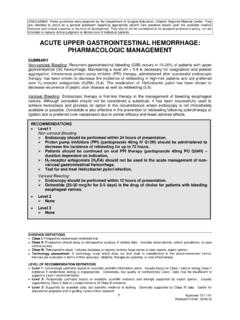
1 DISCLAIMER: These guidelines were prepared by the Department of Surgical Education, Orlando Regional Medical Center. They are intended to serve as a general statement regarding appropriate patient care practices based upon the available medical literature and clinical expertise at the time of development. They should not be considered to be accepted protocol or policy, nor are intended to replace clinical judgment or dictate care of individual patients. SNAKEBITE / CROTALID ANTIVENOMS . SUMMARY. SNAKEBITE / CROTALID envenomations are characterized by an erratic and unpredictable clinical course.
2 They should be considered medical emergencies requiring close monitoring. Manifestations of CROTALID envenomations may include local tissue injury, coagulopathy, and severe systemic effects. Treatment for venomous snakebites includes aggressive supportive care and prompt administration of antivenom to selected patients. Although prospective data on CROTALID ANTIVENOMS are limited, use of antivenom in progressive CROTALID envenomations should be considered. RECOMMENDATIONS. Level 1. None Level 2. antivenom should be administered within 6 hours of North American CROTALID envenomation to patients showing evidence of progressive or severe venom injury.
3 FabAV initial dose is 4 to 6 vials IV over 60 minutes. An additional dose of 4 to 6 vials should be given if initial control is not achieved with the first dose. After initial control is achieved, 2 vials may be administered every 6 hours for up to 18 hours (total of 3 additional doses). Level 3. Late administration of antivenom (greater than six hours post-envenomation) may be beneficial in patients with coagulopathy and local symptoms. Follow-up evaluation after 7 days may be prudent to assess the patient for delayed coagulopathy. INTRODUCTION.
4 Although relatively infrequent, approximately 8,000 venomous snakebites resulting in significant morbidity and several deaths occur each year in the United States (1,2). In the United States, the primary snakes of concern belong to the subfamily Crotalinae, also known as the pit vipers: rattlesnakes, cottonmouths, and copperheads. SNAKEBITE envenomations are characterized by an erratic and unpredictable clinical course, making assessment and determination of the severity of envenomation difficult. They should be considered medical emergencies requiring close monitoring in the intensive care unit.
5 Manifestations of CROTALID envenomations may include local tissue injury, such as marked tissue swelling, pain, ecchymosis and severe coagulopathies characterized by hypofibrinogenemia, prolonged prothrombin time (PT), variable changes to activated partial thromboplastin time (aPTT), and decreased platelet count (2). EVIDENCE DEFINITIONS. Class I: Prospective randomized controlled trial. Class II: Prospective clinical study or retrospective analysis of reliable data. Includes observational, cohort, prevalence, or case control studies.
6 Class III: Retrospective study. Includes database or registry reviews, large series of case reports, expert opinion. Technology assessment: A technology study which does not lend itself to classification in the above-mentioned format. Devices are evaluated in terms of their accuracy, reliability, therapeutic potential, or cost effectiveness. LEVEL OF RECOMMENDATION DEFINITIONS. Level 1: Convincingly justifiable based on available scientific information alone. Usually based on Class I data or strong Class II. evidence if randomized testing is inappropriate.
7 Conversely, low quality or contradictory Class I data may be insufficient to support a Level I recommendation. Level 2: Reasonably justifiable based on available scientific evidence and strongly supported by expert opinion. Usually supported by Class II data or a preponderance of Class III evidence. Level 3: Supported by available data, but scientific evidence is lacking. Generally supported by Class III data. Useful for educational purposes and in guiding future clinical research. 1 Approved 10/22/2007. Revised 11/30/2010. Additionally, severe systemic effects including altered mental status, tachycardia, respiratory distress, and hypotension can occur (2).
8 Treatment for venomous snakebites includes aggressive supportive care and prompt administration of antivenom to selected patients, antivenom therapy Administration of antivenom is generally indicated in the presence of progressive venom injury, defined as worsening local injury ( , swelling, ecchymosis), development of a clinically important coagulation abnormality, or systemic effects ( , hypotension, altered mental status) (3). The severity of envenomations by North American pit vipers can be assessed by using the guidelines provided below.
9 ANTIVENOMS work by binding and neutralizing venom toxins, facilitating redistribution away from target tissues and elimination from the body (4). Use of antivenom may result in increased patient comfort and fewer invasive treatment measures such as incision or excision of the bite site or performance of a fasciotomy (5,6). Guidelines for Assessing the Severity of North American Pit-Viper Envenomations (1). Signs and Severity of Envenomation*. Symptoms Minimal Moderate Severe Swelling, erythema, or Progression of swelling, Rapid swelling, erythema, or Local ecchymosis confined to erythema, or ecchymosis ecchymosis involving the the site of the bite beyond the site of the bite entire body part Non-life-threatening signs Markedly severe signs and and symptoms (nausea, symptoms (hypotension No systemic signs or vomiting, perioral [systolic blood pressure <80.))]
10 Systemic symptoms paresthesias, and mild mm Hg], altered sensorium, hypotension) tachycardia, tachypnea, and respiratory distress). Markedly abnormal coagulation profile with evidence of bleeding or threat Mildly abnormal coagulation of spontaneous hemorrhage No coagulation profile without clinically (unmeasurable INR, APTT, abnormalities or other Coagulation significant bleeding; mild and fibrinogen; severe important laboratory abnormalities on other thrombocytopenia with abnormalities laboratory tests platelet count <20,000 per mm3).