Transcription of Social Security Administration
1 Facts For Nursing Homes S o c i a l S e c u r i t y A d m i n i s t r a t i o n On This Topic: Representative Payee. Who needs a payee and how you can help. SSI and Short Term Stays. Continued full SSI payments Power of Attorney. Why Social Security needs more. Employee Facts. Your Social Security Statement and Retirement benefits. Most people who receive Social Security or Supplemental Security Income (SSI) benefits handle their own finances. Others need assistance in the management of their money. Nursing homes are often the first to alert Social Security that a person is no longer capable of handling his or her own benefits. Social Security law requires that some persons, such as most minor children, legally incompetent adults, and persons receiving disability benefits who have substance or alcohol abuse history, have a Representative Payee. In other situations, adults are pre-sumed able to manage their own benefits, unless Social Security is presented evidence, usually medical or lay, that indicates the person is no longer mentally capable of handling his or her own finances.
2 Social Security 's Representative Payment Program provides financial management for the Social Security and SSI payments of our beneficiaries who are incapable of managing their Social Security or SSI payments. When Social Security encounters one of the above situations, we begin the process of finding and appointing an appropriate Representative Payee. Once a Representative Payee is appointed by Social Security , the payee is able to conduct business on the mentally incapable person s behalf with our agency. Sometimes nursing homes even serve as Representative payee. It should be noted that persons with physical impair-ments but no mental impairments rarely need a Representative Payee because, in most situations, they are able to manage or direct the management of their benefits. If you encounter someone in your facility who you feel may not be able to manage his or her own Social Security or SSI funds, notify your local Social Security office or call our toll free number, 1-800-772-1213.
3 We will then begin the process to determine that person s ability to manage his or her benefits. Why a Representative Payee? SSI and Short Term Stays People who reside in a public institution generally are ineli-gible for Supplemental Secu-rity Income (SSI). However, certain people, who reside in medical institutions, may be able to continue to receive their full SSI payments during a temporary stay. SSI recipients can qualify for these continued payments if they need to maintain and pay expenses associated with their permanent residence and a doctor certifies they are ex-pected to be in your facility 90 days or less. Social Security must receive evidence of these require-ments by the 90th day after the person has entered your insti-tution or by the date of dis-charge, which ever is the ear-liest date. You can help people qualify for continued SSI payments by promptly notifying (or helping them notify) the local Social Security office of their temporary stay in your facili-ty.
4 Do this as soon as possi-ble after their entrance into your facility, but no later than 90 days. You can also call our toll free telephone num-ber, 1-800-772-1213. Last Update 07/13/2017 Helpful Tip: Safeguard your Social Security card and number to prevent identity theft. Do not carry your card with you unless you are seeking employment or Social Security ser-vices. Resources Guide for Organizational Payees To help you under-stand the duties and responsibilities of a representative payee Why Social Security Doesn t Use Power of Attorney Many businesses and financial institutions recognize a Power of Attorney as a legal in- strument giving the holder the right to negotiate business on another person s behalf. However, Treasury Department does not recognize a POA for negotiating federal pay-ments, including Social Security or SSI checks. The Social Security Act protects a person s right to receive benefits directly and to use them as he or she sees fit by prohibiting the assignment of benefits.
5 Sending the benefits to a third party serving as a beneficiary or recipient s POA is therefore contrary to the protections granted by the Social Security Act. However, Social Security can appoint a Representative Payee to receive the Social Security or SSI benefits for anyone who can-not manage or direct the management of his or her benefits. POAs may apply to serve as Representative Payees. Events often happen which may affect benefit eligibility. By law, the responsibility for reporting these events to Social Security is placed directly on the beneficiary or the bene-ficiary s Representative Payee. When payments are negotiated, the beneficiary or the payee attests to their continued eligibility for payment. If benefits are misused, they can be recouped from a the Representative Payee. This is not true with the POA. In light of these facts, Social Security has determined it is inappropriate for POAs to con-duct business with Social Security on another person s behalf.
6 With a few exceptions, the process generally requires a face-to-face interview unless: Social Security Administration PAGE 2 Retirement Benefits Full, unreduced Retirement Benefits are payable to eligible workers at their full retirement age. If you were born from 1943 to 1960, the age at which full retirement benefits are payable increases gradually to age 67. If your birth year is 1948 or earlier, you already are eligible for your full Social The Social Security Statement: All workers, age 18 and older are now able to request their Social Security Statement online. You can create a Social Security online account to get your Social Security Statement, to re-view estimates of your retirement, dis-ability, and survivors benefits; your earnings record; and the estimated So-cial Security and Medicare taxes you paid. The Social Security Statement is a valuable financial planning tool. It is important to review your statement annually to ensure your earnings record is accurate.
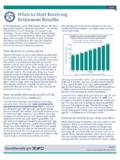
7 The Social Security bene-fits you will receive in the future are based on the earnings shown on your Social Security record. If you discover that your record is inaccurate, contact Social Security as soon as possible. Go to: Security benefit. Use the following chart to find out your full retirement age. When to Start Receiving Retirement Benefits Eligible workers can still elect to receive reduced retirement benefits as early as age 62. Social Security retirement benefits are increased by a certain percentage (depending on date of birth) if you delay your retirement beyond full retirement age. The benefit increase no longer ap-plies when you reach age 70, even if you continue to delay taking benefits. Medicare If you are within three months of age 65 or older and not ready to start your monthly cash benefits yet, you can use our online retirement application to sign up just for Medicare and apply for your retirement or spouses benefits later. For more information, visit our website Important Information for Nursing Home Employees The Social Security Act protects a person s right to receive benefits directly.
8 Year of birth Full retirement age 1943-1954 66 1955 66 and 2 months 1956 66 and 4 months 1957 66 and 6 months 1958 66 and 8 months 1959 66 and 10 months 1960 or later 67