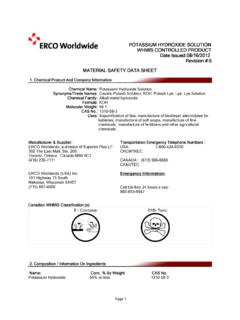
Transcription of SODIUM CHLORATE SOLUTION 20% - 50% Date …
1 Page 1 SODIUM CHLORATE SOLUTION 20% - 50%WHMIS CONTROLLED PRODUCTDate Issued:06/08/2012 Revision #:5 material safety data sheet 1. Chemical Product And Company InformationChemical Name: SODIUM CHLORATE SOLUTION 20% - 50%Synonyms/Trade Names: SODIUM CHLORATE , Aqueous SOLUTION ; CHLORATE of Soda; ERCOCIDE S; R8 SOLUTION ; R2 SolutionChemical Family: Inorganic compoundFormula: NaClO3 Molecular Weight : No.: 7775-09-9 Uses: Oxidizing agent; pulp bleaching; defoliant; & Supplier:Transportation Emergency Telephone Numbers :ERCO Worldwide, a division of Superior Plus LP302 The East Mall, Ste. 200 Toronto, Ontario Canada M9B 6C7(416) 239-7111 ERCO Worldwide Km1 camino antiguo a Angol, Villa Mininco, IX RegionCasilla 10-D, Angol, CHILE56-2-597-7200; 56-2-597-7208 CANADA: (613) 996-6666 CANUTECUSA:1-800-424-9300 CHEMTREC Canadian WHMIS Classification (s):C - Oxidizing D2B- Other Toxic Effects 2.
2 Composition / Information On Ingredients Name: Conc. % By Weight CAS CHLORATE Solution20% - 50% 7775-09-9 Page 2 3. Hazard IdentificationEmergency Overview : SODIUM CHLORATE SOLUTION is clear to very pale yellow. The SOLUTION is oderless. It is harmful if swallowed. SODIUM CHLORATE is a very strong oxidizer. SODIUM CHLORATE does not burn but contact with organic materials such as wood, paper, oil, clothing may cause fire or explosion. In case of a fire, only use water to extinguish the fire. May form shock sensitive mixtures. Contact with acids may produce toxic chlorine dioxide and chlorine of Entry :EFFECTS OF SHORT -TERM (ACUTE) EXPOSURE:SKIN CONTACT: Direct contact with dust or concentrated solutions can cause mild CONTACT: Dust or mist may cause temporary eye irritation and mild pain until material is rinsed from the surface of the : Non-occupational ingestion has produced death.
3 Initial symptoms include vomiting, diarrhea, nausea, and abdominal pain. After several hours or more, there may be severe intestinal bleeding, destruction of red blood cells and formation of inactive hemoglobin. Urine may be dark with blood clots. Within a day, kidney damage or kidney failure may occur, with cessation of urination. Liver damage, laboured breathing, convulsions, and coma may also may take several weeks and may not be complete. The human adult lethal dose is estimated at 5 to 10 : SODIUM CHLORATE dust or mist may cause coughing and mild temporary irritation of the nose and OF LONG -TERM (CHRONIC) EXPOSURE:Repeated and prolonged exposure of the skin can cause dermatitis. Repeated exposure by inhalation or ingestion may result in toxic effects, which appear gradually over weeks.
4 Initially there may be abdominal pain, followed by internal bleeding, destruction of red blood cells, lung damage, liver damage, and kidney damage. The skin may be of Exposure :Mild irritation on skin contact. Prolonged exposure may cause dermatitis. Eye contact may cause itching and burning. SODIUM CHLORATE is harmful if swallowed. Ingestion of large amounts may be fatal. May be irritating to the respiratory system if SODIUM CHLORATE dust is inhaled. Page 3 4. First Aid MeasuresSkin:Wash with soap and water. Remove any contaminated clothing and water wash it on site before :Flush immediately with plenty of lukewarm water for at least 15 minutes, holding the eyelids open. Get medical attention if irritation :Move the victim to fresh air.
5 If symptoms persist get medical :DO NOT GIVE ANYTHING BY MOUTH OR INDUCE VOMITING IF THE PATIENT IS the patient is conscious, give one or two glasses of water to dilute stomach contents, and induce vomiting. SODIUM thiosulfate (2-5g in 200 ml of 5% SODIUM bicarbonate) is a specific antidote that inactivates the CHLORATE ion. Get medical attention promptly. 5. Fire-Fighting MeasuresConditions Of Flammability : SODIUM CHLORATE is not combustible, but it is a strong oxidizer. Mixtures of the SOLUTION with combustible materials, if allowed to dry, can ignite easily and burn fiercely, or may To Extinguish :WATER IS THE ONLY EFFECTIVE EXTINGUISHER for fires involving SODIUM NOT use dry chemical fire extinguishing agents containing ammonium compounds (such as some A:B:C agents), since an explosive compound can be formed.
6 DO NOT use carbon dioxide, dry chemical powder or other extinguishing agents that smother flames, since they are not effective in extinguishing fires involving Combustion Products :After water is lost on heating as in a fire situation, oxygen is released. This promotes fierce burning of any combustibles which are Point & Method: Not applicableUpper Flammability Limit : Not applicableLower Flammability Limit : Not applicableAuto-Ignition Temperature : Not applicableMechanical Impact Sensitivity : Experimental data is not available. Not notably sensitive unless contaminated with Discharge Sensitivity : Experimental data is not available. Not notably sensitive unless contaminated with combustibles. Page 4 6. Accidental Release MeasuresLeak Or Spill Procedures :Contain and collect spilled material if possible into clean containers, then flush down the spill area with water.
7 Keep spills and residues out of sewers and the external environment. Keep materials which can burn away from spilled Control Procedures :Reuse recovered material if possible, otherwise return it to the manufacturer. Thoroughly wash or incinerate all contaminated combustible material in an environmentally acceptable manner before it dries out. 7. Handling StorageHandling Procedures And Equipment :No smoking, flames or sparks may be allowed where SODIUM CHLORATE is stored or used. Clothing fires are the principal hazard when working with this material in an industrial setting - immediately wash any clothing contaminated with CHLORATE . Do not wear leather boots since they are a potential fire and personnel safety hazard upon exposure to or flame cutting should be avoided near SODIUM CHLORATE due to fire hazard.
8 If this cannot be avoided, a designated fire watch with a charged water hose in hand should be in attendance throughout the :Store in a cool, dry, fireproof area. Keep away from combustible or readily oxidizable materials and acids. Recover or wash away any spillage promptly. 8. Exposures Controls / Personal ProtectionProtective Equipment :For intermittent exposures with a high potential of contact with SODIUM CHLORATE , wear PVC or rubber rainsuit, hard hat, rubber or plastic gloves, rubber boots, and safety glasses or goggles. Wash down clothing, gloves and boots after each use to remove traces of SODIUM CHLORATE . For continuous use with a low likelihood of exposure to SODIUM CHLORATE , wear polyester/cotton clothing (flame retardant recommended) in lieu of rainsuit, but keeping rubber boots (Do Not Wear Leather Boots) and gloves, hard hat and safety glasses.
9 Change clothing at the end of each work shift or when it may be contaminated. Keep contaminated clothing wetted between taking it off and washing it. Do not send clothing which may be contaminated with CHLORATE off site to be washed. Tuck pants into boots, to avoid absorbing any SOLUTION which may be on the floor. A dust mask should be worn where there may be exposure to SODIUM CHLORATE Controls :Keep both crystal and solutions contained. Do not use combustible materials of construction where CHLORATE will be used or stored. Page 5 9. Physical And Chemical PropertiesState: LiquidOdour: NoneOdour Threshold : Not applicableBoiling Point: This will vary according to SOLUTION composition, and is typically in the range 102 - 108 C Melting Point: Not applicableFreezing Point: This will vary according to SOLUTION composition and concentration.
10 Ice will crystallize from 20% SOLUTION @ -8 C. Ice+NaClO3 will crystallize from a 40% SOLUTION @ -18 C. NaClO3 will crystallize from 50% SOLUTION @ +25 : 7 - 9 for all concentrationsCoefficient Of Water /Oil Distribution: Not availableAppearance: Clear, colourless to pale yellow SOLUTION . Specific Gravity : This will vary according to SOLUTION composition, and is typically in the range - Pressure : Not applicable. Vapour is Density : Not applicableEvaporation Rate : No information availableSolubility In Water : Product is water SOLUTION and can be diluted at any Density: Not applicable 10. Stability And ReactivityChemical Stability:Stable, but see "Hazardous decomposition products" below. Note: In intense fire situations there have been several cases of violent explosions attributed to SODIUM CHLORATE by Conditions :Reaction may occur when mixed with any combustibles, especially in the presence of heat or a source of ignition.