Example: marketing
Soil Moisture Content Test
Soil Moisture Content 3 PROCEDURE For fine-grained soils 1. Clean and dry the weighing tin+lid and weigh to 0.01 g (W 1). (See Note 2.) Select a representative quantity of moist soil in the amount specified by a test. Where not otherwise specified use at least 30 g. Place the sample in the weighing tin and replace lid. Weigh the tin and ...
Tags:
Information
Domain:
Source:
Link to this page:
Documents from same domain
Unified Soil Classification System
www.environment.nsw.gov.auUnified Soil Classification System: Field Method 1 Department of Sustainable Natural Resources. SOIL SURVEY STANDARD TEST METHOD. UNIFIED SOIL CLASSIFICATION
Soil Organic Carbon Test - Office of Environment …
www.environment.nsw.gov.auOrganic Carbon 1 Department of Sustainable Natural Resources SOIL SURVEY STANDARD TEST METHOD ORGANIC CARBON ABBREVIATED NAME OC TEST NUMBER C6 TEST METHOD TYPE A VERSION NUMBER 2 ...
Soil Particle Size Analysis Test - Office of …
www.environment.nsw.gov.auParticle size analysis is the standard laboratory procedure for the determination of the particle size distribution of a soil.
Technical Notes: Assessment and management of …
www.environment.nsw.gov.auTechnical notes: assessment and management of odour from stationary sources in NSW page 1 1 Classifying odour sources 1.1 Applying ground-level and odour assessment criteria to point
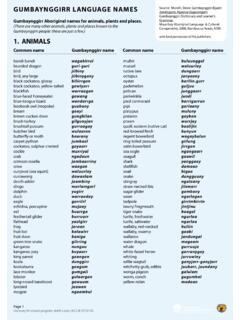
GUMBAYNGGIRR LANGUAGE NAMES Jandaygam, …
www.environment.nsw.gov.auGUMBAYNGGIRR LANGUAGE NAMES Gumbaynggirr Aboriginal names for animals, plants and places. (There are many other animals, plants and places known to the

Compliance Audit Handbook - NSW Environment …
www.environment.nsw.gov.auThis Compliance Audit Handbook has been produced by the Compliance and Assurance Section of the Department of Environment and Conservation NSW (DEC).

scarredtrees ABORIGINAL in New South Wales …
www.environment.nsw.gov.auABORIGINAL SCARRED TREES IN NEW SOUTH W ALES A FIELD MANUAL scarredtreesABORIGINAL in New South Wales Afield manual www.environment.nsw.gov.au

Sample Education Monitoring and Evaluation Plan
www.environment.nsw.gov.auMonitoring and evaluation plan - form 2 1. Project objectives 1 Develop and pilot a range of education tools and strategies to effectively educate residents, including
Emerson Aggregate Test - NSW Environment & …
www.environment.nsw.gov.auEmerson Aggregate Test 3 DETERMINATION OF THE EMERSON AGGREGATE CLASS Determine the Emerson Aggregate Class Number from …
Use of effluent by irrigation - NSW Environment & …
www.environment.nsw.gov.auForeword Water recycling is becoming a critical element for managing our water resources. By safely irrigating recycled water, sustainable development can be
Related documents
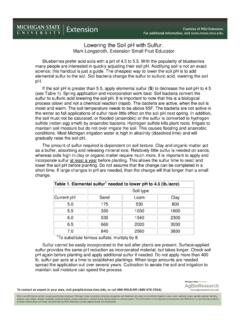
Lowering the Soil pH with Sulfur. Mark Longstroth ...
www.canr.msu.eduThe bacteria are active, when the soil is moist and warm. The soil temperature needs to be above 55F. The bacteria are not active in the winter so fall applications of sulfur have little effect on the soil pH next spring. In addition, the soil must not be saturated, or flooded (anaerobic) or the sulfur is converted to hydrogen

12 Orders of Soil Taxonomy - Home - Soil | Soil Science ...
www.soils.orgSoil surveys are inventories of the soil resources in a geographic area and include: • morphologic descriptions of a soil profile (including soil color, patterns, horizons, depth, ... Climate – temperature and moisture influence the speed of chemical and biological reactions, which help

The importance of soil organic matter
www.fao.orgTemperature fluctuations at a soil depth of 3 cm in a cotton crop with and without a soil cover of mucuna 39 19. Effect of organic matter on soil pH 42 20. Maize yield under conventional tillage and direct sowing, with and without 90 kg of N fertilizer 44 ...

U.S. Land Use and Soil Classification
www.ars.usda.govis made up of soils that have soil limitations within the rooting zone, such as shallowness of the rooting zone, stones, low moisture-holding capacity, low fertility that is difficult to correct, and salinity or sodium content. Subclass c. is made up of soils for which the climate (the temperature or lack of moisture) is the major
8 Managing Soil pH and Crop Nutrients
extension.cropsciences.illinois.eduperfect: a soil test represents a measurement at one point in time, while a crop takes nutrients through an extended period, and typically under very different soil-water and temperature conditions than at the time of sampling; the information generated typically comes from a sample from the plow layer, but the crop roots extract nutrients below
Introduction to Soil Mechanics Geotechnical Engineering
drshahpak.weebly.com3 Objectives of Soil Mechanics To perform the Engineering soil surveys. To develop rational soil sampling devices and soil sampling methods. To develop suitable soil testing devices and soil testing methods. To collect and classify soils and their physical properties on the basis of fundamental knowledge of soil mechanics. To investigate the physical properties of soil and

Soils and Climate
www.soils.orgClimate refers to the temperature and moisture conditions of an area over time. Climate is the typical pattern of the area over the long term, but weather is the actual daily condition. Of interest, climate is one of the five soil forming factors and has a significant influence on the properties of soil. Soils in warmer or wetter climates are more