Transcription of Soil Strength - i-astm.com
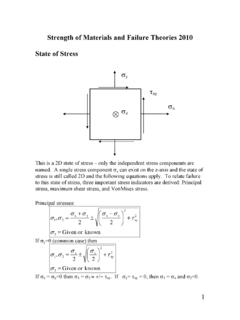
1 soil StrengthSoil strengthu Soils are essentially frictional materials the Strength depends on the applied stressu Strength is controlled by effective stresses water pressures are requiredu soil Strength depends on drainage different strengths will be measured for a given soil that(a) deforms at constant volume (undrained) and(b) deforms without developing excess pore pressures (drained)Mohr-Coulomb failure criterionThe limiting shear stress ( soil Strength ) is given by = c + n tan where c = cohesion (apparent) = friction angle n The parameters c, are in general not soil constants.
2 They depend on the initial state of the soil (OCR or Id ) the type of loading (drained or undrained) The Mohr-Coulomb criterion is an empirical criterion, and the failure locus is only locally linear. Extrapolation outside the range of normal stresses for which it has been determined is likely to be failure criterionEffective stress failure criterion =+ cn'tan'c and are known as the effective (or drained) Strength the soil is at failure the effective stress failure criterion will always be stress failure criterion =+ cn'tan'c and are known as the effective (or drained) Strength behaviour is controlled by effective stresses, and the effective Strength parameters are the fundamental Strength parameters.
3 But they are not necessarily soil the soil is at failure the effective stress failure criterion will always be stress failure criterion =+cun utanIf the soil is taken to failure at constant volume (undrained) then the failure criterion can be written in terms of total stress ascu and u are known as the undrained Strength parametersTotal stress failure criterion =+cun utanIf the soil is taken to failure at constant volume (undrained) then the failure criterion can be written in terms of total stress ascu and u are known as the undrained Strength parametersThese parameters are not soil constants, they depend strongly on the moisture content of the stress failure criterion =+cun utanIf the soil is taken to failure at constant volume (undrained)
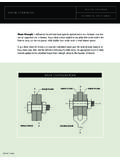
4 Then the failure criterion can be written in terms of total stress ascu and u are known as the undrained Strength parametersThese parameters are not soil constants, they depend strongly on the moisture content of the undrained Strength is only relevant in practice to clayey soils that in the short term remain undrained. Note that as the pore pressures are unknown for undrained loading the effective stress failure criterion cannot be to measure soil strength1. Shear Box TestMotor driveLoad cell to measure Shear ForceNormal loadRollersSoilPorous platesTop platenMeasure relative horizontal displacement, dx vertical displacement of top platen, dyu Usually only relatively slow drained tests are performed in shear box apparatus.
5 For clays rate of shearing must be chosen to prevent excess pore pressures building up. For sands and gravels tests can be performed quicklyu Tests on sands and gravels are usually performed dry. Water does not significantly affect the (drained) If there are no excess pore pressures and as the pore pressure is approximately zero the total and effective stresses will be identical. u The failure stresses thus define an effective stress failure envelope from which the effective (drained) Strength parameters c , can be box testTypical drained shear box resultsHorizontal displacement (dx)Shear Load (F)
6 Normal load increasingTypical drained shear box results = F/A = N/APeakUltimateN1N2u A peak and an ultimate failure locus can be obtained from the results each with different c and All soils are essentially frictional and continued shearing results in them approaching a purely frictional state where c = 0. u Normally consolidated clays (OCR=1) and loose sands do not show separate peak and ultimate failure loci, and for soils in these states c = Overconsolidated clays and dense sands have peak strengths with c > Note that dense sands do not possess any true cohesion (bonds), the apparent cohesion results from the tendency of soil to expand when of shear box testsShear box test - advantagesu Easy and quick test for sands and gravelsu Large deformations can be achieved by reversing shear direction.
7 This is useful for determining the residual Strength of a soilu Large samples may be tested in large shear boxes. Small samples may give misleading results due to imperfections (fractures and fissures) or the lack of Samples may be sheared along predetermined planes. This is useful when the shear strengths along fissures or other selected planes are Non-uniform deformations and stresses in the specimen. The stress-strain behaviour cannot be determined. The estimated stresses may not be those acting on the shear There is no means of estimating pore pressures so effective stresses cannot be determined from undrained testsu Undrained strengths are unreliable because it is impossible to prevent localised drainage without high shearing ratesIn practice shear box tests are used to get quick and crude estimates of failure parametersShear box test - disadvantagesTests to measure soil strength2.
8 The Triaxial TestCell pressurePore pressure and volume changeRubber membraneCell waterO-ring sealsPorous filter discConfining cylinderDeviator loadSoilStresses in triaxial specimens r r = Radial stress (cell pressure) a = Axial stressF = Deviator load rStresses in triaxial specimens r r = Radial stress (cell pressure) a = Axial stressF = Deviator load r arFA=+From equilibrium we haveStresses in triaxial specimensF/A is known as the deviator stress, and is given the symbol qqar= = ()() 13 The axial and radial stresses are principal stressesStresses in triaxial specimensF/A is known as the deviator stress, and is given the symbol qqar= = ()() 13 The axial and radial stresses are principal stressesIf q = 0 increasing cell pressure will result in volumetric compression if the soil is free to drain.
9 The effective stresses will increase and so will the strengthStresses in triaxial specimensF/A is known as the deviator stress, and is given the symbol qqar= = ()() 13 The axial and radial stresses are principal stressesIf q = 0 increasing cell pressure will result in volumetric compression if the soil is free to drain. The effective stresses will increase and so will the Strength increasing pore water pressure if soil volume is constant (that is, undrained). As the effective stresses cannot change it follows that u = rStresses in triaxial specimensF/A is known as the deviator stress, and is given the symbol qqar= = ()() 13 The axial and radial stresses are principal stressesIf q = 0 increasing cell pressure will result in volumetric compression if the soil is free to drain.
10 The effective stresses will increase and so will the Strength increasing pore water pressure if soil volume is constant (that is, undrained). As the effective stresses cannot change it follows that u = rIncreasing q is required to cause failureStrains in triaxial specimensFrom the measurements of change in height, dh, and change in volume dV we can determineAxial strainVolume strainwhere h0 is the initial height and V0 is the initial volume adhh= 0 VdVV= 0 Strains in triaxial specimensFrom the measurements of change in height, dh, and change in volume dV we can determineAxial strainVolume strainwhere h0 is the initial height and V0 is the initial volumeIt is assumed that the specimens deform as right circular cylinders.