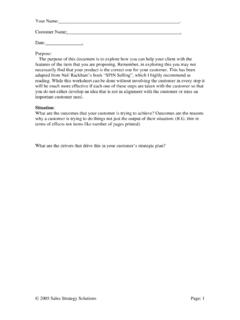
Transcription of SPIN Selling SITUATION PROBLEM IMPLICATION …
1 spin Selling SITUATION PROBLEM IMPLICATION NEED-PAYOFF By Neil Rackham 1. Sales Behavior and Sales Success Small Sales Selling Techniques The traditional Selling techniques that most of us have been trained to use work best in small sales a sale which can normally be completed in a single call and which involves a low dollar value. These Selling techniques don t work for major sales and in fact can hurt your success as the sales grow larger. Characteristics of Major Sales Longer Selling Cycle - Whereas a simple low-value sale can often be completed in one call, a major sale may require many calls spread over a period of months. Building Value is Critical to Sales Success - As the size of the sale increases, successful salespeople build up the perceived value of their products or services. The building of perceived value is probably the single most important Selling skill in larger sales. On-going Relationship As the sales grows larger, the customer puts more emphasis on the salesperson as a factor in the decision.
2 In a large sale, product and seller may become inseparable in the customer s mind. The Risk of Mistake Customer s become more cautious as the decision size increases. Purchase price is one factor, but fear of making a public mistake may be even more important. The Four Stages of a Sales Call - almost every sales call, from the simplest to the most sophisticated, goes through four distinct stages: Preliminaries These are the warming-up events that occur before the serious Selling begins. This includes such things as the way you introduce yourself and how you begin the conversation. Investigating Almost every sale involves finding something out by asking questions. Investigating is the most important of all Selling skills. Demonstrating Capability In every sales call you must convince your customer that you have something to offer. spin Selling Page 2 of 12 Obtaining Commitment Finally, a successful sales call will end with some sort of commitment from the customer.
3 Larger sales contain a number of intermediate steps that we call Advances. Each step advances the customer s commitment toward the final decision. The spin Sequence of Questions SITUATION Questions At the start of the call, successful people tend to ask data-gathering questions about facts and background. PROBLEM Questions they explore problems, difficulties, and dissatisfactions in areas where the seller s product can help. Inexperienced people generally don t ask enough PROBLEM Questions. IMPLICATION Questions are more complex and sophisticated types of questions. IMPLICATION Questions take a customer PROBLEM and explore its effects, helping the customer understand a PROBLEM s seriousness. Need-payoff Questions they get the customer to tell you the benefits that your solution could offer. Need-payoff Questions have a very strong correlation to sales success. The spin Model - These four types of questions SITUATION , PROBLEM , IMPLICATION and Need-payoff form a powerful questioning sequence that successful sales people use in the Investigating stage of the call.
4 2. Obtaining Commitment: Closing the Sale What is Closing? A close is anything that puts the customer in a position involving some kind of commitment from them. Consensus among writers of traditional Selling is: Closing techniques are strongly related to success. You should use many types of closes. You should close frequently during the call. A series of studies by Rackham conclude that traditional closing techniques have no place in large sales transactions and can be both ineffective and dangerous. Conclusions about Closing Techniques By forcing the customer into a decision by using closing techniques, it speeds the sales transaction. spin Selling Page 3 of 12 However, closing techniques reduce the chances of making a sale with expensive products. Closing techniques, like all forms of pressure, become less effective as decision size increases. Most professional buyers have an unfavorable view of closing techniques.
5 The more there is a continuing post-sale relationship with the customer the less effective are closing techniques. But You Most Close Sales training, over the years has clearly put too great an emphasis on closing. But it would be equally unfortunate if we let the pendulum swing so far the other way that we began to teach people never to close at all. Defining Closing Success in Larger Sales There are four possible outcomes of the sales call with larger sales: Orders to be an order, the customer must show an unmistakable intention to purchase, usually by signing some kind of paperwork. Calls that result in orders are less common in larger sales than most sellers would like. So there are relatively few occasions when you can close for the order. spin Selling Page 4 of 12 Advances are those times, either in a call or after it, which moves the sale forward toward a decision. Typical Advances might include: o A clearance that will get you in front of a higher level of decision maker.
6 O An agreement on need, with a promise for the needed information to prepare preliminary loan requests to prospective lenders. o A scheduled meeting to discuss lender proposals. All of these represent an agreement with the customer that moves the sale forward toward the ultimate decision. In larger sales the most common objective of closing would normally be to obtain an Advance. Successful closing in the major sales starts by knowing what Advance you can realistically obtain from the call. Continuations where the sale will continue but where no specific action has been agreed upon by the customer to move it forward. These calls don t result in an agreed action, yet neither do they involve a No from the customer. For example: o Thank you for coming. Why don t you visit us again the next time you re in the area. o We liked what we saw and we ll be in touch if we need to take things further. In none of these cases has the buyer agreed to a specific action, so there s no concrete sign that the sale has progressed.
7 Continuations are considered failures because these positive noises at the end of a call are a polite way to get rid of an unwanted seller. Whether a call has been successfully closed should be determined by customer s actions, not by their words. No-sales where the customer actively refuses a commitment. The Importance of Having a Clear Understanding of These Four Sales Outcomes Our studies of top salespeople consistently showed that they used their understanding of these different outcomes to help them close calls more effectively by turning Continuations into Advances. What s more, by understanding what kind of Advance would be required to make a call successful, top salespeople set the kind of realistic closing objectives that moved the sales forward. spin Selling Page 5 of 12 Setting Call Objectives in your planning, always include objectives that result in specific action from the customer. Know the difference between Continuations and Advances and become dissatisfied with setting call objectives that result only in a Continuation.
8 Obtaining Commitment: Four Successful Actions we found that there are four clear actions that successful people tend to use to help them obtain commitment from their customers: 1. Giving attention to Investigating and Demonstrating Capability Successful salespeople give their primary attention to the Investigating and Demonstrating Capability stages. If you can convince buyers that they need what you are offering, then they will often close the sale for you. 2. Checking that key concerns are covered. The most effective salespeople take the initiative and ask the buyer whether there were any further points or concerns that needed to be addressed. 3. Summarize the Benefits. Successful salespeople summarize key points of the discussion, especially Benefits, before moving to the commitment. 4. Proposing a commitment. At the point of commitment, successful salespeople don t ask for the order they tell. The most natural, and most effective, way to bring a call to a successful conclusion is to suggest an appropriate next step to the customer.
9 Propose the highest realistic commitment that the customer is able to give. Successful sellers never push the customer beyond achievable limits. Your objective is not to close the sale but to open a relationship. spin Selling Page 6 of 12 3. Customer Needs in the Major Sale Different Needs in Small Sales and Large Needs take longer to develop in the Investigating stage. Needs are likely to involve several people. Needs are more likely to be expressed on a rational basis even if the customer s underlying motivation is emotional. A decision that doesn t meet the needs of the client is likely to have a more serious consequence on the decision maker. Definition of need any statement by the buyer which expresses a want or concern that can be justified by the seller. Implied Needs statements by the customer of problems, difficulties and dissatisfactions with the present SITUATION . For example, I m not happy with my current loan.
10 Explicit Needs specific customer statements of wants or desires. For example, We need a loan with a longer amortization. Explicit Needs and Success As sales grow larger it becomes increasingly important to obtain Explicit Needs, not just Implied Needs. Explicit needs are the buying signals that predict success in larger sales. The real skill is how to convert Implied Needs into Explicit Needs so that the buyer wants to take action. When the customer starts to talk about action, that s when I hear buying signals. The purpose of questions in the larger sale is to uncover Implied Needs and to develop them into Explicit Needs. 4. The spin Strategy SITUATION Questions Collect facts and background data about the customer s existing SITUATION . They are not positively related to sales success. They are an essential part of questioning but they must be used sparingly so as not to bore or irritate the client. spin Selling Page 7 of 12 PROBLEM Questions These questions probe for problems, difficulties or dissatisfactions.