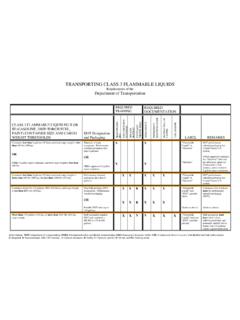
Transcription of SPRAYER CALIBRATIONS AND CALCULATIONS
1 APPENDIX K CALIBRATIONS , CALCULATIONS , & CONVERSIONS SPRAYER CALIBRATIONS AND CALCULATIONS1 TABLE K - 1. SPRAYER CALIBRATIONS AND CALCULATIONS Calculation Example Formula 1. Determining the gallon per Minute (GPM) required of nozzles to achieve a given gallon per Acre (GPA) Example 1 You want an output of 20 GPA. Your nozzles are 20 feet apart. Your field speed is 5 MPH. How much do you need to collect from each nozzle to achieve 20 GPA? 20 GPA x 5 MPH x 20 = 2000 5940 5940 = GPM per nozzle Example 1a - Convert Gallons per Minute (GPM) to Ounces per Minute (OPM) From Example 1 you have collected GPM from each nozzle. x 128 = 43 OPM per nozzle Example 1b - Convert OPM to GPM You have collected 43 OPM from each nozzle. 43 OPM / 128 = Formula 1 GPM = GPA x MPH x W 5940 GPM = Gallons per minute from one nozzle GPA = Gallons per acre W = nozzle spacing (inches) or; = spray width (inches) if using a broadjet or; = row spacing (inches) divided by the number or nozzles per row.
2 MPH = Field speed in Miles Per Hour 5940 = a constant Formula 1a OPM = GPM x 128 Formula 1b GPM = OPM / 128 2. Determining GPA when given nozzle GPM, spacing between nozzles and field speed Example 2 Nozzle spacing = 20 . Field speed = 5 MPH. You collected liquid from all of the nozzles for one minute and obtained an average of 51 ounces per nozzle. Convert 51 OPM to GPM 51 OPM / 128 = or 40 GPM per nozzle. GPM x 5940 = 5 MPH x 20 100 = or 24 GPA Formula 2 GPA = GPM x 5940 MPH x W 3. Determining required speed when you know GPA, GPM and spacing between nozzles or broadjet swath Example 3a Nozzle output = 10 GPM. Swath width = 35 feet (420 inches). Desired GPA = 30 GPA. What speed do you need to be traveling to achieve 30 GPA? 10 GPM x 5940 = 59,400 30 GPA x 420 12,600 = or 5 MPH *Broadjet Example: If you had nozzles that were 20 inches apart and GPM was GPM, the answer would be or 4 MPH.
3 Example 3b You want 30 GPA with a field speed of 7 MPH and nozzle spacing is 30 inches. Using formula #1, you determine that you need to collect 1 GPM from each nozzle. When you check the nozzles, the output is actually GPM. You can either change the nozzles or adjust your field speed to achieve 30 GPA. GPM x 5940 = 8,910 30 GPA x 30 inches 900 = or 10 MPH as the new field speed Formula 3 GPM x 5940 30 GPA x 420 4. How much area can my SPRAYER cover (acres)? Example 4 Your SPRAYER is calibrated at 30 GPA. You have a SPRAYER with a 500 gallon tank. How many acres can you treat with 500 gallons? How many can you treat with 250 gallons? 500 gallons 250 gallons 30 GPA 30 GPA = acres treated = acres treated Formula 4 Volume in tank = Acres Treated GPA 5. How much total solution do you need in order to spray a given acreage?
4 Example 5 You want to spray 10 acres and your SPRAYER is calibrated to 25 GPA. How much total solution do you need in your SPRAYER tank? 10 acres x 25 GPA = 250 gallons Formula 5 Acres to spray x GPA = Gallons required 6. How much pesticide, dry or Example 6a Your SPRAYER can treat 30 acres and the label calls for a rate of 1 pint Formula 6 1 Montana State University Extension Service, 2000. MontGuide MT 2000-14 Appendix K CALIBRATIONS , CALCULATIONS , Conversions Page K - 1 APPENDIX K CALIBRATIONS , CALCULATIONS , & CONVERSIONS Calculation Example Formula liquid, do you add to the tank when rate is given on a per acre basis? per acre. How much pesticide do you add to the tank? 30 acres x 1 pint = 30 pints or 3 gallons (30 / 8 pints per gallon ) Example 6b Using the information in Example 6a, you are using dry ingredients in ounces per acre. How much pesticide do you add to the tank to treat 30 acres?
5 30 acres x 10 ounces = 300 ounces or 18 pounds (300 / 16 oz. per pound) Acres treated x labeled rate = Amount of pesticide to add to the tank 7. How much liquid pesticide do you add to the tank when the rate is given according to pounds of active ingredient ( ) per acre? Example 7a A rate of 3 lbs/acre of the active ingredient ( ) is recommended. This pesticide contains 8 lbs. of per gallon of formulation. 3 lbs. per acre / 8 lbs. per gallon = gallons per acre or 1 quarts per acre ( x 4) or 3 pints per acres ( x 8) Example 7b You have calibrated a 300 gallon SPRAYER . It can spray acres per tank at 40 GPA. A recommendation indicates to apply pound per acre. The label indicates that it contains 2 pounds of per gallon . How much pesticide will you add to the tank to spray acres? lb = gallon (1 quart)/ac 2 lb acres/tank x 1 quart per acre = quarts Formula 7 Labeled Rate Per Acre = gallon amount to apply Amount of per gallon 8.
6 How much dry pesticide do you apply per acre when the rate is given as a percentage of Example 8 A recommended rate of lbs. of a 25% wettable powder (WP) is recommended (One pound of formulation contains lbs. ) lbs. per acre = lb formulation /ac lbs. To convert to ounces: lbs. x 16 ounces/lbs. (dry) = ounces per acre Formula 8 Recommended rate = lbs. of formulation/acre % per lbs of formulation 9. Check the output of boom nozzles. All nozzles across a boom need to be applying roughly the same amount of liquid within a certain error range (usually 5% on either side of the average). Clean and/or replace any nozzles that fall outside of your given error range. Example 9 You have a 10 nozzle boom and you have collected from under each nozzle for one minute. You noted the following nozzle outputs Nozzle = 1 2 3 4 5 6 7 8 9 10 Output (Oz)=43 44 47 42 46 44 50 41 42 42 = 441 oz.
7 Total Average Nozzle Output = 441 oz. / 10 nozzles = oz. For 5% error: oz. x = oz. to add and subtract from the average. Error range (5%) on either side of the average = oz. to oz. Nozzles 3, 7, & 8 needs to be cleaned or replaced. Note: If a nozzle s output is lower, it may be plugged and only need to be cleaned. Repeat this exercise until all nozzles fall with the error range. Formula 9 Nozzle 1 output + nozzle 2 output + etc. Number of nozzles on the boom = Average Nozzle Output Average Nozzle Output x = amount to add and subtract from the Average Nozzle Output to make an error range of 5%. 10. Adding Adjuvants to the Spray Tank Pesticide labels often suggest adding adjuvants to the spray mix, listing the rate of the adjuvant in terms of percentage of the spray mix, volume per acre, or volume per quantity of spray mix Example 10a When the rate is expressed as a % of the spray mix Total spray mix = 500 gallons.
8 Adjuvant rate is 1% of the finished spray volume. x 500 = 5 gallons of adjuvant added along with pesticide to make a 500 gallon solution Example 10b When the rate is expressed as a volume per acre. Your SPRAYER is calibrated to 30 GPA and you plan on using 300 gallons of solution. An adjuvant calls for a rate of 1 pint per acre. 300 gallons / 30 GPA = 10 acres x 1 pint per acre = 10 pints of adjuvant added along with pesticide to make a 300 gallon solution. Formula 10a % of spray mix x gallons of spray mix 100 = Gallons adjuvant needed Formula 10b Adjuvant needed = Adjuvant rate x acres to be treated Formula 10c Adjuvant needed = Rate per 100 gallons x gallons of spray mix 100 Appendix K CALIBRATIONS , CALCULATIONS , Conversions Page K - 2 APPENDIX K CALIBRATIONS , CALCULATIONS , & CONVERSIONS Calculation Example Formula Example 10c When the rate is expressed in quarts per 100 gallons.
9 Adjuvant rate = 2 quarts per 100 gallons. A total of 400 gallons of spray mix will be used. 2 quarts x 400 gallons total mix 100 gallons = 8 quarts of adjuvant to add along with pesticide to make a 400 gallon solution. 11. Dilution Rule Example 11 How much of a 50% concentrate is needed to make 100 gallons of a spray? 50 x Volume 1 (V1) = x 100; V1 = 3 gallons The final mixture (Volume 2 or V2) is the amount of the concentrate (V1) plus the required amount to make up to V2. If V1 = 3 gallons and the required amount is 100 gallons, add 97 gallons of water to 3 gallons of concentrate. Formula 11 C1 x V1 = C2 x V2 C1= % of in concentrate V1 = quantity of concentrate needed C2 = % desired in final mixture V1 = quantity of final mixture It is important that the units used are all the same: percent x pounds = percent x pounds or percent x volume = percent x volume Hints on Percentage Mixing A pesticide label may tell you to mix up a concentration or percentage of the product in water.
10 For example, mix 1 part of the pesticide concentrate and 99 parts water. This makes a 1 percent mixture. Since there are 128 fluid ounces in one gallon , ounces of a concentrate mixed into 1 gallon of water will make approximately a 1 percent mixture (Hint: 1 tablespoon is about ounce.) The label may also instruct you to make a spray solution with a specific percentage of active ingredient ( , for example, a one percent solution for a particular pest. If the pesticide is formulated as an emulsifiable concentrate (EC) containing 57 percent active ingredient. To make a 1 percent spray solution from this formulation, you would add 1 part of the pesticide to 56 parts of water. Glyphosate product rates based on formulation, acid equivalent (ae) and active ingredient (ai).2 Pounds ae/gal or ai/gal are found on glyphosate product labels. The following table displays conversions. ae ae ae ae ae lb ae lb ai fl oz/A 3 4 16 24 32 48 64 4 12 18 24 36 48 12 18 24 36 48 11 16 22 32 44 5 10 15 20 30 40 2 NDSU 2005 Appendix K CALIBRATIONS , CALCULATIONS , Conversions Page K - 3 APPENDIX K CALIBRATIONS , CALCULATIONS , & CONVERSIONS HAND-HELD / BACKPACK SPRAYER CALIBRATION TABLE K - 2.)