Transcription of Staff Training and Education
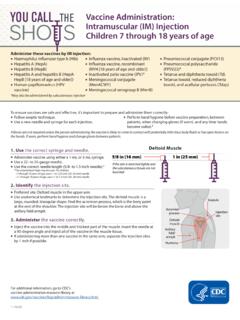
1 vaccine Administration796 Proper vaccine administration is a critical component of a successful immunization program. It is a key part of ensuring that vaccination is as safe and effective as possible. This chapter provides best practice guidance for vaccine admin-istration. The guidance should be used in conjunction with professional standards for medication administration and guidance from the vaccine foundation of medication administration is application of the Rights of Medication Administration. These rights should be applied to each encounter when vaccines are administered. These rights include the: Right patient Right vaccine and diluent (when applicable) Right time (including the correct age and interval, as well as before the product expiration time/date) Right dosage Right route (including the correct needle gauge and length and technique) Right site Right documentationVaccine providers should also incorporate the evidence-based safe injection practices, outlined on CDC s Injection Safety Information for Providers webpage, Staff Training and Education Improper administration of vaccines may result in injuries or prevent the vaccines from providing optimal protection.
2 All personnel who will administer vaccines should receive comprehensive, competency-based Training regarding vaccine administration policies and procedures before administering vaccines. Providers need to validate Staff s knowledge and skills regarding vaccine administration with a skills checklist. See the Skills Checklist for Immunization at for an example. Competency-based Training should be integrated into existing Staff Education programs such as new Staff orientation and annual Education requirements. Staff should receive ongoing Education , such as whenever vaccine administration recommendations are updated, or when new vaccines are added to the facility s inventory, to maintain Staff competency. Accountability checks should be put in place to ensure policies and procedures are followed. Trainings should also be offered to temporary personnel vaccine Administration Key to ensuring vaccination is as safe and effective as possible Incorporate professional standards for medication administration manufacturer s vaccine -specific guidelines evidence-based safe injection practices on CDC s Injection Safety Information for Providers webpageStaff Training and Education Before administering vaccines, all personnell who administer vaccines should receive competency-based Training validate knowledge and skills Integrate Training into new Staff orientation annual Education requirements when vaccine administration recommendations are updated when new vaccines are added to the inventory80 vaccine Administration 6who may be filling in on days when the facility is short staffed or helping during peak times such as flu season.
3 Evidence-based injection safety information and educational programs for healthcare personnel are available on the CDC Injection Safety website at In addition, the Immunization Action Coalition (IAC) offers web-based educational programs and job aids. IAC resources for administering vaccines can be found at Patient Care Before Administering vaccine All immunization providers should be knowledgeable regarding appropriate strategies to prepare and care for patients whenever vaccines will be administered. Immunization AssessmentThe patient s immunization history should be reviewed at every healthcare visit. When the patient arrives, providers should obtain a complete immunization history, and compare the patient s immunization record to the medical record and immunization information system or registry data, if available. Use the current immunization schedule based on the age of the patient to determine all recommended vaccines that are needed. Assess for all routinely recommended vaccines as well as any vaccines that are indicated based on health status, occupation, or other risk factors.
4 If a documented immunization history is not available, administer the vaccines that are indicated based on the person s age, medical condition and other risk factors. With the exception of influenza and pneumococcal polysaccharide vaccine (PPSV23), providers should only accept written, dated records as evidence of vaccination; self-reported doses of influenza vaccine and PPSV23 are accept able. This prevents missing an opportunity to vaccinate while the patient or parent searches for the immu-nization record. Screening for Contraindications and PrecautionsPatients and their family members count on providers and their Staff to administer vaccines safely. Screening for contraindications and precautions can prevent adverse events following vaccination. All patients should be screened for contraindications and precautions prior to administering any vaccine , even if the patient has previously received that vaccine . The patient s status may change from one visit to the next or recommendations regarding contraindications and precautions may have changed.
5 Staff should be knowl-edgeable of all possible contraindications and precautions to vaccination and only valid contraindications should Patient Care Before Administering Vaccines Obtain complete immunization history at every healthcare visit accept only written, dated records (exception influenza and PPSV23 self-report) use recommended schedule to determine vaccines needed based on age, medical condition, and risk factors Screen for contraindications and precautions prior to administering any vaccine (s) Discuss vaccine benefits and risks and vaccine -preventable disease risks using VISs and other reliable resources Provide after-care instructionsVaccine Administration816be followed. Information about contraindications and precautions can be found at Screening for contraindications and precautions should be included in vaccine administration procedures. Using a standardized screening tool helps Staff assess patients correctly and consistently. Many state immunization programs and other organizations have developed standard-ized screening tools.
6 Two examples are Screening Checklist for Contraindications to Vaccines for Children and Teens at and Screening Checklist for Contraindications to Vaccines for Adults at In addition, both screening checklists are available in other languages. To save time, some facilities ask patients to answer screening questions prior to seeing the provider, such as electronically via an electronic healthcare portal or with a paper copy and pen while in the waiting or exam room. Patient or Parent Education including vaccine Safety & Risk CommunicationResearch shows that parents want clear, consistent information from multiple sources they consider credible. Many of today s parents do not know very much about vaccine -preventable diseases, and therefore do not understand vaccines disease-protection benefits. They often cite the Internet as the source of vaccine information. However, some of the information available online is not accurate and conflicting. It can be difficult for a parent to know which sites to believe.
7 Therefore, parents may turn to their most trusted information source of vaccine information: their child s doctor or nurse. Healthcare profes-sionals need to be ready to provide parents with timely and transparent information about vaccine benefits and risks. Establishing an open dialogue promotes a safe, trust-building environment in which individuals can freely evaluate information, discuss vaccine concerns and make informed decisions regarding immunizations. Not all parents want the same level of medical or scientific information about vaccines. Healthcare professionals are encouraged to assess the level of information that each parent wants and provide clear and transparent information. Research shows that a provider s recommendation for vaccination is a powerful motivator. Immunization providers may be asked about many topics, including vaccine -preventable diseases, specific vaccines, the immunization schedule, and vaccine safety issues. Fortunately, there are many resources available to help providers stay up-to-date on all of these vaccine -related issues.
8 82 vaccine Administration 6 vaccine Information Statements (VISs) are information sheets produced by the Centers for Disease Control and Prevention (CDC) that explain to vaccine recipients, their parents, or their legal representatives both the benefits and risks of a vaccine . Federal law requires that VISs be handed out whenever vaccinations routinely recommended for children are administered, but CDC encourages the use of ALL VISs, whether the vaccine is covered by the law or not. The VIS should be given every time a dose of vaccine is administered, even if the patient has received the vaccine and a VIS in the past. VISs can be provided at the same time as the screening questionnaire, while the patient is waiting to be seen. They include information that may help the patient or parent respond to the screening questions. In addition to traditional paper copies, VISs are increas-ingly available in electronic formats that can read on smart phones and other devices.
9 Providers can also use the CDC website titled, Provider Resources for vaccine Conversations with Parents, available at to talk to parents of infants and young children. The materials available on this website are based on formative, mixed methods research, informed by risk communication principles, and reviewed annually by subject matter experts. In addition, all fact sheets are co-branded with the American Academy of Pediatrics and the American Academy of Family Physicians. In addition, healthcare professionals may find the CDC resource, Tips and Time-savers for Talking with Parents about HPV vaccine , available at , helpful when talking with parents of adolescents. A best practice strategy is to allow time for questions and discussion of after-care instructions with patients or parents/guardians before the vaccines are administered. This allows the parent to comfort the child immediately after the injection. After-care instructions should include information and strategies for dealing with side effects such as injection site pain, fever, fussiness (infants especially) and for determining when medical attention should be sought.
10 An age-appropriate dose of a non-aspirin-containing pain reliever may be considered to decrease discomfort and fever after vaccination. The prophylactic use of antipyretics before or at the time of vaccination is not recommended. Examples of after-care instructional materials for parents and patients are After the Shots at and After Receiving Vaccines at vaccine Administration836 Patient Care During vaccine Administration Patients should be prepared for vaccination with consid-eration for their age and stage of development. Parents/guardians and patients should be encouraged to take an active role before, during and after the administration of vaccines. Be There for Your Child During Shots is a handout for parents. It is located at vaccine safety concerns and the need for multiple injections have increased anxiety associated with immunizations for patients, parents and health-care personnel. Health-care providers need to display confidence and establish an environment that promotes a sense of security and trust.