Transcription of Steam Sterilization Principles - ISPE
1 1 PHARMACEUTICAL ENGINEERING NOVEMBER/DECEMBER 2013facilities and equipmentSteam Sterilization PrinciplesSteam Sterilization Principlesby Marcel Dion and Wayne ParkerThis article presents how a good understanding of basic Steam Sterilization Principles can help with avoiding most common mistakes made when using Steam team Sterilization has been used for more than a century to sterilize items that can withstand moisture and high temperature. Steam is water in the vapor state; therefore, it is non-toxic, generally readily avail-able, and relatively easy to control. A good understanding of basic Steam Sterilization Principles and cycles is necessary to avoid mistakes that can lead to non-sterile load items, poor performance of the equipment, personnel injury, lower productivity, higher operation and maintenance costs, and damage to load items.
2 Steam sterilizers are used for numerous applications in the pharmaceutical and medical device industries. The focus of this article is saturated Steam applications, such as laboratory media Sterilization , decon-tamination, and general component Sterilization . Terminal Sterilization of parenteral liquid products or devices containing liquids may require processes using Steam -air mixtures or super-heated water -air mixtures. These processes, as well as in-situ Sterilization of tanks, filters, etc., are not addressed in this Sterilization PrinciplesSix factors are particularly critical to as-sure successful Steam Sterilization :1. Time2. Temperature3. Moisture4. Direct Steam contact5. Air removal6. Drying 1.
3 TimeThe exposure ( Sterilization ) time is a critical factor simply because all the organisms do not die at the same time. A minimum amount of time at Sterilization temperature is required to kill all the organisms. Geobacillus stearother-mophilus (Bst) spores are generally used to test Steam steril-izer cycles because they are extremely resistant to moist heat Sterilization . They are also non-pathogenic and commer-cially readily available. The number of survivors is usually plotted on a logarithmic scale. A straight line survivor curve such as the one shown in Figure 1 is typical. The D-value (time to reduce the microbial population by 90%) for Bst should be to minutes at C (250 F) .1 For the purpose of this discussion, a D121 value of min-utes and a Sterilization temperature of 121 C (250 F) is used.
4 A typical Sterilization cycle will include an exposure phase Figure 1. Typical survivor fromPHARMACEUTICAL ENGINEERINGTHE OFFICIAL TECHNICAL MAGAZINE OF ISPENOVEMBER/DECEMBER 2013, VOL 33, NO 6 Copyright ISPE 2013 PHARMACEUTICAL ENGINEERING facilities and equipmentSteam Sterilization Principlesof at least 20 minutes at 121 C (250 F) for a Sterility Assurance Level (SAL) of 10-4, assuming a starting population of one million (106) organisms. This means there is a one in ten thousand (10-4) chance of a single viable Bst spore surviv-ing the process. For each additional two minutes of exposure at 121 C (250 F), the SAL is decreased by a factor of ten. The required SAL varies with applica-tion. Care should be taken to assure the correct SAL is targeted prior to cycle development.
5 The actual bioburden of the products being sterilized will logically be killed faster than Bst. The resultant overkill is an accepted method for ster-ilization of durable items and should be used when TemperatureThe second critical factor in Steam Sterilization is the tem-perature of the saturated Steam controlled in the chamber of the sterilizer. Figure 2 clearly demonstrates how increasing the temperature dramatically reduces the time needed to achieve Sterilization . Figure 2 illustrates approximately how much time is required to achieve equivalent microbial lethal-ity (SAL 100 with a starting population of 106, D121- value minutes) at different moist heat exposure The temperature of saturated Steam is directly related to the pressure at which it is controlled.
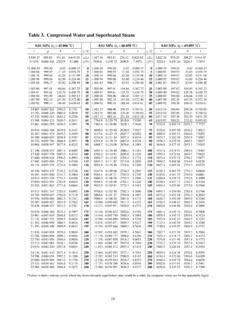
6 The pressure-temperature relationship values are shown in saturated Steam A typical cycle at 121 C (250 F) will require 15 to 17 lbs of gauge pressure (103 to 117 kPa) in the chamber of the steril-izer. The gauge pressure required will be higher than the pressure shown in the saturated Steam table due to air mixed with the Steam and elevation above sea level. The maximum pressure in an autoclave is limited by the specifications (ASME pressure rating) of the pressure vessel (chamber and jacket).3. MoistureMoisture in the Steam has a major impact on its ability to denature, or coagulate proteins; hence the importance of using saturated Steam . Saturated Steam is at equilibrium with heated water at the same pressure, which means it contains the maximum amount of moisture without liquid condensate present.
7 Saturated Steam is recommended for Steam Sterilization . Not all Steam is acceptable for use in a sterilizer. A dedicated clean Steam supply is recommended. superheated Steam , Steam containing excessive liquid water , and Steam containing excessive boiler additives or contami-nates (such as rust) should be avoided. superheated Steam is defined as Steam that is above its saturation temperature. Superheat occurs in Steam distribution systems when the line pressure is dropped across a Pressure Reducing Valve (PRV). The larger the pressure drop, the more superheat is created. superheated Steam does not contain the required moisture necessary to assure Sterilization . The excess energy in superheated Steam is transient and is eventually dissipated by the items in the sterilizer chamber, but can cause difficulty when validating the sterilizer to the empty chamber temperature stabilization requirements of the European Standard The ideal clean Steam system for Steam sterilizers is regulated at 30 to 35 psig (207 to 241 kPa) at the source.
8 EN285 indicates the Steam supply pres-sure should not be more than twice the chamber pressure at the desired temperature. Superheat is also created when saturated Steam passes over a surface at a higher tempera-ture. The sterilizer jacket temperature should always be set slightly below the chamber Sterilization temperature to avoid superheating of the Steam as it enters the chamber. 4. Direct Steam ContactDirect Steam contact with the surface of the object to be ster-ilized is required for the Steam to transfer its stored energy to the object. Without direct Steam contact to all surfaces, the item will not be sterilized. The amount of energy stored in Steam is much higher than dry air or water at the same temperature.
9 From the saturated Steam table mentioned above, one can see that it takes 419 kJ/kg (180 Btu/lb) to heat water from 0 C to 100 C (32 F to 212 F). This is the enthalpy of water (hl). It takes an additional 2,257 kJ/kg (970 Btu/lb) to create Steam at atmospheric pressure (100 C or 212 F). This additional energy stored in the Steam is the enthalpy of vaporization (he), and is the key to Steam steril-ization. In order for the Steam to transfer its stored energy, it must condense on the surface of the object being Air RemovalAir is the biggest deterrent to Steam Sterilization . Air must be removed from the chamber and the load before direct Steam contact and Sterilization can occur. This is accom-Figure 2.
10 Sterilization time versus ENGINEERING NOVEMBER/DECEMBER 2013facilities and equipmentSteam Sterilization Principlesplished in a Steam sterilizer by a series of vacuum pulses prior to Sterilization (pre-conditioning phase). A small amount of air will always be present in the autoclave cham-ber, but must be minimized. Insufficient air removal, steril-izer chamber vacuum leaks and poor Steam quality (excess non-condensable gases) are the most common causes of Sterilization failures. 6. DryingWrapped items must be dry before they can be aseptically removed from the sterilizer. Condensation is the natural result of Steam contact with the cooler surfaces of the load during the heating and exposure phases.