Transcription of Subject Tests - Unauthorized
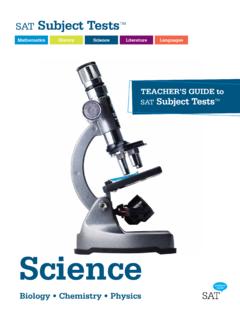
1 MathematicsLevel 1 Level 2 TEACHER S GUIDE toS AT Subject Tests S AT Subject Tests 60 ft. 123 ft. CBAM athematicsHistoryScienceLiteratureLangua gesMathDear Educator, We know connecting your students with college opportunity and success is important to you. One way to help your students along the path to higher education is to share with them the bene ts of taking SAT Subject Tests . e SAT Subject Tests are hour-long Tests based on high school course work o ered across ve Subject areas: Mathematics, Science, English, History and Languages. Coupled with students high school grades and SAT scores, Subject Test scores can create a powerful and comprehensive picture of your students capabilities, helping them stand out to prospective colleges.
2 Colleges also use SAT Subject Tests to put other admission factors into context, place students in certain courses, and even o er credit based on Subject Test performance. To better support you in helping your students do well on these Tests , we are pleased to provide you with the Teacher s Guide to SAT Subject Tests in Mathematics, a comprehensive resource that will familiarize you with the mathematics Tests and the topics they cover. It also includes sample questions as well as tips and best practices from other teachers to help you prepare your students to do their best on the SAT Subject Tests . e best news for math teachers? SAT Subject Tests cover the material you already teach your students and strongly align with the Common Core State Standards.
3 In fact, nearly 90 percent of the items on the Math I and Math II Subject Tests aligned with one or more of the Common Core standards in Math. Eighty percent of high school math teachers agree that the knowledge and skills measured by the SAT Subject Tests in Mathematics are part of their existing curriculum. Almost 90 percent of mathematics and English high school teachers and college professors indicated that the knowledge and skills tested on the SAT Subject Tests are important for college readiness. ere is no better source than you teachers in the classroom when it comes to helping students prepare for the SAT Subject Tests . If you have feedback, tips or ideas you d like to share with other teachers, please send them to us at so we can include them in future guides.
4 E SAT Subject Tests in Mathematics help your students shine in the college admission process. We appreciate the opportunity to partner with you to help your students showcase the knowledge and skills you have taught them. e College BoardMath Level 1 Math Level HistoryWorld HistoryBiology E/MChemistryPhysicsLiteratureSpanishFren chGermanModern HebrewLatinItalianChinese with ListeningJapanese with ListeningKorean with ListeningSpanish with ListeningFrench with ListeningGerman with ListeningAbout the SAT Subject TestsFor more than 75 years, SAT Subject Tests have played an integral role in providing institutions with insights into a student s achievement and readiness for college-level study in speci c Subject areas.
5 E hour-long exams are o ered in ve major Subject areas: Mathematics, History, Science, Literature and Subject Tests are o ered six times a year in nearly 7,000 test centers in more than 170 countries. Fee waivers are available for students to take up to six SAT Subject Tests , increasing access for all students. SAT Subject Tests continue to evolve, maintaining their vital role in the college-going process with new research studies, test and student experience enhancements and updates of student practice Subject Tests O eredSAT Subject Tests in nonlanguage subjects assess a student s comprehension of fundamental concepts, their content knowledge and their ability to apply that knowledge to solve routine and nonroutine problems.
6 SAT Subject Tests in languages assess a student s understanding of the language and ability to communicate in that language in a variety of cultural contexts. When there is a listening component on the test, the skills include reading comprehension, language usage and listening comprehension. 2012 e College Board. College Board, achieve more, Advanced Placement, AP, SAT and the acorn logo are registered trademarks owned by the College Board. SAT Subject Tests and Score Choice are trademarks owned by the College Board. All other products and services may be trademarks of their respective owners. Visit the College Board on the Web: AT Subject Tests1 TABLE OF CONTENTSI ntroduction SAT Subject Tests .
7 2 Overview of the Mathematics Subject Tests ..9 Calculator Use and Geometric Figures ..12 Mathematics Level 1 Sample Questions and Answer Explanations ..15 Mathematics Level 2 Sample Questions and Answer Explanations ..41 Best Practices From Teachers to Teachers ..65 Answer SheetSample SAT Subject Test Answer Sheets ..692S AT Subject TestsWhat Are the SAT Subject Tests ? SAT Subject Tests are one-hour-long exams that give students the opportunity to enhance their college admission credentials by demonstrating their knowledge of specifi c subjects. Th ey are the only national admission Tests where your students choose to take the Tests that best showcase their achievements and interests.
8 Because every student is unique, a student s academic record oft en doesn t tell the whole story of a student s capabilities and potential. Encourage your students to consider taking one or more SAT Subject Tests so they can show colleges a more complete picture of their academic background, interests and talents. What Are the Benefi ts of Taking the SAT Subject Tests in Mathematics? Th e SAT Subject Tests in Mathematics can help students diff erentiate themselves in a competitive college admission environment by providing additional information about their readiness for college-level study. Th is is important for all students as it contextualizes other academic credentials, such as grades, SAT scores, etc.
9 Some schools require an SAT Subject Test in Science for admission into science and engineering programs or majors, while others require the Tests from all students. For example, the California Institute of Technology requires all applicants to submit Subject Test scores in both mathematics and science. Many colleges use Subject Tests to advise students or help with course placement. Other schools allow students to place out of introductory courses or gain credit based on their performance on certain Subject Tests . Students can visit to explore colleges and get information about Subject Test Are the Differences Between the SAT and the SAT Subject Tests ? Th e SAT is the most widely used college entrance exam, testing what students learn in classrooms and how well they apply that knowledge.
10 Its reading, math and writing sections are based on the critical thinking and problem solving skills needed for college Subject Tests cover a wide range of Subject areas, including science, history and languages. Each SAT Subject Test focuses on a single Subject and indicates a student s readiness to take college-level courses in that can use SAT Subject Tests for purposes beyond college admission and placement. For example, students in New York can use them as a substitute for some Regents exams for a New York State Regents high school diploma. Subject Tests can also be used to ful ll Subject -based competency requirements for large university systems like the University of California and the University of Arizona.