Transcription of SUMMARY RECOMMENDATIONS Level 1 None Level 2
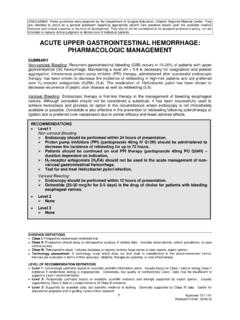
1 DISCLAIMER: These guidelines were prepared by the Department of Surgical Education, Orlando Regional Medical Center. They are intended to serve as a general statement regarding appropriate patient care practices based upon the available medical literature and clinical expertise at the time of development. They should not be considered to be accepted protocol or policy, nor are intended to replace clinical judgment or dictate care of individual patients. EVIDENCE DEFINITIONS Class I: Prospective randomized controlled trial. Class II: Prospective clinical study or retrospective analysis of reliable data. Includes observational, cohort, prevalence, or case control studies. Class III: Retrospective study. Includes database or registry reviews, large series of case reports, expert opinion. Technology assessment: A technology study which does not lend itself to classification in the above-mentioned format. Devices are evaluated in terms of their accuracy, reliability, therapeutic potential, or cost effectiveness.
2 Level OF RECOMMENDATION DEFINITIONS Level 1: Convincingly justifiable based on available scientific information alone. Usually based on Class I data or strong Class II evidence if randomized testing is inappropriate. Conversely, low quality or contradictory Class I data may be insufficient to support a Level I recommendation. Level 2: Reasonably justifiable based on available scientific evidence and strongly supported by expert opinion. Usually supported by Class II data or a preponderance of Class III evidence. Level 3: Supported by available data, but scientific evidence is lacking. Generally supported by Class III data. Useful for educational purposes and in guiding future clinical research. 1 Approved 9/30/2015 DIVERTICULITIS MANAGEMENT SUMMARY Diverticulitis is a common disease that frequently requires surgical management. Traditional management of acute diverticulitis has evolved over the years with the use of antibiotics, percutaneous drainage, and surgical intervention.
3 The preponderance of evidence strongly advocates for a more conservative approach with regards to complicated diverticulitis. Less invasive surgical treatment leads to overall decreased morbidity, mortality, and length of hospital stay. INTRODUCTION Diverticulitis of the sigmoid colon can result in significant morbidity and mortality. The incidence of diverticulitis has increased over the last decade, accounting for nearly 300,000 hospital admissions and $ billion of annual direct medical costs. Although there have been many advances in the diagnosis and treatment of acute diverticulitis, there is still debate over the optimal treatment for complicated diverticulitis. Many cases of acute complicated diverticulitis can be treated with less invasive management than what has been traditionally practiced. It has been common practice to perform a Hartmann s procedure for acute complicated diverticulitis, Hinchey class III and IV, however current data suggests a RECOMMENDATIONS Level 1 None Level 2 Hinchey class I diverticulitis in hemodynamically stable patients can be safely treated in the outpatient setting.
4 Hinchey class II diverticulitis in hemodynamically stable patients can be safely treated with percutaneous drainage and intravenous antibiotics. Hinchey class III diverticulitis can be safely treated with laparoscopic lavage and drainage with outcomes equivalent to Hartmann s procedure. In Hinchey class III diverticulitis, primary anastomosis with diverting loop ileostomy is preferable to Hartmann s procedure. Level 3 The treatment of choice for Hinchey class IV diverticulitis is Hartmann s procedure. ICU / step-down unit admission should be considered in patients with Hinchey class III or IV diverticulitis due to increased mortality rates. Laparoscopic lavage, compared to resection with primary anastomosis with diverting loop ileostomy, appear to have equivalent morbidity and mortality. In computed tomography diagnosed cases of left-sided diverticulitis, colonoscopy is indicated in 6-8 weeks from initial insult to rule out malignancy. Prophylactic sigmoidectomy is not necessary after acute diverticulitis and should be considered on a case by case basis.
5 2 Approved 09/30/2015 more conservative approach may have improved outcomes (1-4). LITERATURE REVIEW Management of Diverticulitis Hinchey class I and II Hinchey class I diverticulitis accounts for 75% of symptomatic diverticular disease. Often these patients are admitted to the hospital for intravenous antibiotics and non-operative management. A randomized control trial by Biondo et al. in 2012 compared the treatment failure rates of an outpatient protocol versus hospital admission for uncomplicated diverticulitis (5). They defined treatment failure as persistence, increase, or recurrence of abdominal pain and/or fever, inflammatory bowel obstruction, need for radiological abscess drainage or immediate surgery due to complicated diverticulitis, need for hospital admission, and mortality during the first 60 days after discharge. There was no statistically significant difference in the two groups (p= ). They concluded that it is safe and cost effective to treat patients with uncomplicated diverticulitis as an outpatient.
6 The incidence of abscesses complicating diverticulitis ranges from 17-19%. In 2008, Singh et al. published a retrospective study evaluating the use of percutaneous drainage of diverticular abscesses over an 8 year period (6). They found in 16 patients that drainage can be safely performed. This data was applied to high-risk surgical candidates and demonstrated that percutaneous drainage is preferable secondary to the risk associated with operative management. Laparoscopic lavage versus Hartmann s procedure Hartmann s procedure (HP) has been considered the gold standard for purulent peritonitis from perforated diverticulitis. It is well established that morbidity and mortality of both the initial HP and subsequent colostomy take-down are high. This led to investigation into the primary management of perforated diverticulitis with laparoscopic lavage (LL). In a randomized control trial by Agenete et al. in 2014 comparing LL versus HP for Hinchey class III diverticulitis, LL was shown to be non-inferior (7).
7 LL may be a feasible and safe alternative to Hartmann s procedure. Multiple smaller studies have shown decreased morbidity and mortality with LL. Mortality rates are reported as and for HP and primary resection and anastomosis, respectively. This compares to a mortality of 4% for LL (8). Laparoscopic HP also carries a higher conversion to an open procedure, which imposes its own morbidity. Thus, LL decreases morbidity and mortality of patients with purulent peritonitis (9-16). In a study by Myers et al., the rate of elective laparoscopic sigmoidectomy after LL was (17). There were 26 patients in this study that did not require additional surgical intervention after LL. This finding was augmented by another retrospective review of 78 cases comparing LL and HP that showed no resection was required in 27 of 35 of the LL cases. This indicates that a wait and see approach after LL should be adopted. Lastly, length of hospital stay (6 days vs. 9 days; p= ) and operative time (1:08 vs.)
8 2:34 hours; p< ) are decreased in those undergoing LL vs. HP (7). The limitations of laparoscopic lavage include patients with an extensive prior surgical history and poor visualization to allow for washout. If the abdomen or pelvis cannot be safely and completely drained via laparoscopic lavage, then conversion to open exploration is mandatory. Primary Anastomosis versus Hartmann s Retrospective data suggests that primary anastomosis with diverting loop ileostomy in the treatment of Hinchey class III diverticulitis may result in decreased mortality compared to Hartmann s procedure. There are no prospective randomized controlled trials to validate this evidence. Multiple retrospective articles have shown that there is no difference in the morbidity and mortality of primary anastomosis with diverting ileostomy compared to Hartmann s procedure after initial colon resection. However, there is evidence to support the superiority of primary anastomosis with respect to the second stage of the operation.
9 In a retrospective review by Herzog et al., the rate of complications with HP was higher than primary anastomosis during immediate surgery for complicated diverticulitis (32% vs. 5%; p= ) with an anastomotic leak rate of (18). HP was also associated with a longer ICU and overall hospital stay. Trenti et al. reproduced similar results when comparing HP and primary anastomosis in patients with purulent or fecal peritonitis, demonstrating primary anastomosis to be associated with fewer post- 3 Approved 09/30/2015 operative complications (p< ) and an anastomotic leak rate of 11% (19). Although leak rates were demonstrated to be as high as 11%, the majority were amendable to medical management and did not require conversion to Hartmann s procedure. The use of primary anastomosis with diverting ileostomy over Hartmann s procedure in the treatment of acute left-sided colonic perforation (Hinchey III and IV) has been controversial. The recommendation of when to implement one treatment over the other has been difficult to establish.
10 A prospective randomized controlled trial by Oberkofler, et al. demonstrated that the stoma reversal rate after primary anastomosis with diverting ileostomy was higher than for Hartmann s procedure (20). This study also demonstrated better outcomes in the primary anastomosis group to include shorter operative time, decreased hospital stay, and reduced in-hospital costs. Reversal rates of primary anastomosis and diverting ileostomy are 90% whereas Hartmann s procedure are approximately 37%. There is no published data to aid in the decision making process of when to use primary anastomosis with diverting ileostomy over Hartmann s procedure for Hinchey class IV diverticulitis (18,21-23). Colonoscopy after diverticulitis Follow up colonoscopy after an acute attack of diverticulitis is recommended. The aim is to exclude underlying malignancy. Colonoscopy has a low associated morbidity and mortality. Retrospective and prospective studies have demonstrated that malignancy rates discovered on routine colonoscopy after CT diagnosed left-sided diverticulitis range from In a prospective study, Meyer, et al.