Transcription of Suspended Ceiling Seismic Assemblies
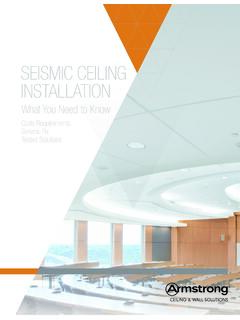
1 Seismic Compliance Seismic compliance refers to the use of approved systems and designs that meet the Seismic design requirements of a building project to provide life safety to occupants during and after an earthquake. New Seismic Requirements Seismic force levels and design criteria were once considered only in certain earthquake-prone locations. But major revisions to the International Building Code (IBC) now require Seismic ceilings throughout the In addition to geographic location, the new code considers soil type and building function ( , hospital, school). Based on these criteria, more than half of the is now considered to have some level of Seismic risk. The design team, consulting engineers and code officials must work together to analyze these factors and determine the applicable Seismic design category (A F). This information is now required for every construction project and must be included in the construction and Design Features Donn grid is produced with the optimal combination of shape,size, steel gauge and conncetion details to produce systems with the greatest stiffness and movement resistance.
2 The advanced connection details used on Donn grid are nearly double the intersection strength requirement of 180 tension and compression for Seismic construction. Extensive Seismic testing proves the advanced connection details along with the systems optimal combination of shape, size, and steel suspension SystemsSuspensionSystemsSuspended Ceiling Seismic Assemblies1 Standard Seismic ApplicationsFor lay-in acoustical panels and direct-hung acoustical tiles visit the USG Seismic Ceilings Resource Center at IBC Category C1 IBC Category D, E, F2 UBC 25-2 Minimum intersection strength limits @ MT / CT3 60 lbs 180 lbs 180 lbs Vertical hanger wire 12-gauge @ 4 Required Required Required Connection device from vertical wire to the structure Not required Required Required above must sustain min 100 lbs Main-tee classifications4 Intermediate- or heavy-duty Heavy-duty Intermediate- or heavy-duty4 1 in 6 max plumb of vertical hanger wires Required Required Required Perimeter vertical hanger wires not more than Not required unless Required Required 8 from wall molding < 7/8 Grid end/wall clearance Min 3/8 Min 3/4 Some clearance on two non-attached walls, if applicable Perimeter closure (molding) width Min 7/8 (or use perimeter wires) Min 2 Min 7/8 Grid connection to perimeter attached on two Not permitted Required Optional adjacent walls Perimeter tee ends tied together at perimeters Required Required Required Horizontal restraint (splay wires or rigid bracing)
3 Not required Required5,6 Required6,7 within 2 of intersection and splayed 90 apart at 45 angles Compression posts (struts) Not required Required5,6 Required6,7 12 in both directions, starting 6 from walls Splay bracing connection strength Not required Required Required 200 lbs or the design load, whichever is greater Partition attachment Allowed only if Ceiling is able Bracing independent of Ceiling Allowed with bracing to move laterally splay bracing Seismic separation joint Not required Required for areas > 2,500 sq. ft. Not required (or full height partition)8 Rigid bracing for Ceiling plane elevation changes Not required Required Not requiredLight Fixture Light fixture (all types) mechanically attached Required Required Required8 Attachment to grid per NEC 410-16 (two per fixture unless independently supported) Surface-mounted fixtures attached to grid Not required Not required Required (including safety wires to vertical wire or structure)8 Pendant-hung fixtures directly supported from Required Required Required structure with 9-gauge wire (or approved alternative) Rigid lay-in or can light fixtures 10 lbs, one wire to structure (may be slack) Required Required Lower limit is 20 lbs.
4 11 56 lbs, two wires from housing Required Required Required lower limit is 20 lbs. to structure (may be slack) 57 lbs, supported directly to structure Required Required Required by approved hangersService Air terminalsApplications 20 lbs, positively attached to grid Required Required Required 21 56 lbs, positively attached to grid and two Required Required Required 12-gauge wires to structure (may be slack) 57 lbs, directly supported to structure Required Required Required Sprinkler heads and other Min 3/8 on all sides Min 2 dia. opening Not required penetration clearance or a swing joint Cable trays and electrical conduit independently Not required Required Not required supported and bracedBasic Connections, Perimeter, and Lateral Splay Bracing1. Refers to CISCA installation recommendations for zones 0-2 via ASCE 7. Max Ceiling weight: Refers to CISCA installation recommendations for zones 3-4 via ASCE All USG Donn brand Ceiling suspension systems meet these Per ASTM Required for ceilings larger than 1,000 square information presented is correct to the best of our knowledge at the date of issuance.
5 Because codes continue to evolve, check with a local official prior to designing and installing a Ceiling system. Other restrictions and exemptions may apply. This is only intended as a quick Where substantiating design calculations are not Seismic standards generally apply to ceilings larger than 144 square When intermediate-duty systems are used, No. 12-gauge hanger wires shall be attached to the suspension members within three inches of each corner of each Please refer to AC3235 for more Refers to CISCA installation recommendations for zones 0-2 via ASCE 7. Max Ceiling weight: Refers to CISCA installation recommendations for zones 3-4 via ASCE All USG Donn brand Ceiling suspension systems meet these Per ASTM Required for ceilings larger than 1,000 square feet. IBC Category D, E, F (Alternate Method)9 IBC Category C (Alternate Method)9 Minimum intersection strength limits @ MT / CT3 180 lbs 60 lbs Vertical hanger wire 12-gauge @ 4 Required Required Connection device from vertical wire to the structure Required Not required above must sustain min 100 lbs Main-tee classifications4 Heavy Duty Intermediate or Heavy Duty 1 in 6 max plumb of vertical hanger wires Required Required Perimeter vertical hanger wires not more than Required Not required 8 from wall Grid end/wall clearance 3/4 min.
6 3/8 min. Perimeter closure (molding) width Min. 7/8 with ACM7 Seismic Clip Min. 7/8 Grid connection to perimeter attached on two Required N/A adjacent walls Perimeter tee ends tied together at perimeters Required Required (ACM7 Seismic Clip satisfies this requirement) (ACM7 Seismic Clip satisfies this requirement) Horizontal restraint (splay wires or rigid bracing) Required5, 6 Not required within 2 of intersection and splayed 90 apart at 45 angles Compression posts (struts) Required5, 6 Not required 12 in both directions, starting 6 from walls Splay bracing connection strength Required Not required 200 lbs or the design load, whichever is greater Partition attachment Bracing independent of Ceiling Allowed only if Ceiling is able splay bracing to move laterally Seismic separation joint Required for areas >2,500 sq. ft. Not required (or full height partition)6 Rigid bracing for Ceiling plane elevation changes Required Not requiredLight-Fixture Light fixture (all types) mechanically attached Required Required RequiredAttachment to grid per NEC 410-16 (two per fixture unless independently supported) Surface-mounted fixtures attached to grid Not required Not required Pendant-hung fixtures directly supported from Required Required structure with 9-gauge wire (or approved alternative) Rigid lay-in or can light fixtures 10 lbs, one wire to structure (may be slack) Required Required 11 56 lbs, two wires from housing Required Required to structure (may be slack) 57 lbs, supported directly to structure Required Required by approved hangersService Air terminalsApplications 20 lbs, positively attached to grid Required Required 21 56 lbs, positively attached to grid and two Required Required 12-gauge wires to structure (may be slack)
7 57 lbs, directly supported to structure Required Required Sprinkler heads and other Min 2 dia. opening or a swing joint Min 3/8 on all sides penetration clearance Cable trays and electrical conduit independently Required Not required supported and bracedBasic Connections, Perimeter, and Lateral Splay BracingAlternate Seismic Solutions6. Where substantiating design calculations are not Seismic standards generally apply to ceilings larger than 144 square When intermediate-duty systems are used, No. 12-gauge hanger wires shall be attached to the suspension members within three inches of each corner of each Please refer to AC3235 for more byUSG Interiors, LLC550 West Adams StreetChicago, IL 60606SC2233/rev. 5-12 2012, United States Gypsum CompanyPrinted in that Determine Seismic Design CategorySoil ConditionsCertain soil types may be prone to liquefaction, when the stress and shaking of earthquake forces cause sediments to behave like liquids rather than a solid, reducing or eliminating structural support.
8 The soil at a building site is analyzed and categorized into one of six types:A Hard rockB RockC Very dense soil and soft rock D Stiff soil (default)E Soft soilF Special soilsBuilding UsageThe function of the structure also determines the level of precaution that is to be designed and built in. Building types fall into three groups: Seismic Use Group III: essential facilities such as hospitals, fire departments and police departments that must function both during and after an Use Group II: buildings that constitute a substantial public interest, such as power plants and those that house more than 300 people. Seismic Use Group I: all other buildings. Geographic LocationThoughts of earthquakes and Seismic activity may typically bring to mind California and the West Coast. However, this is not the only region considered to face Seismic risks. In fact, more than 3,500 earthquakes have been recorded east of the Mississippi River since 1700. Today s building codes are recognizing that Seismic activity may be a risk almost anyplace in the analyzing these three criteria for a construction project, you can determine the Seismic design category (A-F).
9 This is typically done by the project s structural engineer. The design team performs the analysis required to assign the Seismic design category for a construction project and must include that information in the construction documents. This tells the construction team the required level of performance for the building. Refer to local building codes to determine in which section of the specification the Seismic design category must appear (usually in the general-contractor section of the specification and on the first page of structural drawings). MaterialHot-dipped galvanized Content25%. For details, see the Sustainability be installed in compliance with ASTM C636, CISCA, and standard industry performance of Donn ACM7 Seismic clip and systems is based on the specific combination of superior components, and design and installa-tion methods shown. Components from other manufacturers were not evaluated, and their use or any mixed use is not Evaluation Service, Inc.
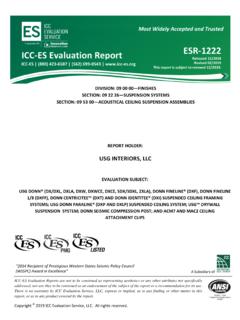
10 , Report ComplianceSuspension systems manufactured by USG Interiors, LLC, have been reviewed and are approved by listing in ICC-ES Evaluation Report 1222. Evaluation Reports are subject to reexamination, revision and possible cancellation. Please refer to or 800 for current Research Report ComplianceDonn brand suspension systems manufactured by USG Interiors, LLC, have been reviewed and are approved by listing in the following ResearchReport number: DisclaimerThe current ICC-ES acceptance criterion (AC) used for the testing and evaluation of Seismic clips is AC156, Acceptance Criteria for Seismic Qualification by Shake-Table Testing of Nonstructural Components and Systems. AC156 was not specifically designed to provide testing guidelines or pass/fail criteria for acoustical suspension systems in a Seismic event. However, in the absence of a specific AC for this purpose, ICC-ES allowed AC156 to act as the basis for all Seismic testing and evaluation for the acoustical Ceiling Suspended ceilings ComplianceTesting and evaluation performed at the University at Buffalo (SUNY), the Department of Civil, Structural and Environmental Engineering Structural Engineering and Earthquake Simulation Laboratory (SEESL) qualify the performance of these systems according to the AC156 Seismic Qualification Specification, and AC368 Acceptance Criteria for Suspended Ceiling Framing Systems.