Example: dental hygienist
Tabl e: Cumulative Binomial probabilities [ ] n ( ) P X c ...
Table: Cumulative Binomial probabilities ( continued ) 2 p c 0.05 0.10 0.20 0.30 0.40 0.50 0.60 0.70 0.80 0.90 0.95
Tags:
Information
Domain:
Source:
Link to this page:
Documents from same domain

Recognizing Types of First Order Di erential Equations
www.math.hawaii.eduRecognizing Types of First Order Di erential Equations E.L. Lady Every rst order di erential equation to be considered here can be written can be written

Vectors and Plane Geometry - math.hawaii.edu
www.math.hawaii.eduMany calculus books will have a section on vectors in the second half, but students would not like to start reading there. The material is also contained in a variety of other mathematics books, but then we would ... vector P moved (by parallel translations) to different positions in the plane.

MATH 244, Fall ’15 Final
www.math.hawaii.eduMATH 244, Fall ’15 Final Name: INSTRUCTIONS: Write legibly. Indicate your answer clearly. Show all work; explain your answers. Answers with work not shown might be worth zero points. No calculators, cell phones, or cheating. Problem Worth Score 1 …

CALCULUS IN BUSINESS AND ECONOMICS
www.math.hawaii.edu11 Use the technique applied in questions 8 and 9 to make an estimate of the speedometer reading at time t =0by computing average speed from t =0to t =0.01 seconds. 12 You could make even better approximations of the speedomete rreadingbycomputingaver-age speed over an even shorter interval.

Isaac Newton: Development of the Calculus and a ...
www.math.hawaii.eduA new method for calculating the value of ˇ Basic rules of integral calculus, 2nd preliminary I Rule 1: If a curve is given by y = axm=n then the area up to x is given by Area(y)= an m+n x (m+n)=n. I For example, if y = x1=2, then Area(y)= 2 3 x 3=2, or if y = 1 2 x 3=2, then Area(y)= 1 2 (2 5 x 5=2). I Rule 2: If a curve is a polynomial sum ...

Math 472 Homework Assignment 6
www.math.hawaii.eduplying Calculus II methods that are taken from the section on L’H^opital’s Rule we are able to evaluate that limit. We leave it as an exercise to con- rm that lim n!1[(n 1)=(n 2)]n=2 = e1=2. Knowing this, we see that lim n!1c n= 1. After some simpli cation, which we leave to the student, we nd that a nb nc n= [( n+ 1)=2] p n=2( n=2): We ...

MAT-203 : The Leibniz Rule - University of Hawaiʻi
www.math.hawaii.eduthe right-hand side becomes d dy µZ b a (f(x,y)−f(x,c))dxand the second part of the integrand (f(x,c)) is independent of y, so it’s derivative withrespect to y is 0, thus the right-hand side is d dy µZ b a f(x,y)dx as desired. Exercise: Using this theorem and the chain rule, prove the more general formula
Chapter 3, Rings
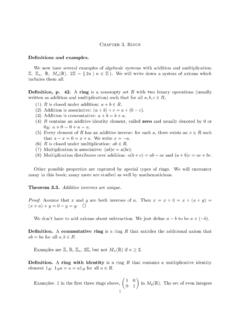
www.math.hawaii.eduThe zero ring is a subring of every ring. As with subspaces of vector spaces, it is not hard to check that a subset is a subring as most axioms are inherited from the ring. Theorem 3.2. Let S be a subset of a ring R. S is a subring of R i the following conditions all hold: (1) S is closed under addition and multiplication. (2) 0R 2 S.
Related documents
CHAPTER 2 Estimating Probabilities
www.cs.cmu.edujoint probabilities over any subset of the variables, given their joint distribution. This is accomplished by operating on the probabilities for the relevant rows in the table. For example, we can calculate: The probability that any single variable will take on any specific value. For example, we can calculate that the probability P(Gender ...
RELEVANT PERCENTAGES FOR BRIDGE PLAYERS
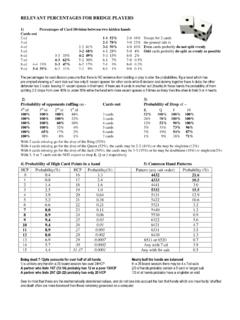
www.bridgewebs.comThe percentages for card division presume that there is NO evidence from bidding or play to alter the probabilities. Eg a hand which has pre-empted showing a 7 card club suit has only 6 ‘vacant spaces’ for other cards while if declarer and dummy together have 4 clubs the other defender has 2 clubs leaving 11 vacant spaces in that hand.

Risk-Neutral Probabilities
people.stern.nyu.eduRisk-Neutral Probabilities 6 Examples of Risk-Neutral Pricing With the risk-neutral probabilities, the price of an asset is its expected payoff multiplied by the riskless zero price, i.e., discounted at the riskless rate: call option: Class Problem: Price the put option with payoffs K u =2.71 and K d =0 using the risk-neutral probabilities. €
Predicting Good Probabilities With Supervised Learning
www.cs.cornell.eduPredicting Good Probabilities With Supervised Learning also justified for boosted trees and boosted stumps. Let the output of a learning method be f(x). To get cali-brated probabilities, pass the output through a sigmoid: P(y = 1jf) = 1 1+exp(Af +B) (1) where the parameters A and B are fitted using maximum

15 Markov Chains: Limiting Probabilities
www.math.ucdavis.edu15 MARKOV CHAINS: LIMITING PROBABILITIES 170 This is an irreducible chain, with invariant distribution π0 = π1 = π2 = 1 3 (as it is very easy to check). Moreover P2 = 0 0 1 1 0 0 0 1 0 , P3 = I, P4 = P, etc. Although the chain does spend 1/3 of the time at each state, the transition
Predicted probabilities and marginal effects after ...
www.princeton.eduPredicted probabilities after logit/probit: estimating the probability that the outcome variable = 1, setting a predictor to specific value
Probabilities: Expected value
people.cs.pitt.eduProbabilities: Expected value M. Hauskrecht Probability basics Sample space S: space of all possible outcomes Event E: a subset of outcomes Probability: a number in [0,1] we can associate with an an outcome or an event Probability distribution A function p: S [0,1] that assigns a probability to every possible outcome in S L ' L Í L : O ; ∈ ...