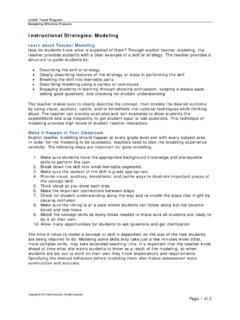
Transcription of Teaching Vocabulary Explicitly - ed
1 Effective Instructional Strategies SeriesPacific Resources for Education and LearningTeaching Vocabulary ExplicitlyBy Susan Hanson and Jennifer PaduaEffective Instructional StrategiesAcknowledgmentsSpecial thanks Gerald Duffy and Anne Cunningham for their content review of this Roger Chesswas for his support, vision, and leadership with directing the Pacific CHILD Randomized Control Advisory Panel members: Drs. Michael Kamil, Gerald Duffy, Anne Cunningham, Jana Echevarria, and Dorothy Strickland for their guidance during the Pacific CHILD M. Look for her contributions to this book. Kalei Arinaga, Sandy Connick, Robin Miller, Anne Milnes, and Jackie McMurray for their Pacific CHILD Teachers in American Samoa, the Commonwealth of the Northern Mariana Islands, and Hawai i for all the learning opportunities and their commitment in helping us gather information on how to improve teachers knowledge and practice and students reading Picture: Jennifer PaduaThis product was funded by the Department of Education s Institute of Education Sciences (IES) under the Regional Educa tional Laboratory Pacific administered by Pacific Resources for Education and Learning, award number ED-06-CO-0024.
2 The content of the publication does not necessarily reflect the views or policies of IES or the Department of Education nor does mention of trade names, commercial products, or organizations imply endorsement by the Vocabulary Explicitly1 Teaching Vocabulary ExplicitlyContentsA Teacher s Story ..2 Introduction ..4 What is Vocabulary ? ..5 Why is Vocabulary Instruction Important? ..6 What are the Essential Components of Vocabulary Instruction? ..8 Why is it Important to Teach Individual Words Explicitly ? ..12 What are the Steps for Teaching Individual Words Explicitly ? ..13 Word-Learning Strategies ..17 Vocabulary Activities ..38 Connecting Vocabulary to Writing ..43 Overview of Key Steps ..45 References ..46 Appendices ..482 Effective Instructional StrategiesA Teacher s StoryMrs. Kaholo thinks about her 4th grade student Charles and the difficulty he has both with reading multisyllabic words in content specific material and with comprehending the text.
3 She has seen some of her previous 4th graders experience the same difficulty. She wonders if Charles is another example of the 4th grade slump, where there is a decline in student reading progress. Mrs. Kaholo recalls reading an article about how students are capable of comprehending grade-level texts in the lower grades but then become struggling readers in the middle grades. These students struggle with comprehending content specific text that is structured in a variety of ways and that uses an increasingly academic Vocabulary (Chall, Jacobs, & Baldwin, 1990). In Charles case, when he moved from reading narrative books in the lower elementary grades to reading more expository text, he began falling behind in his understanding of Vocabulary and overall comprehension. Mrs. Kaholo has noticed that in encountering a greater number of academic words, Charles is struggling with using his word-learning strategies. Specifically, Charles is not using his prior knowledge of the word, word analysis, or context clues effectively to aid in determining word meaning.
4 Charles needs to realize that unlocking meaning at the word level will help him increase his chances of comprehending the entire text. Mrs. Kaholo keeps anecdotal records of her students. For Charles, besides noticing that he has difficulty using word-learning strategies, she recognizes that he avoids reading because it is too hard for him. She notes that he would rather read magazines with colorful pictures and shorter texts than textbooks or trade books with limited picture support. When he does read, Charles rarely applies any problem-solving strategies, such as looking for known parts of the word, rereading, or questioning to check for understanding. On top of this, Charles has limited background knowledge and experience with the grade-level topics they will learn this year. Mrs. Kaholo knows she has a great deal to learn about Teaching Vocabulary , especially for readers like Charles whose reading experience is primarily in fictional texts.
5 First, she would like to research Vocabulary instructional strategies, including the Teaching of word parts. Second, she would like Charles to become a problem solver when it comes to unknown words. She hopes when he encounters difficult words, such as mistreat, Charles will use Teaching Vocabulary Explicitly3word-solving techniques such as asking questions like What parts of this word do I know? and What have I read so far that will help me figure out the meaning of this word? Mrs. Kaholo would also like to expand her teacher strategy toolbox to include more activities for building background knowledge prior to the lesson. Luckily for Mrs. Kaholo, she recognizes Charles reading needs early in the school year. She has a strong desire to increase her understanding of Vocabulary instruction and is willing to make changes in her instruction. Mrs. Kaholo has made it her professional goal to ensure that Charles does not become another statistic contributing to the 4th grade slump.
6 4 Effective Instructional StrategiesIntroductionBecause of its important role in reading development, Vocabulary instruction has been a well-researched area in the field of education for many years, and it is an area in which we continue to gain new insights. The purpose of this book is to present Vocabulary instruction research that is practical and effective for our target audience teachers and staff and to support their instructional efforts. In Teaching Vocabulary Explicitly , you will learn the importance of Explicitly Teaching Vocabulary through one teacher s journey. In A Teacher s Story, we saw through the eyes of Mrs. Kaholo, a 4th grade teacher, as she experienced the challenges of helping 4th grade students make the transition from reading fiction in the lower grades to reading nonfiction in the upper grades. Among the challenges Mrs. Kaholo and many other teachers face is their students unfamiliarity with academic words.
7 The framework for this book is based on the Pacific Communities with High-performance In Literacy Development (Pacific CHILD) program implemented by the Regional Educational Laboratory Pacific (REL Pacific) as part of a randomized control study in the Pacific region. Pacific CHILD is a principles-based professional development program consisting of research-based Teaching and learning strategies proven to help improve students reading comprehension using informational text. During the development process, the REL Pacific staff spent more than two years working alongside teachers as they implemented explicit Vocabulary instruction. We begin this book by discussing the meaning of Vocabulary and why it is important to teach. Then we explain the effective components of explicit Vocabulary instruction. From there, we delve further into two of the components, how to teach individual words Explicitly and how to teach word-learning strategies.
8 As concepts are explained, we include vignettes illustrating Mrs. Kaholo s processes and her application of this information. At the end of the book, we provide various Vocabulary activities piloted by our Pacific CHILD teachers. We hope that the readers of this book find these activities useful for their own classrooms. Teaching Vocabulary Explicitly5 What is Vocabulary ? Vocabulary refers to words we use to communicate in oral and print language. Receptive Vocabulary refers to the words we understand through reading and listening. Productive Vocabulary refers to the words we use to communicate through writing and speaking (Lehr, Osborn, & Hiebert, 2004). In order to communicate effectively using oral and print language, we must be able to flexibly use words that we recognize and understand. Effective reading requires two types of Vocabulary , word recognition Vocabulary and word meaning (Chall, 1983; as cited in Blachowicz, Fisher, & Watts-Taffe, 2005).
9 Word recognition is the readers ability to pronounce or figure out the word by using word attack strategies. Word meaning refers to words students know or can define. Though we recognize the importance of both word recognition and word meaning, the emphasis of this book will be on word meaning. 6 Effective Instructional StrategiesWhy is Vocabulary Instruction Important? In reading, Vocabulary knowledge is essential to comprehending text (National Institute of Child Health and Human Development [NICHD], 2000). When students do not understand at least 90% of the words in a text, they do not adequately understand what they read (Hirsch, 2003; Sedita, 2005). Research suggests that students acquire 2,000 to 3,500 new words a year and know the meaning of approximately 50,000 words by the time they graduate from high school (Graves, 2006; Lehr, Osborn, and Hiebert, 2004; PREL, 2008). As students progress from the lower elementary grades into the middle grades, the majority of their reading moves from narrative to expository text.
10 Narrative text is fictional material that mainly uses one text structure (or format). Text structure is the way an author organizes the text (PREL, 2007, 2008). The narrative text structure usually includes plot, setting, problem, and resolution. This commonly used structure makes it easier for students to predict what the story will be about or what the author plans to write. Expository text, or nonfiction, usually has more complex content and higher-level Vocabulary and is written using different types of text structures, such as description, compare and contrast, cause and effect, and problem and solution. As a result, students find it difficult to anticipate what the author plans to write next or which direction the content will flow. Below are two examples explaining how a mother panda supports its young. One example is written using a narrative structure, the other using an expository structure. Narrative TextAfter playtime, his mother sat down to snack on her favorite food, bamboo.