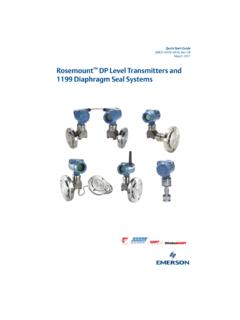
Transcription of Technical Note: Reliable Pressure Measurement …
1 Technical Note00840-1500-4801, Rev AAApril 2015 Reliable Pressure Measurement with remote DiaphragmSeals in Cold Weather ApplicationsApril 2015 Reliable Pressure Measurement with remote diaphragm Seals in Cold Weather Applications Introduction .. page 1 Rosemount 3051S Thermal Range Expander .. page 2 Rosemount Thermal Optimizer .. page 4 Heat trace .. page 5 Technology comparison .. page Making a Pressure or DP Level Measurement of a hot process in a cold ambient environment has some challenges associated with it. A Rosemount transmitter with Rosemount 1199 diaphragm Seal from Emerson can be directly connected to processes up to 401 F (205 C); above that temperature, either an extension is required for the Rosemount 1199 Direct Mount Seal, or a remote mount seal with capillary is needed.
2 A sufficiently hot process would require the use of a high temperature fill fluid such as Silicone 704, Silicone 705, or Rosemount UltraTherm 805. These high temperature fill fluids are stable in high temperature processes. Unfortunately, these high temperature fill fluids are challenged by low ambient temperature environments because as the temperature decreases, the response time increases and the Measurement can eventually become nonresponsive. Emerson offers multiple solutions to the challenge of taking Pressure or DP Level readings in a system that has a hot process temperature combined with a low ambient temperature. The methods discussed here apply to the Rosemount Thermal Range Expander, the Rosemount Thermal Optimizer, and heat tracing. 2 Technical Note00840-1500-4801, Rev AAReliable Pressure Measurement with remote diaphragm Seals in Cold Weather ApplicationsApril 2015 Reliable Pressure Measurement with remote diaphragm Seals in Cold Weather 3051S Thermal Range ExpanderThe Rosemount 3051S Thermal Range Expander is a seal system that uses an intermediate diaphragm to separate two different fill fluids; this allows each of the fill fluids to operate within its optimal temperature 1-1.
3 Rosemount 3051S Tuned-System Assembly with a Thermal Range ExpanderA. Process diaphragmB. Intermediate sealC. Primary fill fluidD. Secondary fill fluidThe primary fill fluid, which is closer to the hot process, is designed to operate in the high process temperature, while the secondary fill fluid, located on the other side of the intermediate diaphragm , is designed to operate in the colder ambient temperature. This allows the Thermal Range Expander to cover ambient temperatures as low as -103 F (-75 C), and process temperatures up to 770 F (410 C), with comparable response time to a system that only uses low temperature fill 1-2. Temperature LimitsNoteThe top two bars above illustrate the temperature limits of a single fill fluid system. The bottom two bars represent two specific temperature ranges with the Thermal Range CapillaryThermal Range ExpanderABCD3 Technical Note 00840-1500-4801, Rev AAReliable Pressure Measurement with remote DiaphragmSeals in Cold Weather ApplicationsApril 2015 Reliable Pressure Measurement with remote diaphragm Seals in Cold Weather ApplicationsThe Thermal Range Expander is available on all Rosemount 3051 SAL (Scalable Advanced Level) systems including Electronic remote Sensor (ERS ) Systems, Tuned-System Assemblies, Balanced Systems, single capillary, and single direct mount configurations.
4 It is also available in both all-welded or welded-repairable construction types and with the following seal types: Flush Flanged Seal (FF) Extended Flanged Seal (EF) Flanged Seal (RF) Threaded Seal (RT) Flushed Flanged Ring Type Joint (FC) Ring Type Joint Flanged (RC)UltraTherm 805 is the fill fluid that allows the Thermal Range Expander to handle high temperatures up to 770 F (410 C) and it is only available in a Thermal Range Expander 1-3. Thermal Range Expander ConfigurationsDirect mount in-line Thermal Range ExpanderERS System with Thermal Range Expander connections4 Technical Note00840-1500-4801, Rev AAReliable Pressure Measurement with remote diaphragm Seals in Cold Weather ApplicationsApril 2015 Reliable Pressure Measurement with remote diaphragm Seals in Cold Weather Thermal OptimizerThe Thermal Optimizer is a single fill seal system that uses the heat from a hot process to keep the fill fluid within its operating temperature range.
5 There is a patented heating element enclosed inside the Thermal Optimizer that helps heat transfer throughout the Thermal Optimizer, as shown in Figure 1-4. Figure 1-4. Thermal Optimizer and Thermal Optimizer CutawayA. Patented heating elementThis allows for a Reliable Pressure Measurement in applications with increased process temperatures in low ambient temperature climates. By maintaining an optimal temperature, the fill fluid is prevented from becoming too viscous and this allows for fast time response with excellent accuracy. The Thermal Optimizer is only available for Rosemount In-line Pressure transmitter configurations (3051ST, 3051T, 2051T, or 2088 models), but when coupled with Rosemount 3051S ERS System, it is also capable of measuring differential 1-5. ERS System with Thermal Optimizer ConnectionsA5 Technical Note 00840-1500-4801, Rev AAReliable Pressure Measurement with remote DiaphragmSeals in Cold Weather ApplicationsApril 2015 Reliable Pressure Measurement with remote diaphragm Seals in Cold Weather traceTraditionally, when high temperature fill fluids are used to measure the Pressure of the hot process and then the capillaries would be kept warm with heat tracing so the fill fluid can operate.
6 Heat tracing can refer to either electrical heat tracing or steam heat tracing. Steam heat tracing uses steam that may or may not be routed from somewhere else in the plant. Steam heat tracing has many disadvantages such as potential steam leaks, poor temperature control, high operating costs, trap maintenance, and water treatment costs. Electrical heat tracing uses a cable connected to a power source to generate heat to warm the capillaries; a continuous flow of electricity is required to keep the heat traces working. Heat tracing can allow a consistent Pressure Measurement if it can always keep the capillaries at the same temperature, but there will be a shift in the output as the heat tracing is turned on or off. In order to keep the temperature constant, a temperature controller is required.
7 Even with a temperature controller heat tracing can still cause problems if there are separate heating elements on the upper and lower seals. Separate heating elements turn on and off independently, so the heat tracing on one side could be turned on while the other side is turned off making the response time different for each side. Using heat tracing is expensive and can be complicated to install. If the heat tracing loses electricity it will fail and can cause an inaccurate reading on the Pressure transmitter which could lead to catastrophic failure. On top of that, heat tracing can be difficult to remove and replace if the heat tracing , wet/dry legs can be used and heat traced instead of remote seals with capillaries. Wet/dry legs in a cold ambient environment would still require heat tracing and it's associated complications, which is in addition to the complications of wet/dry legs themselves such as draining and refilling the 1-6.
8 Balanced System with Heat Trace6 Technical Note00840-1500-4801, Rev AAReliable Pressure Measurement with remote diaphragm Seals in Cold Weather ApplicationsApril 2015 Reliable Pressure Measurement with remote diaphragm Seals in Cold Weather comparisonWhile all three options are designed for similar applications, there are some key differences that will help determine which is better for different applications. Use Ta b l e 1 - 1 to compare the technologies and determine which works best for your application. Table 1-1. Comparison of Thermal Range Expander, Thermal Optimizer, and Heat TraceNoteThe Thermal Range Expander temperature range depends on the combination of primary, secondary fill fluids, and process temperature; see Figure 1-7 on page Range ExpanderThermal OptimizerHeat traceTemperature Range (above atmospheric Pressure )-103 F (-75 C) Ambient to 770 F (410 C) ProcessRefer to Figure F (-60 C) Ambient to 698 F (370 C) ProcessRefer to Figure upon customer controlled temperaturePressure Range1500 psi (10342 kPa) Max Working Pressure4000 psi (27579 kPa) Max Working PressureDetermined by configuration or flange ratingTr a n s m i t t er Ty p eCoplanar (AP, GP, DP)In-line (AP, GP,DP with ERS)In-line (AP,GP, DP with ERS)
9 Any transmitter with capillariesConnection TypeDirect MountRemote MountDirect MountRemote MountTe c h n o l o g yIntermediate diaphragm separating a high temperature fill fluid and a low temperature fill single 3051 SAL Level Transmitter tube insulates high temperature fill fluid, requires hot process to maintain the fill fluids by hot ambient : In-line transmitter Thermal Optimizer seal systemUses steam or electricity to heat fill fluid inside large installation and high ongoing maintain : Transmitter remote Seal System Heat trace Temperature controller Power supplyRecommended ApplicationsProcess temperature above 401 F (205 C)Ambient temperature below 32 F (0 C)Process Pressure below 1500 psi (10342 kPa)Process temperature above 401 F (205 C)Ambient temperature below 32 F (0 C)Process Pressure above 1500 psi (10342 kPa)Pressures up to 10,000 psi7 Technical Note 00840-1500-4801, Rev AAReliable Pressure Measurement with remote DiaphragmSeals in Cold Weather ApplicationsApril 2015 Reliable Pressure Measurement with remote diaphragm Seals in Cold Weather ApplicationsFigure 1-7.
10 Process Temperature Ranges(1)(2)(1)The Thermal Range Expander is designed to transfer heat from the process to the intermediate isolator; therefore, the ambient temperature limit is interdependent on the process temperature.(2)It is recommended to not violate the lower temperature limits of the secondary fill HeadquartersEmerson Process Management 6021 Innovation BlvdShakopee, MN 55379, USA+1 800 999 9307 or +1 952 906 8888+1 952 949 7001 America Regional OfficeEmerson Process Management 8200 Market , MN 55317, USA+1 800 999 9307 or +1 952 906 8888+1 952 949 7001 America Regional OfficeEmerson Process Management 1300 Concord Terrace, Suite 400 Sunrise, Florida, 33323, USA +1 954 846 5030+1 954 846 Regional OfficeEmerson Process Management Europe GmbHNeuhofstrasse 19a Box 1046CH 6340 BaarSwitzerland+41 (0) 41 768 6111+41 (0)