Transcription of The 5 Competitive Forces Framework in a technology ...
1 The 5 Competitive Forces Framework in a technology mediated environment. Do these Forces still hold in the industry of the 21st century? Author: Marvin Larry Shamir Luis Fernando Johnson University of Twente Box 217, 7500AE Enschede The Netherlands In 1979 Michael E. Porter published his article How Competitive Forces shape strategy which has gained massive popularity among entrepreneurs and managers for suggesting a holistic Framework to analyze the Forces driving industry competition. Now, more than 30 years later, academics suggest that the model became frozen in time, and, is in its original form no more applicable to today s business context.
2 Hence, this study will find out that indeed according to recent literatures the five Competitive Forces model can be partly rejected. Moreover, four additional Forces will be presented in the course of this study to make up for the innate weaknesses imposed by Porter s Framework . These additional Forces will then be integrated into Porter s original five Forces Framework and applied to the telecommunications industry to depict the weaknesses of the unaltered model. It will be understood that Porter s model in its original form will solely provide a very superficial attempt to explain the Forces driving industry competition in the 21st century.
3 The readjusted model will allow to step beyond Porter s model and provide a much clearer view on the decisive Forces determining industry competition. Supervisors: Dr. E. (Efthymios) Constantinides. Assistant Professor Marketing / E Media Dr. K. (Kasia) Zalewska-Kurek. Assistant Professor Strategic Management Keywords five Forces Framework , Competitive Advantage, Innovation, Digitalization, Globalization, Deregulation Permission to make digital or hard copies of all or part of this work for personal or classroom use is granted without fee provided that copies are not made or distributed for profit or commercial advantage and that copies bear this notice and the full citation on the first page.
4 To copy otherwise, or republish, to post on servers or to redistribute to lists, requires prior specific permission and/or a fee. 3rd IBA Bachelor Thesis Conference, July 3rd, 2014, Enschede, The Netherlands. Copyright 2014, University of Twente, Faculty of Management and Governance. 2 2 1. INTRODUCTION: A MODEL THAT SEEMS TO HAVE BECOME FROZEN IN TIME In the year of 1979 a Framework was introduced that should turn the entire way around how managers and entrepreneurs view the Competitive environment, in which a firm in a specific industry is embedded in. The model is most widely known as Porter s Forces model (Porter, 1979).
5 Since then Porter s model was considered to be the ultimate tool to discover the Forces that drive industry competition. It is handy, it is quick to use and, most importantly, it is easy to understand. The model basically aims at describing the Competitive environment a firm is embedded in along five industry -specific factors that drove to Porter s mind industry competition (Porter, 1979). Despite that, in recent years, these Forces have massively come under fire. Some researchers argue that the model has an innate weakness, and, besides this, is difficult to operationalize (Lee, Kim, & Park, 2012). Other researchers, on the contrary state that the model does not take into account a firm s potential collaborative relations with determinants of the industry environment (Dul i , Gnjidi , & Alfirevi , 2012).
6 Grundy (2006) even said that it seems as if the once so popular Forces model has become frozen in time. This gives rise to the question if Porter s five Forces are still holding in today s Competitive environment and, hence, if these Forces still define modern industry competition. As the environment changes, so does the industry and also the firms that react according to the changes imposed by the changing environment and industry . And this is exactly where this paper draws on. This paper aims at providing an in-depth literature review of the latest findings on Porter s Competitive Forces model.
7 It will answer the question whether the five Forces Framework should be accepted, partly rejected, or probably even fully rejected in today s business context. This, in turn, will be facilitated by firstly introducing the reader to the five Forces Framework and informing him what it is basically about. Afterwards, the latest thoughts and findings on alterations to Porter s Framework will be identified. These findings will either constitute whole new approaches, which will serve as substitute approaches to Porter s model, or approaches that go beyond Michael E. Porter s Framework by adding additional Forces to it.
8 From there, this paper will overflow to empirical work that is derived from the findings made earlier in this paper. Here, this study will take a closer look at the telecommunication industry with the case study of Apple, HTC, Google and many other important players from the telecom industry . The case study will then allow to comprehend a new conceptual Framework that is specifically designed for application in the high-tech industry . Augmenting the existing five Forces Framework will allow to solve the research problem of the ever growing competition in the telecommunication sector in recent years.
9 Laffont and Tirole (2001, p. 1) mention this dilemma in their book Competition in telecommunications by saying that competition in the telecommunication has developed faster than in other industries. Hence many firms operating in this industry struggle to gain Competitive advantage and this is where this paper sets in. The research problem will be solved along the course of this study by finding an answer to the following three research questions: To what extent do Porter s five Forces alone drive industry competition in large multinational companies operating in the telecommunication industry ?
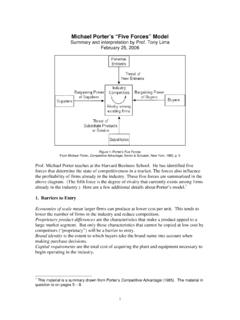
10 To what extent are the factors globalization, deregulation, digitalization and innovation relevant to driving industry competition? To what degree do the factors globalization, deregulation, digitalization and innovation show applicability in business practice? 2. A SNEAK PREVIEW INTO THE five Competitive Forces Porter defined five distinct Forces that have to be thought of when determining the attractiveness of a certain industry . Attractiveness, at this point, refers to the profitability the industry offers its entrant. According to the profitability it should then be thought about if entering the industry is reasonable or should be avoided.