Transcription of THE ARRL OUTGOING QSL SERVICE
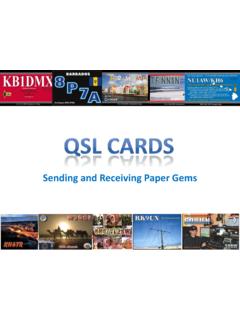
1 THE arrl OUTGOING QSL SERVICE Exchanging paper QSL cards to confirm a two-way contact is a tradition that dates back to the beginning of Amateur Radio. Today, many amateurs prefer to confirm QSOs electronically with Logbook of The World (LoTW), however there are those who like to swap paper cards. Exchanging QSL cards directly with your QSO partner can be very expensive. If you calculate the cost of postage to send an envelope overseas, plus any money enclosed to cover the return postage, a single QSL card request can cost up to five dollars or more. Confirming QSOs electronically through LoTW is a rapid and cost-effective way to earn QSO credit for awards, but for the paper card collector, the QSL Bureau offers an alternative to the direct QSL method.
2 To use this SERVICE , you only need to provide proof of arrl membership and pay the fee according to the schedule below. Cards sent via the Bureau are sorted by the OUTGOING QSL SERVICE staff, who handle approximately 700,000 each year. Cards are shipped from HQ on a quarterly basis. The SERVICE ships QSL cards to QSL Bureaus throughout the world, which are typically maintained by the national Amateur Radio Society of each country. (Please be advised that the arrl QSL SERVICE cannot be used to exchange QSL cards within the 48 contiguous states [US to US].) Sending QSL cards via the Bureau takes a little longer than mailing them directly, but keep in mind that what you might lose in speed is more than made up in the convenience and savings of not having to address and mail each QSL card separately.
3 You may also send QSLs via the bureau to any QSL manager who manages a non-US call sign. However, you must look up the QSL manager and clearly indicate the QSL manager s call sign on your OUTGOING card. For example: Example 1: 8P8P via NN1N. Sort this card in with other cards going to US managers. Example 2: 6Y1V via OH3RB. Sort this card in with cards to Finland. There are many sources of QSL information, including , logging programs, the GoList, , and the The Daily DX website at How To Use The arrl OUTGOING QSL SERVICE Sorting Cards Presort your DX QSLs alphabetically by parent call sign prefix (AP, CE, DL, ES, EZ, F, G, JA, LY, PY, UN, YL, 5N, 9Y, and so on).
4 Canadian and Australian cards should be sorted by numerical call sign (VE1, VE2, VE3 and VK1, VK2, VK3, etc). Note: Some countries have a parent prefix and use additional prefixes, G (parent prefix) = M, 2E, 2I, 2M, 2W, etc. When sorting countries that have multiple prefixes, keep that country s prefixes grouped with the parent prefix in your alphabetical stack. Addresses are not required. Do not separate the country prefixes by use of paper clips, rubber bands, slips of paper, or envelopes. This only slows down processing. Proof of Membership Please enclose proof of your current arrl membership. This can be in the form of a photocopy or cut- out of the address area from your current copy of QST.
5 You can also write the information from the label on a slip of paper and use that as proof of membership. A copy of your current membership card is also acceptable. Fees and Payment arrl members including foreign members, QSL Managers, or managers for DXpeditions should enclose payment as follows: $ per ounce, plus $ QSL Bureau SERVICE fee. For example, a package containing pounds of cards 24 ounces, or about 225 cards will cost $ Please see the information below for additional pricing details. The minimum charge is $ for one ounce or less. DXCC credits cannot be used towards the QSL SERVICE fee. You should use an accurate scale to weigh your cards.
6 Most post offices have scales that you may use. Please pay by check (or money order) and write your call sign on the check. Send cash at your own risk. DO NOT send postage stamps or IRCs. Please make checks payable to: The arrl OUTGOING QSL SERVICE . If you would like to know that your cards were received at the arrl QSL Bureau, include your e-mail address and we will notify you. Notifications will only be made by e-mail. Packages received with insufficient payment will not be processed until the balance is paid in full. The OUTGOING QSL bureau does not keep money on account. Packing and Mailing Your package must include: Slip with your name, call sign, weight of cards enclosed, and proof of arrl membership.
7 Include your e-mail address if you wish to be notified that cards were received. Proof of arrl membership Copy of QST mailing label or membership card. Your payment in the form of check or money order. DO NOT send cash. Your QSL cards, sorted as instructed. Include only the cards, proof of membership, and the appropriate fee in the package. Box the cards securely and address the package to: arrl OUTGOING QSL SERVICE 225 Main Street Newington, CT 06111-1494. It is strongly recommended that you use a traceable method to ship your cards. Other Helpful Information Who may use the arrl OUTGOING QSL SERVICE Family members may also use the SERVICE by enclosing their QSLs with those of the primary member.
8 Include the appropriate fee, and indicate family membership on the primary member s proof of membership. Blind members who do not receive QST need only include the appropriate fee along with a note indicating that the cards are from a blind member. arrl Affiliated Club stations may use the SERVICE to submit club QSLs for its members in bulk ( pooling their members cards together in one package) by indicating the club s name inside the package. Club secretaries should check their club s affiliation on the arrl website to ensure i t is current. In a pooled package, each club member using this SERVICE must also be an arrl member. Cards should be sorted en masse by prefix, and proof of membership should be enclosed for each arrl member.
9 QSLs for unaffiliated club calls may also be sent via the OUTGOING bureau to foreign destinations if the trustee of the club call is a member in good standing. The trustee s proof of membership must be included with the club call-QSLs. Recommended QSL card dimensions The efficient operation of the worldwide system of QSL Bureaus requires that cards be easy to handle and sort. Cards of unusual dimensions either much larger or much smaller than normal, or printed on thin paper ( copier paper) slow the work of the Bureaus, most of which is done by unpaid volunteers. A review of the cards received by the arrl OUTGOING QSL SERVICE indicates that most fall in the following range: Height: 2-3/4 to 4-1/4 in.
10 (70 to 110 mm) Width: 4-3/4 to 6-1/4 in. (120 to 160 mm) IARU Region 2, which includes the United States, has suggested the following dimensions as optimum: Height 3-1/2 in. (90 mm) Width 5-1/2 in. (140 mm) Cards in this range can be easily sorted, stacked, and packaged. Cards outside this range create problems. In particular, the larger cards often cannot be handled without folding or otherwise damaging them. In the interest of efficient operation of the worldwide QSL Bureau system, it is recommended that cards entering the system be limited to the range of dimensions given. Countries Not Served By the OUTGOING QSL SERVICE Approximately 225 DXCC entities are served by the arrl OUTGOING QSL SERVICE , as detailed in the arrl DXCC List.