Transcription of The Day the Crayons Quit - BCSCR
1 1st Grade - Unit 2: Crayons , Pencils and Creativity Other books in this unit include: The PencilFrom Wax to CrayonThis grant is managed by The Three Rivers Education Foundation 505-436-2548501 Airport Dr., Suite 209 Farmington, NM 87401 New Mexico/Colorado The Day the Crayons quit By Drew DaywaltLexile 730 1st Grade Unit 2: Crayons Unit Overview New Mexico / Colorado The Day the Crayons quit 1 1st Grade CCSS Unit of Study Purpose for Reading & Learning:The overall unit purpose is to explore the essential question: What is creativity? In addition, each book will explore its own guiding question: The Day the Crayons quit - Why is creativity important?
2 How can practicing our creativity help us? From Wax to Crayon - How can tools, like Crayons , help us be creative? The Pencil - How can thinking be creative? When might we want to think creatively? Pacing Guide:This unit is designed to be completed in 5 - 6 instructional days. The assessment contains questions from each of the 3 texts. The individual sections of the assessment may be completed following reading and instruction for each text or after the study of all 3 texts - at the teacher s discretion. The Day the Crayons quit 1 day of instruction From Wax to Crayon 2 days of instruction The Pencil 2 days of instruction Book 1: The Day the Crayons quit Describe characters, settings, and major events in a story, using key details.
3 Write opinion pieces with anintroduction, opinion, reason, andsense of 2: From Wax to Crayon Know and use various text features to locate key facts or information in a Determine or clarify themeaning of unkown and multiple-meaning words and phrases,choosing flexibly from an array 3: The Pencil Describe characters, settings, and major events in a story, using key Use illustrations and details in a story to describe its characters, setting, or is Creativity?CCSS Focus: RL. 5: Explain major differences between books that tell stories and books that give information, drawing on a wide reading of a range of text types.
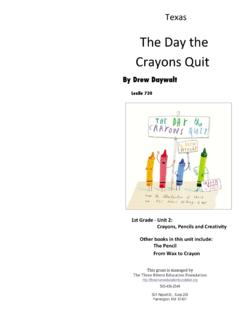
4 RL. 9 Compare and contrast the adventures and experiences of characters in stories. 1st Grade Unit 2: Crayons Unit Overview New Mexico / Colorado The Day the Crayons quit 2 Student Texts 1. The Day the Crayons quit , by Drew Daywalt (2013) Lexile 730 Fictional text Synopsis: Poor Duncan just wants to color. But when he opens his box of Crayons , he finds only letters, all saying the same thing: We quit ! Beige is tired of playing second fiddle to Brown. Blue needs a break from coloring all that water, while Pink just wants to be used. Green has no complaints, but Orange and Yellow are no longer speaking to each other.
5 What is Duncan to do? Debut author Drew Daywalt and New York Times bestseller Oliver Jeffers create a colorful solution in this playful, imaginative story that will have children laughing and playing with their Crayons in a whole new way. 2. From Wax to Crayon, by Robin Nelson (2013) Lexile 370 Informational text Book Jacket Synopsis: How does wax turn into a colorful crayon? Follow each step in the production cycle from melting wax into a liquid to coloring a fun picture in this fascinating book! 3. The Pencil, by Allan Ahlberg (2008) Lexile 540 Narrative fiction Book Jacket Synopsis: Once there was a pencil, a lonely little pencil, and nothing else.
6 It lay there, which was nowhere in particular, for a long, long time. Then one day that little pencil made a move, shivered slightly, quivered and began to draw. What did he draw? Whom did he draw? What did they do? Find out in this comical story about a pencil and the world he creates, brought to life by the imaginative twosome behind The Runaway Dinner and Previously. CCSS Focus The Day the Crayons quit Describe characters, settings, and major events in a story, using key details. Identify words and phrases in stories or poems that suggest feelings or appeal to the senses.
7 Write opinion pieces with an introduction, opinion, reason, and sense of closure. From Wax to Crayon Know and use various text features ( , headings, tables of contents, glossaries, electronic menus, icons) to locate key facts or information in a text. 1st Grade Unit 2: Crayons Unit Overview New Mexico / Colorado The Day the Crayons quit 3 Determine or clarify the meaning of unknown and multiple-meaning words and phrases based on grade 1 reading and content, choosing flexibly from an array of strategies. The Pencil Describe characters, settings, and major events in a story, using key details.
8 Use illustrations and details in a story to describe its characters, setting, or events. Additional Teacher Resources Accompanying this unit are sets of documents entitled Resources for Effective Instruction and Resources: Forms and Reproducibles. In these resources you will find: Curriculum Design Theory Differentiation Think Alouds Vocabulary Instruction Protocol Partner Reading Routines Question Stems for Partner Reading Character Analysis Charts Sentence Webs Vocabulary Word Map Examples 1st Grade Unit 2: Crayons Unit Overview New Mexico / Colorado The Day the Crayons quit 4 Table of Contents The Day the Crayons quit Book Assessment Preview Phonemic Awareness & Phonics - Day 1 Vocabulary List and Activity Menu Text Dependent Questions From Wax to Crayon Book Assessment Preview Phonemic Awareness & Phonics - Day 2 Phonemic Awareness & Phonics - Day 3 Vocabulary List and Activity Menu Text Dependent Questions The Pencil Book Assessment Preview Phonemic Awareness & Phonics - Day 4 Phonemic Awareness & Phonics - Day 5 Vocabulary List and Activity Menu Text
9 Dependent Questions Reader s Journal Crayons , Pencils, and How We Are Creative Student Resources Essential Question Anchor Chart Phonemic Awareness & Phonics Resources Tracking Mat Day 1 Materials Day 2 Materials Day 3 Materials Day 4 Materials Day 5 Materials Fluency Passages Vocabulary Cards Unit Assessment Student Copy PARCC Evidence Tables Reading Information Reading Literature Vocabulary Interpretation and Use Writing to Express Understanding Using Text Sources 1st Grade Unit 2: Crayons Unit Overview New Mexico / Colorado The Day the Crayons quit 5 Citations Ahlberg, A.
10 (2008). The pencil. Somerville, MA: Candlewick Press. Jeffers, O. (2013). The day the Crayons quit . New York, NY: Philomel Books. Moats, , & Hall, S. (2010). Language essentials for teachers of reading and spelling: Teaching phonics, word study, and the alphabetic principle. Boston, MA: Sopris West Educational Services. Nelson, R. (2013). Start to finish: From wax to crayon. Minneapolis, MN: Lerner Publications Company. PARCC evidence tables. Retrieved from 4-24-2015. Patterson, K. (2013). Robust vocabulary instruction. Des Moines, NM: Professional development session by Regional Reading Coach.