Transcription of The Functional Movement Screen
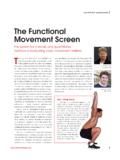
1 Test 1: Deep Squat The squat is a Movement needed in most athletic events. It is the ready position and is re-quired for most power and lifting movements involving the lower extremities. The deep squat is a test that challenges total body mechanics when performed properly. It is used to assess bilateral, symmetrical and Functional mobility of the hips, knees and ankles. The dowel held overhead assesses bilateral, symmetrical mobility of the shoulders as well as the thoracic spine.
2 The ability to perform the deep squat requires appropri-ate pelvic rhythm, closed-kinetic chain dorsifl exion of the ankles, fl exion of the knees and hips and extension of the thoracic spine, as well as fl exion and abduction of the stabilizing movements. The tests place the individual in extreme positions where weaknesses and imbalances become noticeable if appropri-ate stability and mobility is not utilized. It has been observed that many individuals who perform at very high levels during activities are unable to perform these simple movements.
3 These individu-als should be considered to be utilizing compen-satory Movement patterns during their activities, sacrifi cing effi cient movements for ineffi cient ones in order to perform at high levels. If these compensations continue, then poor Movement patterns will be reinforced leading to poor Functional Movement Screen (FMS) is an innovative system used to evaluate move-ment pattern quality for clients or athletes. The beauty of the Functional Movement Screen is that a personal trainer, athletic trainer or strength and conditioning coach can learn the system and have a simple and quantifi able method of evalu-ating basic Movement abilities.
4 The FMS only re-quires the ability to observe basic Movement pat-terns already familiar to the coach or trainer. The key to the Functional Movement Screen is that it consists of a series of simple tests with a simple grading system. The FMS allows a trainer or coach to begin the process of Functional Movement pat-tern assessment in individuals without recognized pathology. The FMS is not intended to diagnose orthopedic problems but rather to demonstrate limitations or asymmetries in healthy individuals with respect to basic Movement patterns and eventually correlate them with outcomes.
5 The Functional Movement Screen provides a strength and conditioning coach or personal trainer with an evaluation option that relates closely to what the athlete or client will actually do in training. In a sense, the tests are improved by working on variations of the skills tested. The FMS allows evaluation with tools and Movement patterns that readily make sense to both the cli-ent and the trainer or coach. The test is comprised of seven fundamental Movement patterns that require a balance of mo-bility and stability.
6 These fundamental Movement patterns are designed to provide observable performance of basic loco motor, manipulative The Functional Movement ScreenThe system for a simple and quantifi able method of evaluating basic Movement abilitiesGray Cook, MS, PT, OCS, CSCS Lee Burton, PhD, ATC, CSCSTest 2: Hurdle Step The hurdle step is designed to challenge the body s proper stride mechanics during a step-ping motion. The Movement re-quires proper coordination and sta-bility between the hips and torso during the stepping motion as well as single leg stance stability.
7 The hurdle step assesses bilateral Functional mobility and stability of the hips, knees and ankles. Perform-ing the hurdle step test requires stance-leg stability of the ankle, knee and hip as well as maximal closed-kinetic chain extension of the hip. The hurdle step also requires step-leg open-kinetic chain dor-sifl exion of the ankle and fl exion of the knee and hip. In addition, the subject must also display adequate balance because the test imposes a need for dy-namic stability.
8 Movement 3: In-Line Lunge This test attempts to place the body in a position that will focus on the stresses as simulated during rotational, decelerating and lateral-type movements. The in-line lunge is a test that places the lower extremity in a scissored po-sition, challenging the body s trunk and extremities to resist rotation and maintain proper alignment. This test assesses torso, shoulder, hip and ankle mobility and stability, quadri-ceps fl exibility and knee stability.
9 The ability to perform the in-line lunge test requires stance-leg stability of the ankle, knee and hip as well as apparent closed kinetic-chain hip abduction. The in-line lunge also requires step-leg mobility of the hip, ankle dorsifl exion and rectus femoris fl exibility. The subject must also display adequate stability due to the rotational stress imposed. Test 5: Active Straight-Leg Raise The active straight-leg raise tests the abil-ity to disassociate the lower extremity while maintaining stability in the torso.
10 The active straight-leg raise test assesses active hamstring and gastroc-soleus fl exibility while maintain-ing a stable pelvis and active extension of the opposite leg. The ability to perform the ac-tive straight-leg raise test requires Functional hamstring fl exibility, which is the fl exibility that is available during training and competition. This is different from passive fl exibility, which is more commonly assessed. The subject is also required to demonstrate adequate hip mobil-ity of the opposite leg as well as lower abdomi-nal stability.